
mon-fri 9-13 / 14.30-18.30
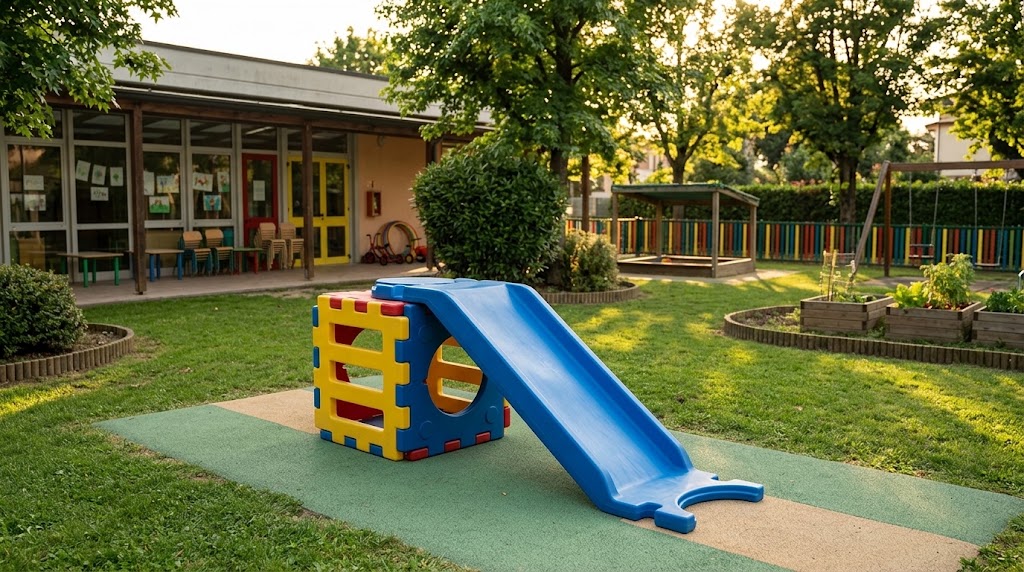
Designing play areas in schoolyards requires a thorough evaluation of the proposed activities, age of users, available space, and safety requirements. Outdoor play equipment for schools can transform courtyards and open spaces into environments dedicated to movement, exploration, and shared play. The Holity catalog primarily includes play cubes, tunnels, trains, playhouses, slides, and modular structures of various sizes. Before purchasing, it is important to check the intended use, size, required area around the equipment, materials, installation methods, and technical documentation for each product. This guide explains how to compare the different solutions and which aspects to check in relation to the EN 1176 standards and impact-absorbing surfaces.
Outdoor games can support motor, exploratory and social activities, but the benefits depend on the type of equipment, the age of the children and the ways in which the space is used:
The Holity category includes compact games and more complex modular structures, to be chosen based on the available space and the activities you want to propose:
Cubes are one of the most characteristic elements of the range. They can be used individually or integrated into compositions with tunnels, ladders, panels and slides. In the larger models, modular elements allow for the creation of complex routes, but it is always necessary to check the overall size of the chosen configuration.
Tunnels encourage crossing and exploration activities and are available both as single elements and within trains or modular structures. The catalogue includes:
The range includes small games with slides and modular compositions in which the slide is connected to cubes, ladders, tunnels and panels. Dimensions, height and configuration vary significantly between products, so it is necessary to check the technical data sheet and the space required for installation.
Houses, roofed cubes and play trains offer recognisable environments that can be used for symbolic play. Some models are stand-alone structures, while others are part of larger modular systems intended for schoolyards, playrooms and recreational areas.
The larger compositions combine tunnels, cubes, ladders, slides and panels in a single path. They are suitable when you have a sufficiently large outdoor area and you want to integrate multiple play modes into the same structure.
The Holity category is mainly characterised by games made of plastic material. Performance and characteristics must however be verified on the individual item:
Before purchasing a game for a school, it is necessary to check who will use it, how much space it requires and what characteristics the structure has:
To design a school play area it is important to distinguish the applicable technical standards and check the documentation actually declared for each product:
The prices of the category vary according to the size, number of elements and complexity of the structure. At the time of the inspection, the Holity range starts from approximately €306 + VAT and exceeds €5,700 + VAT; the values may change and must therefore be checked directly on the product sheets:
To choose outdoor games for schools, first compare available space, indicated age range, dimensions, configuration and technical documentation. In the Holity catalogue you will find play cubes, tunnels, trains, houses, slides and large modular structures for schoolyards and other play areas.
If you need to design a supply for a school, a nursery, a local authority or another educational facility, you can request a personalised quote indicating quantity, available space and required characteristics. When certifications or technical requirements are required by the specifications, request updated documentation relating to the specific product codes selected.
What certifications are required for garden games installed in schools?
The EN 1176 series constitutes the technical reference for permanently installed public play equipment, but it is not correct to state that any product must by law indiscriminately bear the same certification. It is necessary to check the intended use, applicable standards, any specifications and documentation for the specific game.
What is the buffer space and how is it calculated for a school game?
It is the space that must remain available around the equipment to allow for its intended use and to manage possible falls. Size and shape depend on the type of game, the height of free fall and the movements of the user; therefore, there is no standard distance valid for all structures.
When is impact-absorbing flooring required under the game?
It depends on the free fall height and the characteristics of the equipment. When a shock-absorbing surface is required, its performance must be adequate for the expected situation. EN 1177 defines the test methods used to determine impact attenuation and the critical height of the surface.
Are plastic school playground equipment suitable for outdoors?
Many Holity products are made of high-resistance plastic material and, for several models, the manufacturer declares resistance to UV rays and atmospheric agents. It is however necessary to check these characteristics on the individual playground equipment data sheet and follow the instructions provided for cleaning and maintenance.
What periodic checks and maintenance must the school carry out?
EN 1176-7 distinguishes between ordinary visual checks, operational inspections and periodic main inspections. Frequency and methods must be defined considering the equipment, intensity of use, environmental conditions, the manufacturer's instructions and the playground management plan.
What determines the price of outdoor playground equipment for schools?
The price depends primarily on the size, number of components, and complexity of the structure. Compact cubes and playground equipment generally cost less, while large modular structures with tunnels, ladders, panels, and slides require a higher investment. For an up-to-date comparison, it's best to use the prices listed on the individual product pages.
 English
 Italian
 French
 German
 Spanish