
mon-fri 9-13 / 14.30-18.30
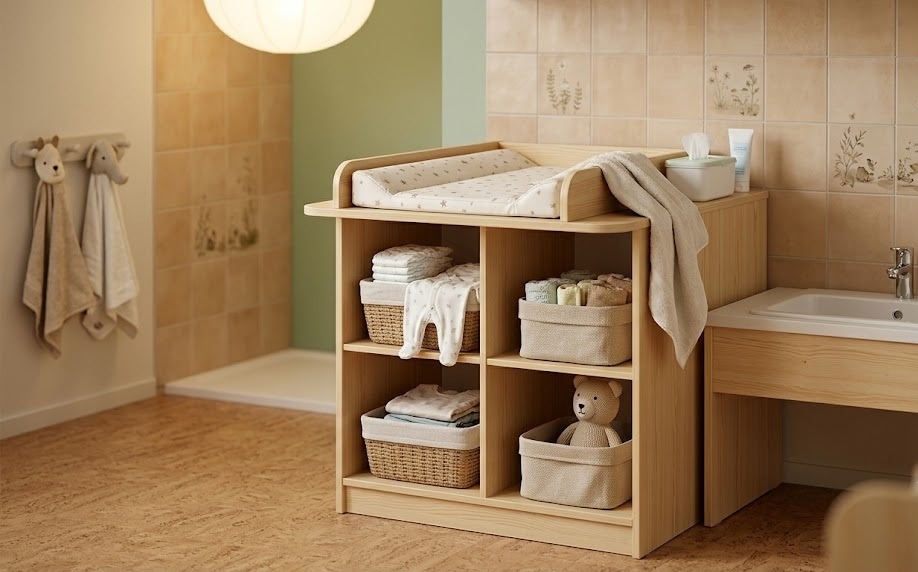
Setting up a hygiene and changing area within a nursery, early childhood center, or company nursery requires careful planning that prioritizes the safety of children and the occupational health of educational staff. Choosing the right changing table for nursery doesn't mean buying a standard changing table for home, but equipping yourself with a professional piece of furniture designed to withstand intense workloads, ensure continuous sanitization cycles, and eliminate the risk of falls or injuries. A well-designed piece of furniture combines structural stability with operational ergonomics that prevent spinal disorders for educators, while also providing a comfortable environment for the child. This buying guide will help you select the models available in the holity.co.uk online catalog, analyzing storage types, ergonomic heights, safety accessories, and regulatory parameters.
Based on the size of the bathroom, the number of little guests and the internal organisation of the complex, our range offers solutions that differ in terms of architecture and functionality:
These represent the classic solution for organising the changing routine in a systematic way.
Advanced systems that combine functionality with motor education and the promotion of autonomy according to modern pedagogical guidelines.
Complete "all-in-one" stations for facilities that require personal hygiene management directly on site.
The sizing of the furniture must be evaluated in relation to the bathroom's overall space and the height of the staff. Our catalogue allows you to filter the models according to precise millimetric parameters:
Since these are furnishings exposed to daily contact with organic substances and disinfectant detergents used in medical-surgical devices, the choice of materials is a critical factor:
The variety of offerings on holity.co.uk allows you to calibrate your spending flexibly, moving within a price range that goes from €281.00 to €1686.00:
Furnishings intended for early childhood services must undergo strict legislative checks:
Equip your nursery or daycare center with safe, ergonomic and legally certified solutions. Explore the holity.co.uk online catalog to find the most suitable changing table: set the type (with ladder, with sink or with open compartments) and select the millimetric dimensional measurements suitable for your environment.
Request a personalized quote today: our team of experts is at your complete disposal to provide you with technical data sheets, approval certificates and confidential quotes for the complete supply of your institution.
How does the adoption of a changing table with a pull-out ladder reduce musculoskeletal injuries to educational staff?
In a nursery school with a class of 15-20 children, a teacher performs up to 50-60 lifts a day from bottom to top to position the little ones on the changing table. This repeated effort loads the spinal axis with compressive tensions that cause lumbago and occupational disc disease. The pull-out ladder, equipped with non-slip steps and grip edges, allows children who are already walking to climb onto the changing table independently, guided by the hand. Once the changing is complete, the ladder retracts into the lower compartment of the cabinet, freeing up the corridor and reducing manual handling of loads by 70%.
What resistance characteristics to sodium hypochlorite and alcohol must the melamine coverings in the changing area have?
Hygiene and sanitation protocols in early childhood facilities require disinfecting changing table surfaces after each use using virucidal sprays, ethyl alcohol-based solutions, or sodium hypochlorite (active chlorine). Professional furniture uses panels coated with high-pressure, heat-fused melamine resins. This continuous, non-porous surface film prevents aggressive chemicals from penetrating the wood fibers, preventing dulling, swelling of the panels, or discoloration of the finish even after thousands of wash cycles.
How does the presence of 15-20 cm raised sides comply with the test requirements of the UNI EN 12221 standard?
The European standard UNI EN 12221 regulates the passive safety of changing tables for collective use, identifying the risk of falling from a height as the main source of injury. The standard requires that the support surface be delimited on three sides (rear and sides) by containment edges no less than 150 mm high from the surface of the mattress being placed. Laboratory tests verify the mechanical strength of the edges by pushing the panels with simulated lateral impact forces, ensuring that no gaps between 5 and 25 mm wide are created where the baby's fingers or limbs could become trapped.
Why do PVC or eco-leather changing mats without external seams prevent bacterial growth and cross-contamination?
Traditional changing mats with textile thread seams have micro-holes along the seams through which organic residues, liquids, and detergents can penetrate, creating a humid environment ideal for the proliferation of bacterial colonies and mold that cannot be reached by surface disinfectants. Professional nursery mats use a heat-sealed or continuously molded plastic covering without seams. The perfectly smooth, waterproof and water-repellent surface allows for the complete removal of residues with a simple wipe with a disinfectant cloth, eliminating the risk of cross-infection between one child and the next.
What operational differences are there between installing a changing table with an integrated stainless steel sink compared to a resin/ABS model?
The AISI 304 stainless steel tub offers unbeatable resistance to abrasion, concentrated chemicals and heat, guaranteeing a biologically inert and long-lasting surface; it is the ideal choice for internal laundries and very high-traffic areas. Integrated handwashing tubs in thermoplastic resin or acrylic ABS, on the other hand, offer a contoured profile without sharp edges, with soft shapes and superior thermal comfort to the touch (the material never feels cold on the baby's skin compared to metal), as well as integrating chromatically with the pastel colors of the classroom's wooden structures.
How can we explain the price gap between the basic models starting at €281.00 and the high-tech integrated stations starting at €1686.00?
The wide price range is determined by the quality of the materials, the linear dimensions and the integrated mechanical functions. The entry level threshold (€281.00 - €450.00) identifies the single monoblock changing tables in melamine with open compartments and simple sides. Moving up to the intermediate range (€500.00 - €900.00) are the structures in high-quality exposed birch plywood with retractable ladders and individual transparent tray holders. The top-of-the-range range (up to €1686.00) includes double changing stations with integrated sinks and taps, laser-shaped backsplashes, large-sized shaped fireproof mats and closed compartments with safety locks.
 English
  Italian
 French
 German
 Spanish