
mon-fri 9-13 / 14.30-18.30
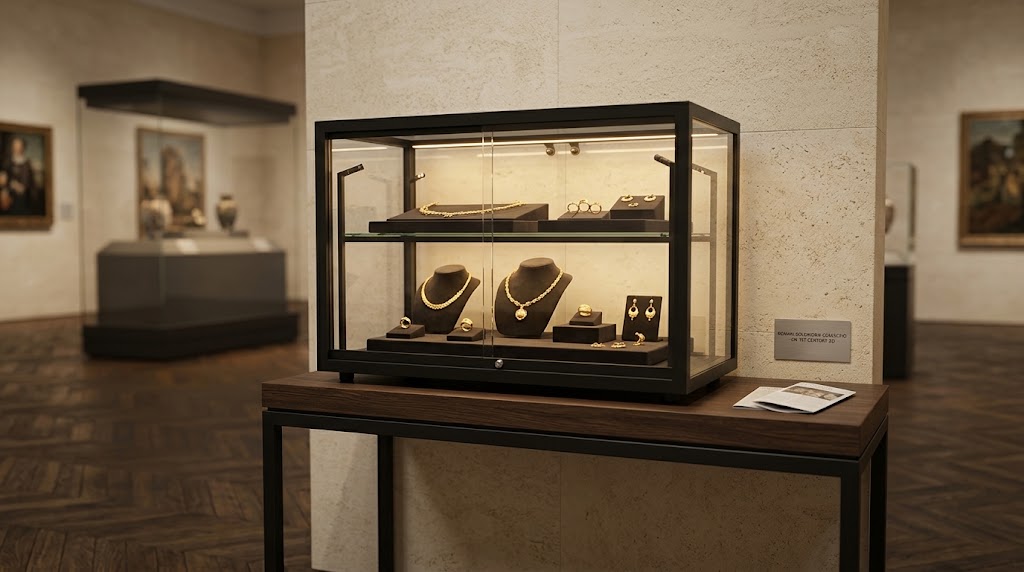
In museums, galleries, archives, and exhibitions, a display case must enhance the object and protect it from direct contact, dust, and accidental impacts. The choice depends on the size and weight of the object, its position in the room, the level of access required, lighting, and conservation needs. The Holity catalog includes models in iron or wood with 8 mm tempered glass, locks, and, on several products, LED lighting.
The configuration must be chosen based on the type of object, the available space, and the visitor route.
The Holity catalogue features structures in iron and models with wooden base. The choice is above all a design one: iron fits easily into contemporary settings and allows for visually essential structures, while wood can coordinate with more classic environments or existing furnishings.
The material of the structure alone does not allow one to establish the level of conservation or security of the display case. For sensitive objects, the finishes, internal materials, locking methods and required environmental conditions must be evaluated separately.
The Holity models in this category use 8 mm tempered glass. Tempered glass offers greater mechanical resistance than ordinary glass and, in the event of breakage, fragments into small pieces; however, it should not automatically be considered equivalent to burglar-proof laminated glass.
Several display cases are equipped with security locks and LED spotlights, often with a declared colour temperature of 4,000 K. The number and position of light sources varies from model to model.
Anti-reflective glass, UV filters, laminated glass with a specific resistance class or burglar-proof systems must be verified in the individual product documentation or required as specific design features.
A display case protects the object from direct contact and creates a physical separation from the environment, but does not automatically guarantee a controlled microclimate. For works sensitive to humidity, temperature, light or pollutants, it is necessary to define the conservation requirements with the collection manager.
Systems such as silica gel, active humidity control, airtightness or environmental monitoring should only be considered when foreseen in the design and documented for the specific display case. Similarly, the Oddy Test is a tool used in museums to evaluate the compatibility of certain materials with collections, but it is not a certification that every professional display case automatically possesses.
Before purchasing, measure the available space and define the dimensions, weight and access methods for the exhibit. You should also consider viewing height, space required for the opening, location of electrical outlets for LEDs and width of the passageways around the display case.
The price varies depending on the size, structure, number of shelves, lighting, locks and configuration of the cabinet. Since prices and availability can change, it is preferable to compare models in the catalogue rather than associating rigid price ranges with a particular technology.
The security of the display case must be assessed in relation to the value and vulnerability of the objects on display. The presence of a lock or tempered glass does not automatically equate to burglar-proof certification.
The UNI EN 356 concerns the classification of glass resistance against manual attack; it should only be referred to when the installed glass has the relevant classification. In Holity products in this category, 8 mm tempered glass is declared.
Accessibility, visitor routes, passageways and visual usability must also be considered when designing the room. Any specific requirements depend on the building, the type of museum and the exhibition design.
Explore the selection of museum display cases on Holity and compare the models by size, iron or wooden structure, number of shelves, tempered glass, LED lighting and locking system.
For museum, gallery, archive or exhibition space installations you can request a personalized quote indicating the dimensions, quantity, type of exhibits and required characteristics.
What is the difference between tempered glass and laminated glass?
Tempered glass is treated to increase mechanical resistance and modify its behavior in the event of breakage. Laminated glass is made up of multiple sheets joined by an intermediate layer. Anti-burglary or anti-reflective performance requires specific characteristics and classifications and cannot be deduced from the presence of glass alone.
Do Holity display cases have LED lighting?
Various models integrate LED spotlights, with different quantities and arrangements. Some display cases declare a color temperature of 4,000 K. The equipment must be verified in the individual product sheet.
Does a museum display case automatically control humidity and temperature?
No. The display case creates a physical barrier, but controlling the microclimate requires specific systems. For sensitive exhibits, it is necessary to verify whether monitoring, buffer materials or dedicated climate control solutions are necessary.
What is the Oddy Test?
It is a test used in museum conservation to evaluate whether certain materials can release substances potentially harmful to the exhibits. This does not mean that all professional display cases are automatically certified through the Oddy Test.
How do I choose the size of the display case?
Consider the size and weight of the exhibit, the required distance from the glass, any shelves, the opening method and the space available in the room. A passageway consistent with the visitor route and the project requirements must also be maintained.
Is 8 mm tempered glass burglar-proof?
Not automatically. Burglar resistance must be supported by a specific classification or documentation. The thickness of the tempered glass alone does not allow for a classification according to UNI EN 356.
 English
 Italian
 French
 German
 Spanish