Buying Guide: How to Choose the Best Body Stretchers for Hospitals, Mortuaries, Nursing Homes, and Funeral Services
Within hospitals, clinics, nursing homes, forensic medicine institutes, mortuaries, and funeral homes, the handling of deceased persons requires professional equipment that can guarantee safety, operational practicality, and respect for the person's dignity. Body stretchers, also known as body transport stretchers or body trolleys, are designed to facilitate the transfer of deceased persons from hospital wards to mortuaries, dissecting rooms, or conservation areas. Mainly made of AISI 304 stainless steel or with structures that combine stainless steel and painted steel, these equipment can be equipped with shaped shelves for containing liquids, swivel wheels with brakes, height adjustment systems and rigid or fabric covers for discreet transport. The Holity.co.uk catalogue includes a professional selection of stretchers and trolleys for transporting remains, available in fixed or variable height versions, with and without lids and with different load capacities, including solutions for bariatric needs up to 250 kg and models with higher load capacities. This purchasing guide analyses the main types of stretchers, lifting systems, construction materials, dimensions, safety features and price ranges, to help healthcare managers, mortuary operators and funeral homes identify the equipment best suited to their operational needs.
1. Types compared: With Dome, Without Dome and Without Lid
The presence and type of cover are among the main criteria to consider when choosing a professional body stretcher. The upper configuration affects privacy during transport, the practicality of transfer operations and the ease of cleaning the equipment:
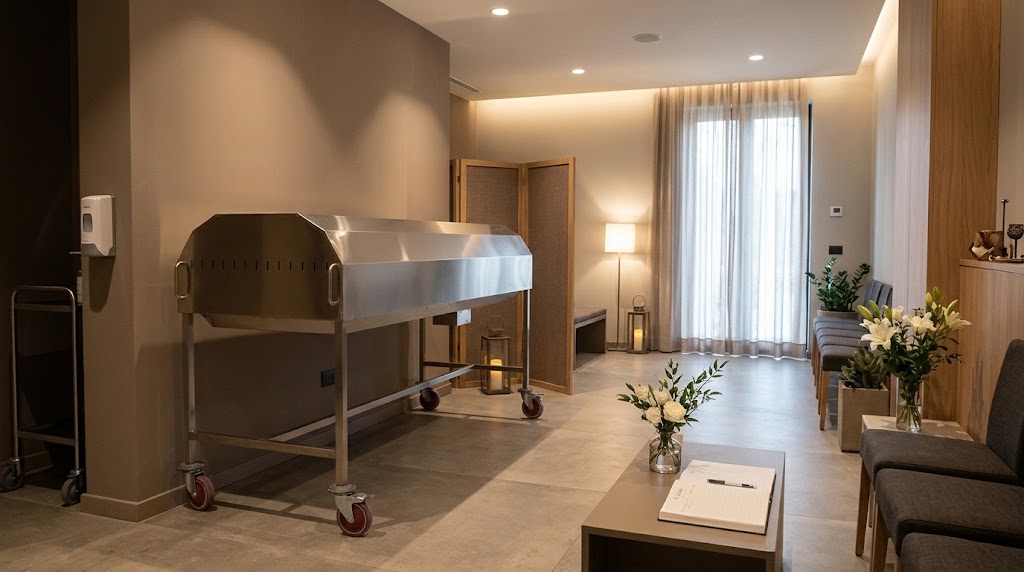
Body Stretchers With Rigid Dome: Stretchers with rigid dome are particularly suitable for hospitals, nursing homes, morgues and facilities where the transfer of the deceased takes place through corridors, elevators or areas shared with other operators and visitors. The lid can be made of stainless steel or resistant synthetic materials, such as ABS, depending on the model. The dome allows the view of the body to be completely shielded during handling, helping to ensure discretion and respect for the person. Smooth surfaces can also facilitate cleaning operations. Before purchasing, it is important to check the cover material, the opening system, the overall weight and the methods of attachment to the structure.
Stretchers Without Dome (With Soft Cover or Hood): Stretchers with soft covers represent a practical solution for healthcare facilities, nursing homes, private clinics and funeral services that require a discreet and relatively lightweight transport system. These models can be equipped with a dome or a resistant fabric cover, supported by a special structure. The cover helps conceal the body during transfer and may be easier to handle than a rigid cover. The Holity.co.uk catalog also includes stainless steel stretchers with fabric domes, suitable for professional use. For proper maintenance, it is important to check whether the cover is removable, washable and compatible with the cleaning products used in the facility.
Lidless Stretchers (Open Top / Free Tray): Lidless stretchers are characterized by a free support surface, generally made of stainless steel, which allows immediate access to the loading surface. They are particularly suitable for internal handling in morgues, mortuaries, dissecting rooms and technical environments where an integrated cover is not necessary. Some models have a continuous surface, while others are equipped with a contoured tray with containment edges and a liquid collection system. The simple construction facilitates transfer and cleaning operations, making these stretchers a functional solution for facilities that use separate cover systems or that operate primarily in restricted areas.
2. Kinematics and Height Adjustment: Fixed Platforms vs. Hydraulic Pantograph Systems
The possibility of adjusting the height of the loading platform is an important element in the choice of stretchers for transporting bodies , especially in structures where transfer operations between surfaces at different heights are frequent. An adequate adjustment system can improve the ergonomics of the work and help reduce the physical effort of the operators:
Fixed Height Stretchers: Fixed height stretchers are equipped with a stable structure, generally made of metal tubing, with a support surface positioned at a pre-established height. In the professional models available on the market, the height is often between 75 and 85 cm from the ground , depending on the configuration. These stretchers represent a practical solution for hospitals, nursing homes, mortuaries and funeral services that carry out transfers on regular routes and towards surfaces of a compatible height. The main advantages are the ease of use, the sturdiness of the structure and generally limited maintenance. Before purchasing, however, it is important to check the height of the platform and compatibility with other equipment present in the facility.
Variable Height Stretchers with Foot-Operated Hydraulic Pump: The variable height body stretchers are designed to facilitate the loading, unloading and transfer of the deceased. In the models with a hydraulic system, the adjustment takes place via a pedal-operated hydraulic pump, often combined with a pantograph lifting mechanism. The range varies according to the product: in the Holity.co.uk catalogue there are adjustable stretchers, for example, from 63.5 to 96 cm, as well as dedicated forklifts with different adjustment ranges. The possibility of modifying the height of the platform allows operators to:
Bring the stretcher platform closer to the height of the hospital bed or another transfer surface, facilitating the operations of moving the deceased and reducing the need for manual lifting.
Adjust the height according to the work surface, the anatomical table or the equipment used for handling in mortuaries and conservation areas.
Adapt the support surface to the operational needs of the staff during the preparation, recomposition and aesthetic treatment activities of the deceased, improving posture and the practicality of the maneuvers.
3. Construction Materials, Hygiene and Management of Biological Liquids (AISI 304 Steel and Drainage)
The materials used to manufacture the stainless steel body stretchers must guarantee robustness, resistance to frequent use and ease of cleaning. The configuration of the surface and wheels also influences the practicality of daily operations and maintenance of the equipment:
Integral Construction in AISI 304 Stainless Steel (18/10): AISI 304 stainless steel is one of the most used materials in the production of professional body stretchers thanks to its good resistance to corrosion, solidity and ease of cleaning. The smooth, non-porous surface allows residues to be removed and cleaning and disinfection operations to be carried out with compatible products. Some models are made entirely of stainless steel, while others combine an AISI 304 top and collection tray with a painted steel supporting frame. It is important to check the actual composition of the product, as resistance to detergents also depends on the finishes, welds, and substances used for cleaning. To preserve surfaces over time, it is advisable to avoid abrasive treatments and chemical products not recommended by the manufacturer.
Anti-Drip Containment Tray and Drainage Slopes: Some stretchers for transporting bodies are equipped with a contoured top with raised edges, designed to retain any liquids and facilitate their collection. In certain models, the top has a slight slope towards a drain hole, connected to a removable tray positioned at the bottom. This configuration facilitates the management of liquids during transport and allows for easier cleaning operations. Not all stretchers are equipped with the same system: some products have a continuous top without a drain hole, while others integrate removable trays. Before purchasing, it is therefore important to check the presence of a drainage system, the capacity of the collection container and the ease of access for maintenance.
High-Slip Swivel Wheels: Wheels are a fundamental element for moving stretchers in hospital corridors, morgues and funeral environments. Professional models are generally equipped with four swivel wheels, with diameters that can vary approximately from 125 to 200 mm. Some versions have two wheels with brakes, while others may have braking systems on all four wheels. The choice of wheel diameter and material depends on the characteristics of the floor, the frequency of transfers and the conditions of use. Wheels with brakes help keep the structure stable during loading and unloading operations, while non-marking coverings can help preserve floor surfaces.
4. Structural Loads, Bariatric Versions (up to 250 kg) and Dimensions
The maximum load capacity of a body stretcher and its dimensions are essential parameters for choosing a model suitable for the needs of the structure. It is important to consider the maximum weight supported, stability during movement and compatibility with corridors, doors, elevators and work areas:
Standard Load Capacity (135-200 kg): Standard body stretchers are available with different load capacities, generally between 135 and 200 kg in the models in the catalogue. The load capacity must be evaluated in relation to the actual needs of use, avoiding choosing equipment with a capacity too close to the weight to be moved. Before purchasing, it is important to check the maximum limit declared by the manufacturer and respect it during all transport and transfer operations.
Reinforced Bariatric Load Capacity (Up to 250 kg): The bariatric stretchers are designed for the handling of deceased persons with high body weight and have structures sized to support higher loads than standard models. The Holity.co.uk catalogue includes versions with a load capacity of up to 250 kg, equipped with a wider support surface and a robust stainless steel structure. There are also stretchers with different load capacities, which can reach higher values in specific configurations. To choose the most suitable model, it is necessary to check not only the maximum load capacity, but also the useful width of the surface, the stability of the structure and the characteristics of the movement system.
Dimensional Development and Compatibility with Elevators:
Overall Length: professional stretchers generally have a length between 200 and 227 cm, depending on the model and the presence of fixed or foldable handles. Before purchasing, it is advisable to check the actual length of the equipment and the space available for maneuvering.
Overall width: dimensions can vary approximately from 55 to 90 cm. Narrower models are practical in corridors and small spaces, while wider stretchers are recommended when a wider support surface is required, such as in bariatric configurations.
Height: varies depending on the structure and adjustment system. Fixed-height stretchers can have a support surface around 75-85 cm from the ground, while adjustable ones allow the height to be changed according to the range specified by the manufacturer. It is important to consider the height of the support surface and the overall size separately, especially in models equipped with a dome.
5. Operational Safety, Ergonomics, Hygiene and Construction Quality
The choice of professional stretchers for the transport of the deceased must take into account not only the dimensional characteristics, but also the safety during handling, the ease of cleaning and the quality of the components. Suitable equipment helps to make daily operations more efficient and improve the working conditions of the staff:
Safety and Stability During Transport: A stretcher for carrying bodies must offer a stable structure, an adequate support surface and reliable handling systems. Before purchasing, it is important to evaluate the solidity of the frame, the maximum load capacity, the presence of wheels with brakes and the arrangement of the push handles. In models with a cover, it is also useful to check that the fastening system of the dome or lid is practical and safe during movement. The choice must always consider the characteristics of the internal routes and the frequency of use.
Ergonomics and Assisted Movement: The use of variable-height stretchers and forklifts can make the work of operators easier, especially when transferring the deceased between surfaces located at different heights. Hydraulic pedal systems allow the height of the surface to be adjusted without having to manually support the entire load. The presence of ergonomic handles, smooth-running wheels and adequate braking systems also contributes to improving the practicality of the operations. For more complex transfers, however, it is important to use appropriate handling techniques and, when necessary, additional aids.
Hygiene and Ease of Cleaning: Stretchers made of AISI 304 stainless steel are particularly appreciated for their smooth and resistant surfaces, which facilitate the removal of residues and cleaning operations. After each use, it is important to carry out the cleaning and disinfection procedures required by the structure, paying attention to the support surface, handles, wheels and any liquid collection systems. To preserve the finishes, it is advisable to use products compatible with the materials and always follow the maintenance instructions provided by the manufacturer.
Maintenance of Components and Drainage Systems: Periodic checks help to keep the stretcher efficient and to identify any signs of wear. It is advisable to check the operation of the wheels, brakes, handles and any height adjustment mechanisms. In models equipped with a drain hole and removable tray, it is important to check that the collection system is clean and correctly positioned. Regular maintenance helps to preserve the functionality of the equipment and reduce the risk of inconveniences during service.
Construction Quality and Technical Documentation: Before choosing a stretcher, it is advisable to consult the product's technical data sheet to check the materials, dimensions, load capacity, adjustment systems and wheel characteristics. The manufacturer's documentation also allows you to know the correct methods of use and maintenance of the equipment. For hospitals, nursing homes, morgues and funeral homes that need to purchase multiple units, it may also be useful to evaluate the availability of spare parts, after-sales assistance and information relating to the lifespan of components subject to wear.
6. Economic Planning and Spending Ranges
The price of body stretchers varies based on the type of structure, materials, capacity, height adjustment system and the presence of covers or accessories. In the Holity.co.uk catalogue, stretchers and trolleys for transporting bodies are available with indicative prices ranging from €928.16 to €5,085.00 + VAT. The following price ranges are a reference for comparing the main available configurations:
Entry level range (€928.16 - €1,800.00): This range mainly includes body trolleys and fixed-height stretchers, made of stainless steel and equipped with swivel wheels. This range includes models without lids, versions with a continuous support surface and solutions with a fabric dome. Some stretchers are equipped with a drain hole and collection tray, useful features for managing liquids. These products represent a practical choice for nursing homes, clinics, healthcare facilities and funeral services that require robust and functional equipment for daily operations.
Intermediate range (€1,800.00 - €3,200.00): This range includes body stretchers with more specific structural features, such as larger support surfaces, liquid containment systems and configurations suitable for handling heavy loads. This range also includes bariatric models with a capacity of up to 250 kg, stretchers with lids, and forklifts with height adjustment via a hydraulic foot pump. These solutions are suitable for hospitals, morgues, and facilities requiring versatile equipment sized for different operational needs.
Top of the Range Range (€3,200.00 - €5,085.00): Includes variable-height stretchers, models with hydraulic lifting systems, and configurations with an integrated lid. These devices are designed to facilitate the transfer of deceased persons between levels at different heights and to improve the ergonomics of operations. Some versions feature fold-down handles, large-diameter wheels, AISI 304 stainless steel shelves, and liquid collection systems. They are particularly suitable for hospitals, polyclinics, morgues, and facilities with frequent handling needs, where height adjustment and operational convenience are important selection criteria.
Request a personalized quote on Holity.co.uk
Choose the professional body stretchers that best suit the needs of your facility and improve the practicality of transporting and handling deceased persons. On Holity.co.uk you can compare different models of body stretchers and body trolleys, evaluating the type of cover, materials, dimensions, load capacity and the presence of height adjustment systems. Explore the online catalogue to identify the most suitable solution: choose between stretchers with a rigid dome, fabric cover or without a lid, compare the fixed and variable height models and check the characteristics of the bariatric versions. The technical data sheets allow you to evaluate the features of each product and choose the most suitable equipment for the operational needs of your healthcare or funeral facility.
Request a personalized quote: the Holity.co.uk sales team is available to provide information on the characteristics of the stretchers, on the available technical documentation and on the most suitable solutions for professional supplies and orders of multiple units.
Frequently Asked Questions
What is the substantial difference between a variable-height pantograph stretcher and a fixed-height one?
The main difference is the adjustable height of the support surface. Fixed-height stretchers maintain a predetermined height, generally around 75-85 cm from the ground, and are suitable for transfers on regular routes and to compatible surfaces. Variable-height stretchers, on the other hand, can be equipped with a hydraulic pedal system that allows the support surface to be raised or lowered according to operational needs. The Holity.co.uk catalog features adjustable models, for example, from 63.5 to 96 cm. This feature facilitates transfers between surfaces of different heights and helps reduce physical strain on operators, although it does not eliminate the need for appropriate handling techniques.
When is it appropriate to choose a stretcher with a rigid dome?
A stretcher with a rigid dome is particularly suitable when the deceased is being transferred through hospital corridors, elevators, or shared spaces. The lid shields the view of the body during transport, helping to ensure privacy and respect for the deceased's dignity. Domes can be made of stainless steel or durable synthetic materials, depending on the model. Before purchasing, it is important to check the overall dimensions, weight of the cover, opening system, and ease of cleaning. For facilities requiring a lighter solution, stretchers with fabric covers are also available.
How does the system for containing and draining biological fluids on the stretcher deck work?
Some professional stretchers feature a contoured surface with raised edges, designed to retain any liquids. Models with a drainage system may have a slope that facilitates drainage toward a drain hole connected to a removable collection tray. This configuration facilitates liquid management and subsequent cleaning of the equipment. Not all stretchers feature the same system: some models have a continuous surface without a drain hole. Therefore, before purchasing, it is advisable to check the surface features, the presence of a tray, and the removal and maintenance procedures.
What load capacity should be selected to cover bariatric cases in hospitals?
When transporting heavy deceased persons, it is important to use a stretcher with adequate load capacity and dimensions compatible with the individual's build. The standard stretchers available in the Holity.co.uk catalog have different load capacities, generally ranging from 135 to 200 kg. For bariatric patients, reinforced models with load capacities up to 250 kg are available, as well as specific configurations with higher load capacities. The choice must also consider the width of the platform, the stability of the structure, the braking system, and the handling conditions. The maximum load declared by the manufacturer must always be respected.
What sanitization protocols should be applied to the AISI 304 stainless steel of the stretcher?
AISI 304 stainless steel stretchers must be cleaned and disinfected following the facility's procedures and the manufacturer's maintenance instructions. After use, it is important to remove any organic residues with compatible detergents, paying particular attention to the support surface, handles, wheels, and any liquid collection systems. Subsequent disinfection must be performed with products suitable for the surfaces and conditions of use. To preserve stainless steel, it is advisable to avoid abrasive detergents and aggressive, non-recommended substances, especially chlorine-based products used in inappropriate concentrations. After cleaning, surfaces must be treated according to the detergent's instructions and dried as directed.
How does the price range of the category (€928.16 - €5,085.00) correlate with the technical characteristics of the product?
The price of stretchers depends primarily on the material, size, load capacity, height adjustment system, and the presence of covers or accessories. The entry-level range, from approximately €928.16 to €1,800, includes fixed-height trolleys and stretchers, models without covers, and solutions with fabric covers. The mid-range, from €1,800 to €3,200, includes stretchers with specific structural features, bariatric versions, models with covers, and forklifts. The higher-end range, from €3,200 to €5,085, primarily includes variable-height stretchers with hydraulic systems, configurations with covers, and equipment intended for frequent professional use. Prices are indicative, excluding VAT, and may vary based on the model and available offers.

 English
 Italian
 French
 German
 Spanish