
mon-fri 9-13 / 14.30-18.30
Managing and storing medications within a healthcare environment isn't just a logistical necessity, but a fundamental pillar for ensuring patient safety and the facility's legal compliance. Choosing the right medicine cabinets and display cases isn't just a matter of medical furniture, but a strategic investment aimed at preserving the integrity of active ingredients (protecting them from light and contamination), optimizing retrieval times in emergency situations, and preventing access to controlled substances or narcotics. Whether you're setting up a hospital pharmacy, an inpatient ward, a testing laboratory, or a small specialist clinic, organizing your medical equipment immediately conveys a sense of security, rigor, and professionalism. This buying guide is designed to help you navigate the various models in our online catalog, analyzing the modularity of the doors, the precise dimensional parameters, and the safety requirements necessary for your business.
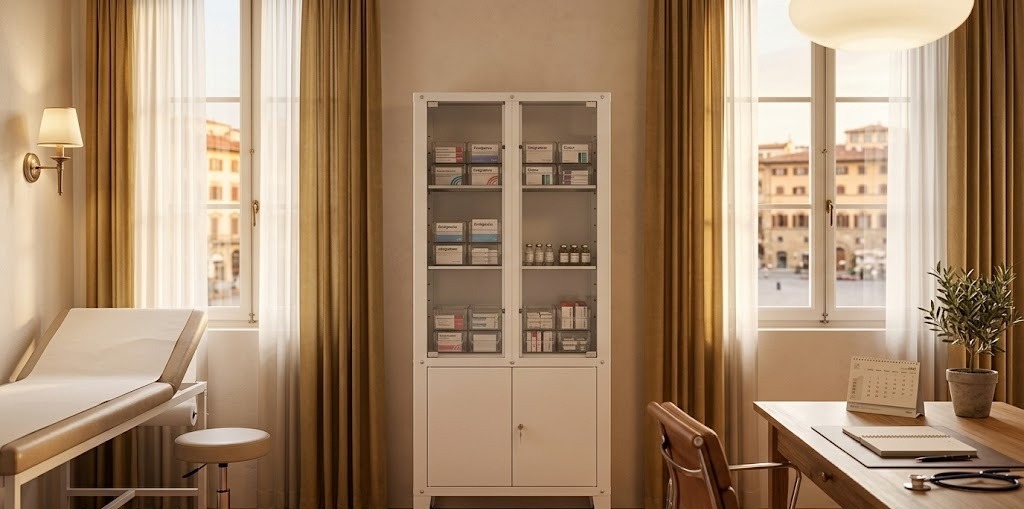
In the Holity.co.uk catalogue, the main distinction between pharmaceutical storage systems is based on the configuration and number of doors, a structural element that determines both the load capacity and accessibility in operating spaces.
They represent the entrance solution par excellence, characterised by a reduced horizontal footprint and a slender vertical structure.
Advantages: Extremely compact visually and easy to place even in rooms or corridors with limited space. They allow you to make the most of verticality without blocking passageways.
Disadvantages: Limited storage volume, not suitable for managing the overall inventory of large departments.
Ideal for: Small medical and dental practices, local clinics, company first aid rooms or dedicated blood collection stations.
This is the most popular configuration on the market, capable of offering the perfect balance between internal capacity and optimisation of floor space.
Advantages: Large display front which, in the models with tempered glass doors, allows an immediate view of all the pharmaceutical products arranged on the shelves, speeding up inventory and picking operations.
Disadvantages: Opening the hinged doors requires a frontal manoeuvring radius free from obstacles or adjacent furnishings.
Ideal for: Ward infirmaries, private clinics, galenical laboratories and medium-sized back pharmacies.
Advanced and combined storage systems, usually structured with a horizontal division (two upper doors and two lower doors) or independent compartments.
Advantages: Maximum versatility of use. They allow for clear separation of drug types, for example by using the upper glass doors to display commonly used medicines and the lower blind doors (in sheet metal or wood) to store loose devices or substances to be protected from light.
Disadvantages: They require meticulous planning of the installation space due to the larger structural footprint.
Ideal for: Hospital pharmacies, intensive care units, centralized pharmaceutical warehouses and large outpatient clinics with a high patient turnover.
To configure efficient healthcare furniture that complies with hygiene regulations, it is essential to set the search filters by setting the millimetric measurements required for your rooms.
The external dimensions of the furniture must fit perfectly into the clinical layouts to ensure safety and fluidity of movement for childcare and medical staff:
In the medical field, surfaces must counteract bacterial proliferation and resist continuous sanitisation cycles. The epoxy powder-coated steel or thick melamine-faced structures guarantee smooth, porous surfaces that are perfectly compatible with chlorine- or alcohol-based hospital chemical detergents. Tempered glass shelves ensure high mechanical strength and transparency that facilitates the passage of light. A crucial factor is the presence of security locks (cylinder or digital) and reinforced internal compartments (called "treasure boxes"), essential for the legally compliant storage of narcotic and psychotropic substances.
The storage of medications complies with strict protocols dictated by health authorities (ASL) and current ministerial decrees. Medicine cabinets must ensure the segregation of expired/returnable medications and ready-to-use medications, and must have efficient locking systems to prevent unauthorized removal. Material certifications, the absence of sharp edges, and certified structural solidity against tipping are essential requirements for passing inspections and quality audits in facilities accredited by the National Health System.
Private Medical Practices and Specialist Clinics: The ideal choice is a compact 1-door display cabinet, preferably with an intermediate height and reduced depth. It allows you to keep first-use medications within reach for daily visits, ensuring a clean, professional aesthetic that reassures the patient.
Hospital Wards and Nursing Homes: We recommend using 2-door cabinets, either mixed or entirely made of sheet metal, equipped with a centralized lock. The robustness of the steel guarantees years of durability against accidental impacts from trolleys, while the key lock protects the liability of the head nurses and nurses on duty.
Pharmacies and Central Storage Warehouses: In these environments, the priority is maximum load density. Configuring your purchase of 4-door cabinets or coupled modules measuring 1000 mm long and 2000 mm high allows you to catalogue your entire inventory by therapeutic category or active ingredient, optimising internal logistics and supply flows.
Protect the integrity of your medicines and adapt your facility to the highest safety standards. On Holity.co.uk you will find a complete range of professional medicine cabinets and display cases, with solutions designed to cover a flexible price range from 0 to 5000 euros, guaranteeing the highest quality for both small office needs and complex hospital supplies.
Use our side filters to select the number of doors you need (1, 2 or 4 doors) and set the millimetric sliders to find the exact height, length and depth for your rooms. Contact our customer service today to receive customized technical advice.
What does the internal security compartment (safety box) consist of and which specific therapeutic classes require its mandatory use?
The so-called "safety box" is an autonomous armored compartment, integrated within the main frame of the cabinet and protected by an independent lock (often double-bit or encrypted electronic). Its presence is a stringent logistical and legal requirement for the storage and segregation of narcotic and psychotropic substances and medicines subject to strict ministerial traceability. This double mechanical barrier prevents accidental or untraceable access by unauthorized personnel, protecting the civil and criminal liability of the head nurse or pharmacist responsible for managing the loading and unloading register.
What kinematic dynamics differentiate the installation of sliding doors from hinged doors in the management of healthcare corridors?
The opening architecture of the doors directly impacts the calculation of emergency corridors and the flow of traffic in filter rooms. Hinged doors offer a complete and immediate 180-degree display front, but require a free frontal maneuver radius equal to the width of the door itself, risking creating bottlenecks or temporary architectural barriers. Sliding doors, moving in parallel on guided internal tracks, completely eliminate external encumbrance during opening, allowing the setup of safe collection points even in infirmary corridors with very high pedestrian or medical cart traffic.
How does selecting tempered glass shelves over solid steel impact interior light and the prevention of latent expirations?
Tempered safety glass shelves offer mechanical load-bearing capacity calibrated for standard pharmaceutical loads and provide complete geometric transparency. This allows overhead lighting or integrated LED lighting systems to penetrate evenly to the lower levels of the cabinet, eliminating shadowy areas where medication boxes could slide to the bottom and expire unnoticed. Solid steel or painted sheet metal shelves are preferred where large volumes of heavy fluids, saline bottles, or loose medical devices requiring higher static load-bearing capacities per level are needed.
How do cabinet systems with internal rotating (rotating) shelving optimize space efficiency and floor plan footprint?
Cabinets equipped with rotating internal modules exploit a central pivot mechanism that allows for 360-degree rotation of the storage compartments. This engineering solution doubles the usable linear display surface area in the same footprint compared to a cabinet with fixed shelves. The operator can rotate the internal structure for instant access to the items stored at the back of the cabinet, a strategic feature for galenical laboratories or therapy preparation centers where every walkable square centimeter must be optimized down to the millimeter.
What chemical-physical properties allow epoxy powder-coated sheet steel to resist the action of hospital sterilization protocols?
Coating with epoxy powders cross-linked in the oven at temperatures above 180°C transforms the metal coating into a continuous, extremely hard polymeric film that is completely free of molecular porosity. This plastic insulation seals the chassis from the hydrolytic action of humidity and counteracts corrosion phenomena triggered by the daily application of aggressive chemical agents used to reduce the microbiological load, such as concentrated solutions based on sodium hypochlorite (active chlorine), denatured alcohol or industrial enzymatic detergents.
How should the organisation of the shelves be structured to ensure the correct separation of logistical flows between compliant batches and expired or returnable drugs?
Healthcare protocols for managing clinical risk prohibit the promiscuous coexistence of active medicinal batches with altered, defective or expired ones. Professional cabinets facilitate this logistical separation by allowing the dynamic adjustment of the shelves on millimetric racks: it is good healthcare practice to allocate and colour-code compartments or entire independent modules for the forced confinement of drugs to be disposed of or returned to the central warehouse, thus eliminating any human error resulting in incorrect sampling and administration to the patient.
 English
  Italian
 French
 German
 Spanish