
mon-fri 9-13 / 14.30-18.30
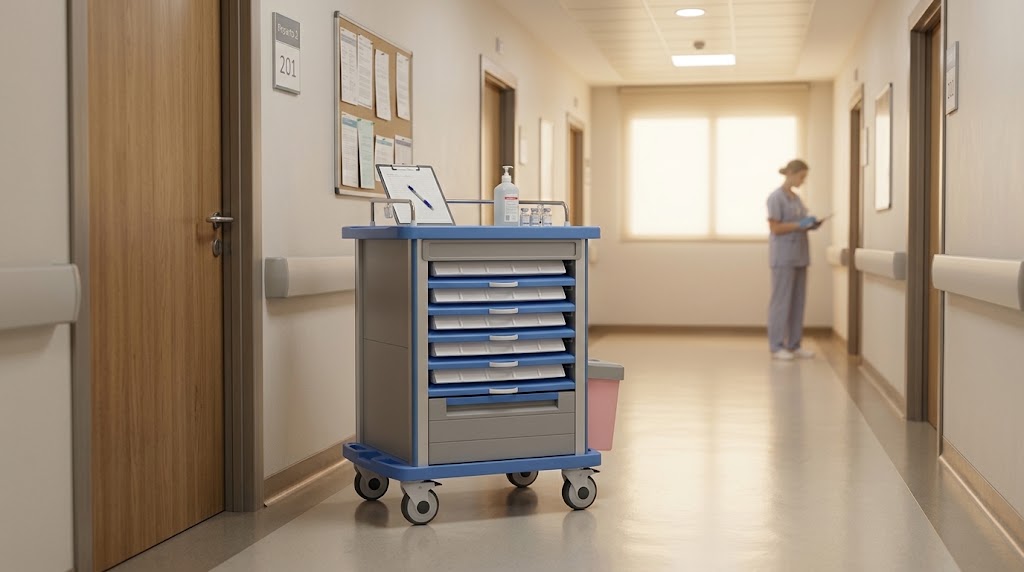
The daily administration of medication is one of the most delicate and critical processes within hospitals, private clinics, nursing homes, and assisted living facilities (RSA). For nursing teams, distributing medications to dozens of patients within specific timeframes requires not only clinical precision but also impeccable logistical management. Choosing the right medicine dispensing cart is essential for speeding up dose preparation, preventing the risk of mix-ups or mismatches, protecting medications from unauthorized access, and ensuring complete hygiene. From solutions for daily/weekly single-dose unified therapy to trolleys with modular drawers and compartments for hospitalisation, Holity offers a complete professional range: this purchasing guide analyses the compartment configuration, the choice of materials, the safety locking systems, the driving ergonomics and the current regulatory frameworks.
The internal organisation of the trolley must be compatible with the distribution protocol adopted by the department (administration by patient, by time or unified therapy):
The configuration of choice for managing personalised daily or weekly therapy.
The trolleys function as real mobile healthcare workstations:
The construction materials must guarantee maximum chemical-physical resistance and quick cleaning after use:
The range on Holity.co.uk allows you to profile the choice of hospital furniture through precise dimensional filters:
The range available on our store satisfies both the needs of small private practices and the preparation of batches for large hospitals, moving within a price range between €716.00 and €4265.00 for the complete professional unit:
Increase the safety of drug administration in your department, prevent therapeutic errors and equip your nursing team with ergonomic, safe and hygienic trolleys with the solutions available on Holity.co.uk. Explore the online catalogue to select the most suitable model: set the number of compartments (from 8 to 66), select the type of locking (key, roller shutter or PIN) and identify the body materials suitable for your sanitisation plan.
Request a personalized quote today: our sales team is at your complete disposal to provide you with quoted technical data sheets, material conformity certifications and offers reserved for the supply of entire ward lots.
How does the therapy distribution system with weekly and daily single-dose trays in pharmacy trolleys work?
The single-dose tray system organizes the therapy for each patient and by time. The trolley contains a series of drawers into which removable transparent trays are inserted, marked with the bed number or the patient's name. Each tray is internally divided by repositionable partitions into 4 or 5 compartments (corresponding to Morning, Midday, Afternoon, Evening, Night Administration). The ward pharmacy or the nurse fills the tray by inserting the prepared pills; during the rounds, the operator only removes the tray of the patient to be treated, eliminating the risk of exchanging drugs or dosages between different beds.
What types of safety locks are most suitable for storing drugs under control or psychotropics?
To prevent unauthorised access to sensitive drugs while the trolley is in the corridors of the department, the most commonly used solutions are two: centralised locking using a vertically sliding PVC or aluminium roller shutter equipped with a unique key lock, or electronic locks with a numeric keypad for PIN or RFID badge reader. The electronic locking allows the credentials of the operator who unlocked the trolley to be tracked, ensuring maximum management accountability.
Why are anodised aluminium and ABS technopolymers preferred for distribution trolleys over all-steel structures?
Anodised aluminium combines the mechanical rigidity of steel with a specific weight that is 60% lower. Combined with the walls and worktop in ABS or thermoformed polycarbonate, it allows the creation of extremely capacious trolleys (up to 60 compartments) that maintain exceptional manoeuvrability and minimal pushing effort for the nurse. Furthermore, plastic polymers are warm to the touch, absorb shock, do not dent and offer completely smooth and rust-free surfaces that are easy to disinfect.
How do you calculate the diameter and type of wheels needed based on the flooring of the hospital ward?
For wards with coplanar floors in linoleum, epochal resin or PVC (standard in modern hospital blocks), non-marking grey rubber swivel wheels with a diameter of 100-125 mm offer perfect smoothness and maximum silence during the night shift. If the structure has unevenness, expansion joints or connections with elevators, it is recommended to choose wheels with a diameter of 125-150 mm equipped with a soft polyurethane tread and shielded ball bearings capable of overcoming roughness without transmitting jolts to the medicine trays.
How does the price range of the category (€716.00 - €4265.00) correlate with the number of units. compartments, the locking system and the construction materials?
The price structure is determined by the overall storage capacity, the quality of the body materials and the presence of advanced safety systems or accessories. The entry level range (€716.00 - €1200.00) includes compact trolleys with 8 to 20 compartments in painted steel with a simple key lock. The intermediate range (€1200.00 - €2200.00) includes department trolleys with 24 to 45 compartments with a PVC closing shutter, ABS worktop and transparent single-dose trays. The top of the range prices (up to €4265.00) identify high density distribution stations (from 50 to 66 compartments), AISI 304 stainless steel or monoblock aluminium structures, trolleys with RFID/PIN electronic locks and double-sided models equipped with computer arms for contract electronic medical records.
 English
  Italian
 French
 German
 Spanish