
mon-fri 9-13 / 14.30-18.30
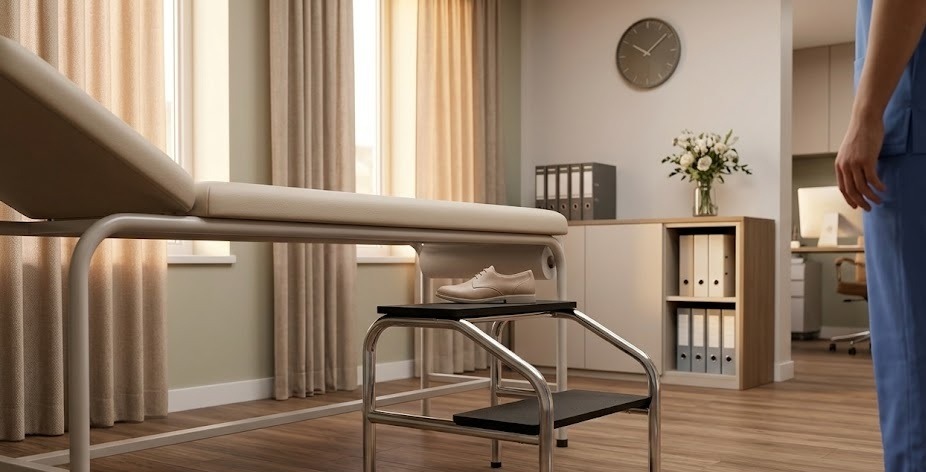
Within a medical office, attention to accessibility and fall prevention are the first tangible indicators of the quality of care provided by the facility. Accessibility aids for examination tables are not a secondary detail, but an ergonomic element that facilitates the interaction between doctor and patient. Choosing the right medical step stools means equipping your clinic with stable, certified tools engineered to support heavy orthostatic loads without the slightest sagging. Whether it's a gynecology department, a pediatric office, a physiotherapy center, or a general medicine clinic, a step stool facilitates the user's postural transition to the sterile or diagnostic field, especially safeguarding the independence of elderly or mobility-impaired patients. This purchasing guide will help you explore the Holity.co.uk online catalogue, analysing step sizing, anti-slip regulations and the selection of structural materials to create an efficient and safe medical environment.
In the diagnostic and outpatient furniture sector, access ladders differ in terms of chassis geometry and vertical development (number of steps), parameters that determine the ease of climbing based on the height of the intended medical bed.
The most widespread and universal entrance configuration, designed to cover the minimum height difference required for access to standard fixed-height examination beds.
Advantages: Extremely small footprint. They are easily positioned close to the bed frame and can be pushed under it at the end of the visit, freeing up precious space for the doctor's circulation in small offices. They raise the patient on average 20-25 cm from the floor.
Disadvantages: The fixed lift does not allow you to overcome the height differences of specialist diagnostic beds with a marked elevation without forcing the patient to make significant muscular effort.
Ideal for: General medicine, pediatric, dermatology practices and offices with confined spaces.
Double-ramp solutions that halve the lifting effort, distributing the load across two staggered support surfaces.
Advantages: Reaching a cumulative useful height of between 40 and 45 centimetres, they allow the patient to access particularly high gynaecological or diagnostic tables through an ergonomic progression. They reduce stress on the knee and hip joints, offering the user a feeling of total stability.
Disadvantages: They require a larger positioning surface on the floor (depth of approximately 40-50 cm) that cannot be hidden under the standard table.
Ideal for: Gynaecological departments, physiotherapy, orthopaedic clinics and facilities with a high influx of geriatric patients.
Structured access systems to overcome significant differences in level or to access raised diagnostic machinery.
Advantages: They transform the access into a real stable ramp, essential in radiology settings or where the equipment requires specific positioning of the patient at heights above the norm.
Disadvantages: Considerable size and weight, comparable to small permanent ladders.
Ideal for: Diagnostic imaging, radiology, advanced sports medicine and specialized surgery departments.
To integrate a safe climbing aid in line with the doctor's operational needs, it is necessary to carefully analyse the load tolerances, material compatibility and properties of the walking surfaces.
The first guiding criterion is the geometric combination between the step and the height of the examination table. Fixed-frame medical tables generally have a mattress height between 60 cm and 78 cm. The inclusion of a single 22 cm step halves the difference in height, making the seat comfortable for the majority of the adult population. If the specialist examination table (e.g. ultrasound or gynecological examination table) exceeds 80 cm in height from the ground, installing a two-step module becomes an essential safety feature to prevent muscle strain in the patient and facilitate any post-examination exit with altered blood pressure.
The robustness of the chassis is the primary clinical requirement. A professional step must not flex, vibrate, or slip when subjected to dynamic weight force (the impact of stepping uphill). It is imperative to check the product's technical data sheet for the certified maximum load capacity. Standard models for outpatient clinics guarantee minimum safe loads between 130 kg and 150 kg. For clinics that treat obesity-related pathologies, dietetics, or for bariatric divisions, the supply must focus exclusively on heavy-duty reinforced frames tested to safely support loads exceeding 200-250 kg.
The frame material affects both the durability against cleaning protocols and the visual impact of the medical room:
Footrests must eliminate the risk of slipping, especially in the winter months when the soles of patients' shoes may be wet. The best devices use non-slip ribbed black rubber surfaces or textured plastic laminate panels with a high friction coefficient. To ensure maximum stability on the floor, the base of the steel or wooden tubes must always end with non-marking rubber tips or suction cup feet, capable of adhering perfectly to the porcelain stoneware or linoleum typical of medical rooms.
Footrests used in healthcare settings are classified as medical equipment and accessories, and must comply with the stability requirements set out in European regulations. The UNI EN 14183 standard regulates the safety requirements for stools and steps, imposing strict tests of vertical static load and transverse inclination, so that the product's center of gravity does not allow it to tip over under diagonal forces. In Italy, their introduction also responds to the obligations of Legislative Decree 81/08 for the protection of the physical integrity of visitors and workers. To complete the supply compliance, stainless steel medical devices must comply with the CE marking directive, attaching the declaration of performance of the materials and non-toxic paints used for the structure.
General Medicine, Dietetics and Basic Clinics: We recommend the use of single-step steps in white painted steel with a standard load capacity (150 kg). They represent a compact, economical solution, easily inserted under classic suitcase-type beds and extremely easy to clean with common hospital sanitizers.
Gynecology, Urology and Sports Medicine: In these areas where the patient needs access to multifunctional chairs or raised gynecological beds with leg rests, the obligatory choice is the two- or three-step step in stainless steel or painted steel, with wide bases and embossed rubber mats. They halve the slope of the riser and offer a safe resting point.
Pediatric Studies, Osteopathy and Holistic Therapies: The purchase choice can focus on elegant one- or two-step steps in solid beech wood. In addition to mechanical stability, wood plays down the "coldness" of the clinical environment, reducing pre-visit anxiety in younger patients and harmonizing with the furnishings of private practices.
Eliminate vertical architectural barriers in your practice, protect the independence of your vulnerable patients, and adapt your clinic to the highest standards of healthcare ergonomics. In the Holity.co.uk online catalog, you'll find a professional and certified selection of access steps for medical beds, developed by the best brands in the hospital sector to withstand uninterrupted load cycles.
Use our lateral search tools to configure the number of steps required (1, 2, or 3 ramps), select the frame type based on your hygiene protocols (stainless steel or painted), and check the maximum safety load capacity required for your users. Contact our customer service team today to request detailed technical data sheets, CE load certificates and a personalized quote tailored to your medical spaces.
How is the force vector distribution calculated on a two-step step to prevent the risk of forward dynamic tipping?
Double-step clinical steps are engineered using vector kinematics principles to neutralize tipping moments. When the patient places weight on the outer upper step, the force vector tends to cause the structure to pitch. To prevent this, the lower tubular frame is designed with an elongated depth wheelbase, which moves the support base well beyond the vertical projection of the last step. This extends the stability polygon on the ground: the applied force always falls within the perimeter of the four feet, physically blocking any forward tipping.
What is the difference in grip between vulcanized ribbed rubber and textured laminate flooring panels?
Vulcanized black ribbed rubber offers excellent static grip in both dry and wet conditions due to the polymer's high compound grip. However, the grooves in the ribbed pattern can trap fine dust and require direct brushing. Textured plastic laminate (HPL), commonly used on wooden platforms, generates grip through small spherical reliefs hot-stamped into the melamine surface. This material offers certified dynamic grip but is infinitely easier to sanitize with wipes and spray disinfectants than porous rubber.
Can single-step steps used in small operating rooms be autoclaved or treated with peracetic acid?
Steps made entirely of AISI 304 austenitic stainless steel (including shelves without rubber or glued plastic inserts) are chemically inert and withstand intensive chemical cleaning cycles. They can tolerate baths with disinfectant solutions based on peracetic acid, chlorhexidine, or quaternary ammonium salts without triggering corrosive pitting phenomena. However, due to their physical dimensions (typically 40x30 cm), they are not designed to be physically inserted into the baskets of saturated steam autoclaves, whose capacity is calibrated for surgical instruments and drapes.
What construction features ensure the total absence of mechanical noise and creaking during use by bariatric patients?
In heavy-duty steps (with a capacity of up to 250 kg), the frame assembly excludes loosening through-screw connections. The entire steel tube chassis (25x25 mm or larger section) is joined using robotic continuous wire welding (TIG/MIG) that fuses the metal into a rigid, inextensible monoblock. Furthermore, the walking panels are not screwed directly onto the metal, but rest on micro-gaskets or shock-absorbing structural adhesives that isolate the platform from the frame, eliminating harmonic resonances and annoying metal creaking under load.
Do ball-joint bases offer superior stability compared to common plastic end caps on floors with wide joints?
Yes, standard flat or curved end caps do not adapt to millimetric disconnections in floors (e.g. antique ceramic tiles with deep joints). High-end steps use articulated feet mounted on ball joints. This kinematic mechanism allows the rubber disk of the base to tilt and self-level to exactly match the angle of the underlying tile, ensuring 100% ground contact area for each leg and eliminating micro-vibrations in the frame.
How does the use of oven-cured epoxy powder coatings prevent bacterial infiltration into micro-cracks in the frame?
Unlike liquid spray painting, the epoxy painting technique uses electrostatically charged thermoplastic powders that are adhered to the metal and then fused in an oven at over 180°C. This thermal cycle triggers "cross-linking", creating a very hard, homogeneous polymer film that is completely free of micro-porosity or volatile solvents. This armored plastic seal prevents surface scratches from reaching the bare steel, blocking oxidation and preventing organic fluids and bacterial colonies from nesting and proliferating under the paint layer.
 English
  Italian
 French
 German
 Spanish