
mon-fri 9-13 / 14.30-18.30
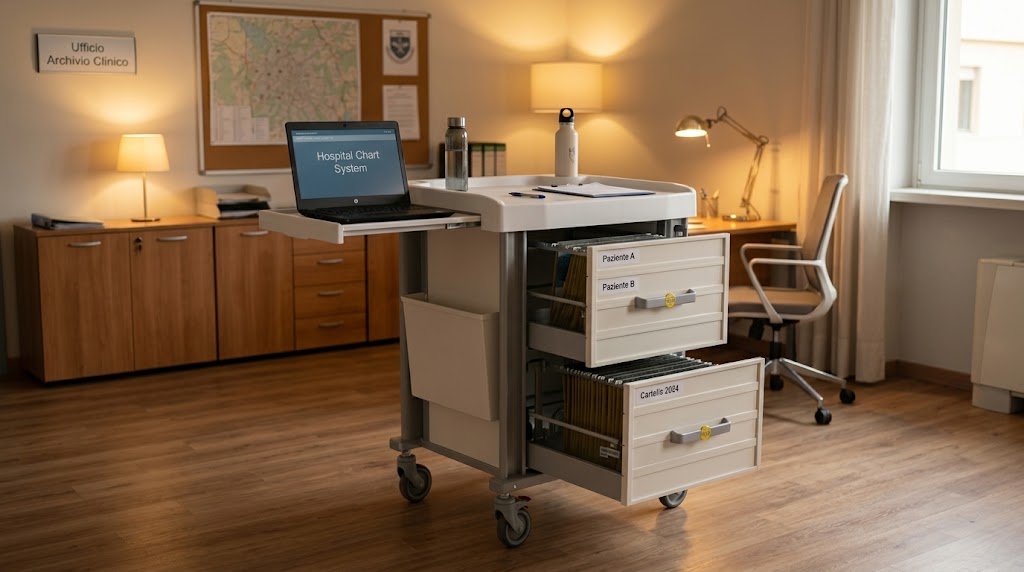
Rounds are one of the most delicate and hectic moments in hospitals, clinics, and nursing homes. Between updating treatments, consulting reports, and interacting with patients, medical and nursing staff need a tool that simplifies their work, not hinders it. Medical record carts are designed for precisely this: to transform a potential mountain of messy paper into a secure, perfectly organized mobile archive.
Choosing the right model means reducing search times, eliminating patient identification errors, and alleviating physical fatigue for staff, who will no longer have to constantly commute to the central archive or the reception area. In this guide, we'll help you choose the solution best suited to your facility's needs, helping you evaluate volumes, materials, data security, and technological integration.
The starting point for an informed choice is the analysis of daily work volumes. A low-status department might need to move only 20 or 25 files at a time, making compact two-drawer models ideal. Conversely, in high-density departments such as internal medicine or surgery, the need quickly increases to 40 or 50 files, requiring three-drawer or multi-compartment carts.
However, be careful not to evaluate capacity alone: the cart must be able to move with agility. Before making a purchase, it is essential to consider the width of the corridors, the size of the elevators and the living space within the patient rooms. An oversized cart, however capacious, risks becoming an obstacle to normal operations.
Medical documentation contains the most sensitive data of all. When the cart is used in corridors, waiting rooms, or public clinics, protecting privacy is not just an ethical issue, but a specific legal requirement under the GDPR.
If the cart is used in mixed-use areas, we recommend choosing models equipped with sliding drawers with key locks or central locking. This ensures that only authorized personnel can access the files. If, however, use is limited exclusively to a closed and closely monitored department, models with open compartments or revolving doors can represent a quicker and more practical solution for extracting and inserting documents.
Today, healthcare is experiencing a hybrid transition, where paper records increasingly coexist with electronic medical records. A modern cart is no longer a simple container, but a true mobile workstation.
Many models in our catalog are equipped with upper support surfaces specifically designed to accommodate laptops, adjustable tablet holders and removable compartments for X-ray films. Having a single mobile station that can accommodate A3 reports, A4 folders and IT devices allows the doctor to have a complete and real-time updated clinical picture directly at the patient's bedside.
In a healthcare environment, ease of sanitization is an essential requirement. Carts must withstand daily cleaning and disinfection procedures with aggressive chemical agents, without showing signs of corrosion or structural degradation.
For high-risk infectious departments, such as intensive care units or operating rooms, stainless steel or anodized aluminum are the first choice: lightweight, resistant to bacteria and resistant over time. For standard wards or outpatient clinics, epoxy powder-coated steel offers an excellent compromise between sturdiness, ease of cleaning, and cost-effectiveness.
The quality of the wheels should not be overlooked. Fully loaded trolleys can be heavy; therefore, large-diameter swivel wheels, possibly equipped with brakes and anti-slip systems, ensure smooth and silent movement on any flooring, from tiles to linoleum, preventing accidental damage to door jambs thanks to perimeter bumpers.
Our offer includes solutions designed in full compliance with UNI EN ISO regulations on stability and prevention of tipping, with CE marking. The catalogue offers great dimensional flexibility, with widths from 100 mm to 1030 mm and heights reaching up to 1400 mm, positioned in a price range that goes from €880.00 to €2132.00 for the most advanced and capacious models.
Request a personalized quote. Our consultants are at your disposal to study the perfect configuration for your operational spaces with you.
How many medical records can a trolley for rounds hold?
The capacity depends strictly on the chosen configuration. The more compact models with 2 or 3 drawers hold on average between 20 and 30 standard A4 folders. The larger configurations, equipped with multiple compartments and extended shelves, can easily exceed 50 units, making them ideal for busier departments.
What are the structural safety requirements for these trolleys?
A professional hospital trolley must guarantee absolute stability even when fully loaded. It must be designed to prevent accidental tipping (complying with UNI EN ISO standards), have drawers with end-of-travel locks to avoid involuntary falls and be fitted with wheels with parking brakes to ensure controlled and safe movement in corridors.
Can I also use the trolley to transport x-ray films?
Absolutely yes. Our catalogue includes specific models defined as "x-ray film holders" which integrate removable compartments dedicated to x-rays and large-format reports. They are the perfect solution for radiology, orthopedics, and surgery departments, where paper documentation coexists with diagnostic images.
How do I choose between a cart with closed drawers and one with open compartments?
The choice depends on the level of privacy required. If the cart is used in areas open to the public, locked drawers are essential to comply with privacy regulations (GDPR). If, however, the cart is used in an area reserved exclusively for medical staff, open compartments significantly speed up the extraction and insertion of documents.
What is the difference between a rounds cart and a normal file cart?
The rounds cart is a real workstation: in addition to compartments for files, it is equipped with support surfaces for writing, storage compartments for small diagnostic instruments, and sometimes supports for tablets or laptops. The generic file cart, on the other hand, is primarily designed as a "mobile archive" and aims to maximize storage space for document transfer.
 English
  Italian
 French
 German
 Spanish