
mon-fri 9-13 / 14.30-18.30
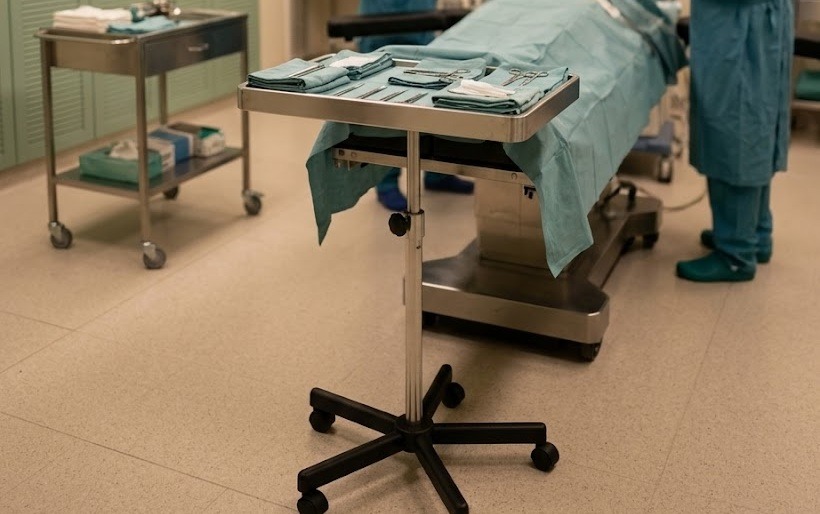
Within an operating room, efficient workflows and maintaining a strictly sterile environment are crucial to the success of any procedure and maximum patient protection. In this critical scenario, Mayo tables (also known as surgical instrument tables) represent a fundamental element of operating room furniture. Specifically designed to be positioned above the surgical field without interfering with the operating table, these devices allow the medical team and nursing staff to keep the necessary surgical instruments within reach and in a perfectly sterile configuration. Choosing the right Mayo table is a strategic investment aimed at reducing downtime during instrument changeovers, preventing the risk of cross-contamination, and ensuring maximum postural ergonomics. This buying guide was created to guide you through the various models available in our online catalog at holity.co.uk, analyzing base configurations, hydraulic adjustment systems, and industry regulatory requirements.
In the hospital and surgical equipment market, Mayo tables are differentiated mainly based on the geometry of the support base and the complexity of the altimetric movement system, variables that directly affect stability and maneuvering space in the operating room.
They represent the classic configuration, focused on maximum structural agility and minimum footprint within the surgical area.
Advantages: Thanks to the slim triangular base, they take up very little floor space and can be placed next to the operating bed with extreme ease and fluidity, even in the presence of other bulky equipment. They are light and very easy to move.
Disadvantages: They offer less stability than radial models if the load of the instruments is distributed in a highly eccentric way or protruding on the edges of the tray.
Ideal for: Surgical clinics, aesthetic or plastic surgery rooms, ophthalmology, dentistry and environments with limited floor space.
Advanced systems designed to guarantee superior static stability and withstand the continuous mechanical stresses of high-turnover operating rooms.
Advantages: The five-star radial base distributes the weight optimally, eliminating the risk of accidental tipping even in the event of lateral impacts or unbalanced loads. They are often combined with hydraulic pump lifting systems for smooth and jerky height adjustment.
Disadvantages: The footprint of the five-star base requires a slightly larger floor area than the three-wheel variant.
Ideal for: Operating rooms in general surgery, orthopedics, traumatology and operating rooms with high staff and equipment turnover.
Configurations engineered to perform highly specialized functions or for inclusion in advanced diagnostics.
Advantages: The bridge models feature a portal frame with large trays (over 90 cm in length) ideal for accommodating a massive quantity of surgical instruments. The MR compatible models are made entirely of non-magnetic materials (such as anodized aluminum) to operate safely without magnetic interference.
Disadvantages: They have a strictly sectorial application and a large structural footprint.
Ideal for: Major surgery rooms, neurosurgery centers, cardiac surgery and suites equipped with intraoperative magnetic resonance imaging.
To configure a supply of high-performance surgical furniture in line with strict hospital sterilization protocols, it is essential to evaluate specific mechanical and material parameters.
The ergonomics of the surgical team directly influences the precision of therapeutic gestures. A good instrument table must have a wide height range, extending approximately from a minimum of 750 mm up to over 1400 mm. Models equipped with hydraulic adjustment via a foot-operated hydraulic pump are preferred in main operating rooms, as they allow the tray to be raised or lowered with a millimetric precision, smoothly and without jolts, preventing the sterile instruments placed on the table from falling or misaligning. Manually adjustable variants with a mechanical locking knob remain an excellent cost-effective solution for shorter procedures.
The surgical environment requires the use of totally non-porous surfaces, resistant to chemical corrosion and aggressive heat treatments. The trays and structures of professional Mayo tables must be made of AISI 304 or higher (AISI 316) stainless steel. This alloy guarantees absolute tolerance to deep decontamination cycles and steam sterilization in an autoclave at temperatures up to 134°C. It is essential to evaluate the purchase of models with a removable or interchangeable tray: this feature greatly speeds up the replacement of instruments and the sanitization of the table between one procedure and the next.
The weight of surgical instruments can be significant, especially in orthopedic or traumatological procedures. The load capacity of Mayo tables generally varies between 25 kg and 50 kg of distributed static load. Choosing an adequate load capacity ensures that the cantilever arm of the table does not undergo flexing or permanent deformation under the weight of the instrument trays, safeguarding the stability of the instruments.
Movement within the operating block must take place in maximum silence and in complete electrical safety. The wheels must be swivel, equipped with strand guards to prevent the accumulation of dirt and fitted with effective braking systems. In the presence of sensitive electromedical equipment (monitors, high-frequency scalpels or medical gases), it is essential that the wheels are of the antistatic type, capable of constantly dissipating the electrostatic charges accumulated during rubbing on the floor, preventing accidental discharges or interference with clinical monitors.
Mayo tables intended for hospital use must comply with rigorous standards that certify their mechanical safety and hygienic suitability. The European reference standard is UNI EN ISO 6930, which governs the safety and performance requirements for the furniture of operating rooms. The locking mechanisms and hydraulic pumps must pass stringent mechanical stress tests (up to 10,000 extension and retraction cycles without fluid leakage or mechanical play). The antistatic castors must comply with the UNI EN ISO 6356 standard for electrical conductivity, while the base of the cabinet (whether three-wheeled or five-spoke) must guarantee a certified stability radius to prevent accidental tipping even under eccentric loads.
General Surgery, Orthopedics and Traumatology: In these contexts characterised by heavy instruments and complex interventions, the installation of professional Mayo tables with a five-spoke base, equipped with a hydraulic foot pump, a removable AISI 304 stainless steel tray with a continuous radius and antistatic castors is recommended. They offer maximum stability and load flexibility.
Ambulatory Surgery, Ophthalmology and Day Surgery: For routine short-stay procedures or targeted specialist interventions, the ideal choice falls on compact models with a three-wheel base and manual or hydraulic adjustment. They allow for millimetric approach to the sterile field while taking up minimal space in surgical cubicles.
Advanced Diagnostics and Magnetic Resonance Imaging (MRI) Rooms: In the presence of strong magnetic fields, the use of common steel is prohibited to avoid the projectile effect. It is mandatory to configure the purchase on special MR-compatible Mayo tables made entirely of anodized aluminum or certified non-magnetic technical polymers, guaranteeing the absolute safety of operators and patients.
Optimize the efficiency of your surgical team, ensure the highest standards of preoperative sterility, and renovate your operating blocks with professional products from holity.co.uk. Our online catalog offers a specialized selection of Mayo surgical instrument tables, developed to withstand continuous cycles of intensive use and chemical-thermal sterilization.
Use our lateral search tools to select the base type (three-wheel or radial), lifting system (manual or hydraulic), and tray dimensional specifications best suited to your clinical layouts. Are you a public healthcare company, a private clinic, or do you need a dedicated quote for large batches, complex tender specifications, or purchases under the e-procurement (MePA) regime? Contact our customer service today to receive complete technical data sheets and customized technical advice for your project.
How is the electrical conductivity of antistatic wheels verified and quantified according to the UNI EN ISO 2882 standard? Conductive wheels intended for surgical furniture must present an ohmic electrical resistance not exceeding 1,000,000 Ohm when measured under a normalized load. This specification prevents the accumulation of electrostatic charges caused by rolling, constantly discharging them towards the conductive flooring of the operating room. This passive dissipation prevents accidental deflagrations in the presence of flammable medical gases and eliminates stray currents that could generate artifacts or background noise on ECG monitors.
What engineering solutions prevent the leakage of fluids or vapors inside the telescopic lifting column? Professional Mayo tables integrate special sliding bushings and dynamic lip seals made of fluorinated elastomer (PTFE or Viton). This hermetic sealing system isolates the telescopic coupling of the supporting column, preventing biological fluids, chemical detergents, or high-temperature vapors from penetrating inside the mechanical chassis or the hydraulic circuit of the pump, eliminating the risks of internal corrosion or hidden bacterial colonization.
How do the perimeter micro-groove and the continuous radius of the tray affect biological containment? Stainless steel surgical trays are cold-stamped with a raised perimeter edge with a continuous radius (free of welds or crevices) and provided with an anti-drip micro-groove. This geometric shape is fluid-dynamically calculated to contain accidental spills of washing liquids or biological fluids up to approximately 1.5-2 liters, preventing them from falling onto the patient's sterile field or onto the floor, and facilitating the mechanical action of the sterile drapes.
What is the biomechanical impact of the bending moment (Mf) induced by an eccentric load on the cantilever arm of the Mayo table? When heavy surgical cassettes are placed at the end of the cantilever tray, a bending moment is generated, expressed by the formula Mf = F * d, where the weight force acts on the distance from the central axis of the column. To counteract the millimetric deflection of the surface and prevent seizing or mechanical play of the telescopic tubes, advanced models use internal linear guides coupled with self-lubricating bronze or Teflon bushings, evenly distributing the transverse forces.
What surface micro-roughness (Ra) parameters must AISI 304 stainless steel comply with to validate passivation and decontamination processes? Austenitic AISI 304 stainless steel used in operating rooms must have a satin or scotch-brite finish with a surface roughness index Ra ≤ 0.8 µm. This reduced level of geometric micro-asperity eliminates microscopic anchoring points for bacterial biofilms or residual protein organic matter. Consequently, enzymatic detergents and chemical passivation cycles with acid solutions can act uniformly, eliminating porosity and restoring the passive protective chromium oxide layer.
How is the "MR Conditional" classification engineered for the use of Mayo tables in hybrid operating rooms with a high magnetic field (3 Tesla)? In hybrid operating rooms equipped with intraoperative magnetic resonance imaging (up to 3 Tesla), the strong spatial attraction prohibits the use of ferromagnetic materials. "MR Conditional" certified Mayo tables completely exclude common steel and cast iron: the chassis and mechanics are made by extruding aeronautical aluminum alloys (6000/7000 series) or medical titanium, coupled with silicon nitride ceramic ball bearings and polymeric gaskets. This non-magnetic architecture neutralizes the projectile effect and prevents image artifacts in radiological diagnostics.
 English
  Italian
 French
 German
 Spanish