
mon-fri 9-13 / 14.30-18.30
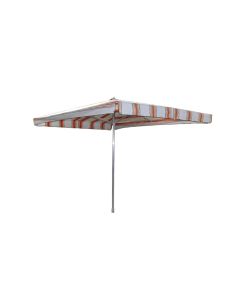
Professional umbrella for fairs and markets h757_47 with cotton-polyester canopy (300 x 260 cm). Compact and lightweight "Base" version, designed to ensure practical use and low costs for street vendors.
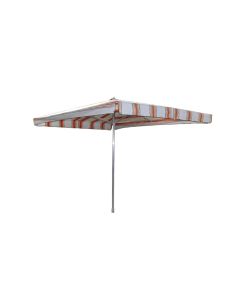
Professional umbrella for fairs and markets h757_51 with resin-coated acrylic fabric (300 x 260 cm). A compact and water-repellent “Base” model, designed to offer practicality and protection from atmospheric agents at affordable costs.
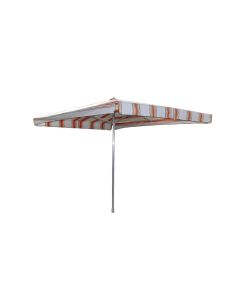
h757_46 market umbrella with cotton-polyester canopy (300 x 400 cm). An essential and lightweight "entry-level" model, designed to offer maximum practicality and low costs for street vendors.

Market umbrella h757_45 with cotton cover (320 x 440 cm). Model designed for those seeking maximum practicality at low cost. Functional structure with 55 mm pole and pulley system.
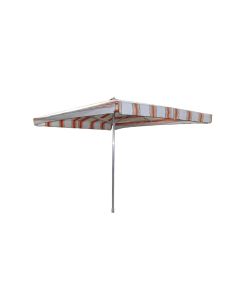
Market umbrella h757_50 with resin-coated acrylic canopy (300 x 400 cm). "Base" model ideal for those seeking protection from humidity and practical use at low costs. Equipped with a 55 mm pole and pulley system.
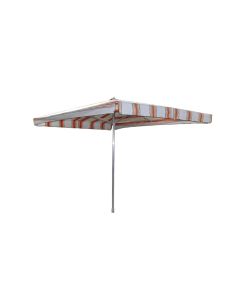
Professional umbrella h757_49 for street vendors (320 x 440 cm). Equipped with resin-coated acrylic fabric for superior protection against rain, it combines practicality and resistance at affordable costs.
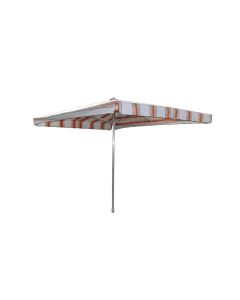
Professional umbrella for street vendors h757_48 with large cotton-polyester fabric (375 x 485 cm). “Base” version designed to offer a wide coverage area with maximum practicality and a limited investment.
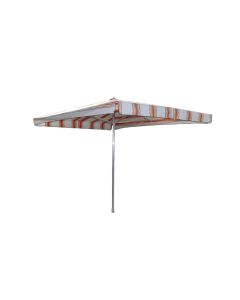
Professional extra-large market umbrella h757_52 for street vendors (375 x 485 cm). Equipped with resin-coated acrylic fabric for high protection against rain.
Market umbrellas represent the primary infrastructural element for street vendors, local markets, and open-air fairs, acting as real tools for protection and delimitation of the sales space. These structures must guarantee superior chemical-physical resistance compared to common garden models, as they are subjected to continuous cycles of assembly, disassembly, transport, and mechanical tension in variable weather contexts. The choice of a professional covering system directly affects the safety of the work area, the preservation of displayed goods, and the thermal comfort of the operator during daily business hours.
The evolution of materials has allowed the development of solutions that combine maximum structural robustness with low specific weights, facilitating logistical operations without compromising the overall stability of the installation. Investing in professional coverings means opting for products engineered to resist wind stress, the degrading action of ultraviolet rays, and wear from dynamic friction. Every component, from the joining hardware to the opening system, is designed to minimize downtime and ensure operational continuity in any season of the year.
The adoption of professional market umbrellas responds to specific needs for structural stability and prolonged protection that residential covering systems cannot satisfy in any way. The mechanical stresses to which a covering device is subjected during itinerant trade require support poles with increased thickness and reinforced ribs capable of absorbing the dynamic loads imposed by sudden wind gusts. The stability of the point of sale is not only a factor of commercial continuity but represents a fundamental requirement for the safety of customers and personnel operating under the cover, avoiding dangerous tipping or structural failure.
Another crucial aspect lies in the intrinsic quality of the fabrics used, usually treated heavy cotton or solution-dyed acrylic, treated to be completely water-repellent, anti-mold, and resistant to solar fading. This level of protection preserves the integrity of the underlying goods, whether they are perishable food products that need constant shade to limit temperature rise, or clothing items that would suffer from the fading action of direct light. The modularity and speed of the opening and closing mechanisms also allow for optimizing the setup times of the stall, reducing the physical fatigue of the operator at the start of the working day.
The landscape of coverings for itinerant trade is mainly divided based on the geometry of the structure and the type of materials used for the frame, distinguishing central pole models from side arm models. Anodized aluminum central pole umbrellas constitute the reference standard for the itinerant market thanks to their perfect weight balance and extraordinary lightness during manual handling. There are variants with shafts in wood treated for outdoor use, often preferred in historic markets or contexts of architectural prestige where aesthetic impact and visual tradition play a decisive role in enhancing the corporate brand and the displayed goods.
Configurations further differ based on the shape of the cover, which can be square, rectangular, or round, allowing for the perfect geometric matching depending on the length of the display counter and the space assigned by the municipal pitch. Models equipped with a peripheral valance offer an additional surface useful for channeling rainwater and for the possible application of identifying signs, while versions with a top wind vent significantly reduce the sail effect, allowing air currents to flow upwards without lifting the load-bearing structure from its ground anchors.
The selection of the ideal covering must be based on the geometric analysis of your sales counter and the prevailing climatic conditions in the geographical area where you usually operate. A frequent error consists in underestimating the pole section and the thickness of the internal ribs, opting for products that are too light and risk bending or breaking at the first moderate adverse weather stress. It is essential to verify the compatibility between the useful height of the shaft and the dimensions of the transport vehicles used for daily logistics, ensuring that the dimensions of the closed umbrella allow for easy and friction-free storage inside the commercial van.
The weight and type of the anchoring base represent the second critical selection factor, as the safety of the entire installation depends on the correct calculation of the ballast in relation to the sail surface of the upper canvas. For use on public ground, it is recommended to use concrete bases or cast iron ballasts equipped with transport handles, having a weight proportional to the span of the umbrella, avoiding the use of improvised or non-certified supports. The choice of fabric must instead follow the nature of the goods handled, preferring breathable yarns for food stalls and total waterproofing fabrics for the protection of electronic equipment or paper goods.
The use of covering structures on public ground is strictly regulated by municipal trade plans and by hygiene and safety regulations at work in force at national and European levels. The textile materials used must meet precise fire reaction requirements, especially in contexts where the covering is positioned near heat sources, mobile kitchens, or cooking plates for the administration of food and beverages. Compliance with fire safety regulations must be certified by specific documentation issued by the manufacturers, which the operator is required to show in case of checks by the supervisory authorities or local police.
From the perspective of static safety, the installer has the responsibility to ensure that the umbrella is firmly anchored to prevent injury to third parties or damage to neighboring properties, in compliance with civil liability provisions. In historic centers or areas subject to landscape constraints, municipalities often impose strict chromatic and dimensional requirements to preserve urban decor, prohibiting the use of clashing colors or invasive commercial logos. Checking the local regulations of your area of competence beforehand avoids the imposition of administrative sanctions and ensures the visual harmonization of your point of sale with the surrounding context.
Explore all the products in the category and compare the available solutions to find the one best suited to your operational context.
Solution-dyed acrylic fabric of at least 300 grams per square meter offers maximum resistance to solar degradation and continuous mechanical tearing. For food stalls, heavy water-repellent cotton canvas is also excellent as it promotes natural thermal breathability, reducing heat accumulation underneath.
The calculation of the ballast depends on the canvas surface and the average exposure to winds in the work area. For a standard three-meter by three-meter model, at least forty or fifty kilograms of base are needed, distributed on stable cast iron or concrete supports to guarantee static stability.
In the presence of wind gusts exceeding thirty kilometers per hour, it is mandatory to proceed with the prompt closing of the canvas to eliminate the sail effect of the structure. The dynamic forces generated by strong wind can lift the umbrella from the ballasts, causing serious damage to people and surrounding goods.
Anodized aluminum offers unbeatable structural lightness that facilitates daily assembly and disassembly without requiring excessive physical effort from the itinerant operator. Furthermore, aluminum does not need periodic protective painting treatments and is not affected by constant humidity resulting from contact with wet ground.
Professional manufacturers offer a wide range of standard colors to satisfy the urban decor guidelines imposed by various historical municipal regulations. It is fundamental to choose neutral tones such as white, cream, or dove gray to avoid administrative sanctions during the occupation of public ground.
Maintenance involves periodic washing of the canvas with lukewarm water and neutral soap, avoiding aggressive chemical detergents that could remove the superficial water-repellent treatment. Before storing the structure in the transport vehicle, the fabric must be completely dried to prevent the formation of destructive mold.
 English
  Italian
 French
 German
 Spanish