
mon-fri 9-13 / 14.30-18.30
In the dynamic sector of street vending, trade shows, and seasonal events, the sales station represents the primary interface between the exhibitor and the end consumer. Choosing the right professional market tables isn't simply a matter of purchasing a temporary support surface; it's a logistical and strategic investment aimed at maximizing merchandise display, optimizing set-up times, and ensuring maximum operational safety. Those who operate in local markets and traveling trade shows are faced daily with continuous cycles of assembly, disassembly, stowage, and transportation within commercial vehicles, as well as having to deal with heavy static loads and the corrosive effects of external weather. This purchasing guide was created to help you choose the various models in our online catalogue on Holity.co.uk, analysing the structural characteristics of the metal frames, the durability of the covering materials and the precise millimetric parametric constraints required to configure an efficient and compliant sales counter.
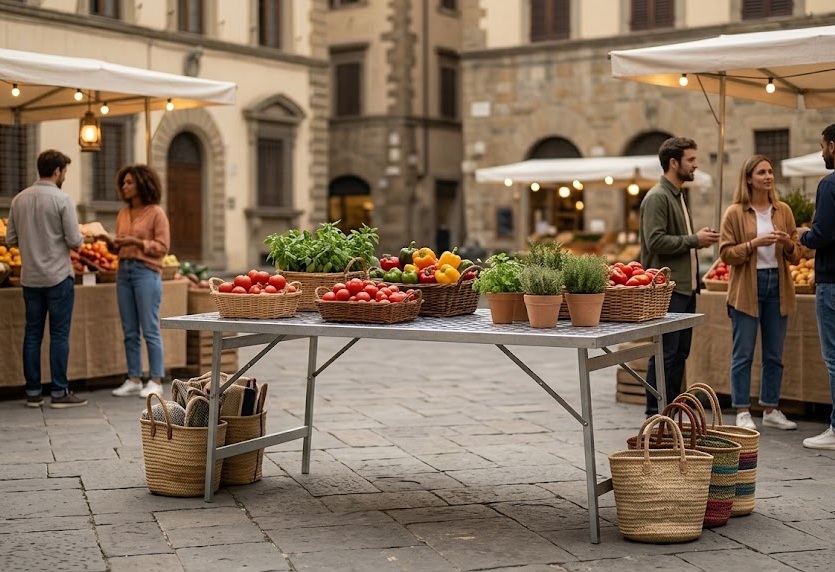
In the panorama of street vending equipment, folding tables and counters are divided into macro-engineering categories developed to meet specific needs in terms of load capacity, lightness and geometric reconfiguration of the space.
They represent the classic and most solid configuration par excellence, designed to withstand massive concentrated loads without undergoing bending or structural deformations.
Advantages: Compass structures in high-strength steel offer unsurpassed mechanical stability. The integrated locking system allows the legs to fold in parallel under the spreading surface, reducing the walkable storage depth to just a few centimetres. Hot-dip galvanising treatments protect the metal from deep rust caused by rain or night-time humidity.
Disadvantages: The dead weight of the module is higher than the all-aluminium variants, requiring greater physical strength during manual handling.
Ideal for: Sellers of heavy textiles, footwear, hardware, homeware and busy local markets.
Modern display systems focused on maximum logistical agility, designed for operators whose operational core is speed of movement and lightness.
Advantages: The low specific weight of extruded aluminium alloys greatly facilitates the loading and unloading phases from vans, reducing muscle fatigue for the street vendor. Aluminum is naturally immune to oxidation and maintains a clean, professional line over time with minimal structural maintenance.
Disadvantages: Distributed static load capacity slightly lower than heavy reinforced steel variants.
Ideal for: Craft fairs, collectibles, costume jewelry, promotional gadgets, flower and nursery exhibitions and temporary markets.
Flexible systems made up of structural modules designed to be coupled linearly using quick mechanical coupling hooks.
Advantages: They allow the linear development of the display window to be expanded depending on the space allowed by the municipal parking lot or the layout of the fair. They guarantee perfect continuity of the sales floor without creating geometric differences in level or dangerous interruptions for the merchandise.
Disadvantages: They require careful planning of the modules during transport to cover the entire linear square footage required.
Ideal for: Large contract clothing counters, stockists, trade fairs and large multifunctional display counters.
To configure a high-performance, customer-safe and long-lasting mobile sales point, it is essential to set the search parameters by analyzing the millimetric dimensional cursors and the configuration metrics provided by our technical panel.
The operational ergonomics of the mobile vendor directly influences the musculoskeletal health during work shifts that vary from 6 to 10 continuous hours in an upright position. Our catalogue offers advanced structural flexibility, including models equipped with telescopic legs or click-type height adjustment systems that allow you to set theheight in millimeters from a minimum of 630.00 mm up to a maximum of 800.00 mm. This geometric excursion allows you to compensate for typical unevenness in the road surface (uneven asphalt, slopes of historic squares or sidewalks) and to align the display surface at the ideal visual and interaction height for the customer.
The width of the table defines the horizontal extension of the sales window and the frontal storage capacity of the products. The dimensional options available in our store cover a **width in millimeters between 1500.00 mm and 2000.00 mm**. Choosing the correct width allows you to optimize the positioning of modular baskets, clothing stands or vertical displays, fitting perfectly within the standard volumes of gazebos or market tents (usually modules of 2, 3 or 4 meters of street frontage).
Depth determines the floor space available for deep-level merchandise placement and operator accessibility behind it. Our range offers flexible solutions with **depths in millimetres ranging from a minimum of 600.00 mm up to a maximum of 1200.00 mm**. Narrow 600 mm formats are excellent as side counters or for confined aisle display areas, while extended depths of up to 1200 mm maximise the display of loose or bulky goods, allowing customers a panoramic and close-up view of the products.
Cost rationalisation is a key pillar of profitability for small businesses and mobile traders. Our online catalog guarantees access to high-performance professional contract solutions within a flexible price range ranging from €81.00 to €121.00. This financial planning allows you to equip your street food business with stable, certified equipment that is resistant to daily wear and tear with a targeted budget that can be amortized in just a few months of operation.
Market tables intended for professional use in public areas must meet strict construction standards to prevent accidental injuries. Stable mechanical frames must pass static and dynamic load tests to ensure that the structure's center of gravity does not alter in the event of lateral impacts due to crowds of customers. For operators in the food sector (fruit and vegetables, delicatessen, cheese and cured meats), the support surfaces – whether made of high-density polyethylene (HDPE) or treated melamine wood – must be perfectly smooth, water-repellent, free of internal porosity and compliant with **HACCP** hygiene and health guidelines. This material standard ensures that the surfaces do not absorb organic liquids or humidity and can be quickly sanitized using common sanitizing detergents at the end of the local market.
Food trade, fruit and vegetables and fresh produce: In this sector where hygiene and frequent chemical washing are mandatory, the use of tables with a galvanized steel frame and high-thickness washable polyethylene tops is recommended. They must tolerate the constant humidity of vegetable crates or the weight of fresh produce, ensuring 100% sanitizable surfaces.
Clothing, Textiles, Leather Goods and Homeware: The priority in this scenario is linear development and resistance to continuous static loads. The optimal configuration includes market tables with a maximum width of 2000 mm and a depth increased to 1200 mm, equipped with central geometric reinforcements under the top to support massive stacks of fabrics or heavy boxes without undergoing central curvature.
Craft, Antiques and Promotion Fairs: For exhibition contexts in which visual impact and ease of transport prevail over industrial loads, the ideal choice is lightweight aluminum models with a width of 1500 mm and a depth of 600 mm or 800 mm. They are very quick to assemble without the use of tools and offer a sober and tidy aesthetic that can be easily concealed with customized display covers.
Raise the display standards of your mobile business, protect the safety of your goods and optimise the daily assembly and dismantling of your trade fair stands. On Holity.co.uk we offer you a technical and select assortment of market tables and folding stalls for street vendors, designed to combine long-lasting mechanical stability with maximum lightness of transport.
Use our lateral navigation sliders to set the millimetric height suitable for your height and select the perfect widths and depths for the layout of your tent or gazebo. Do you represent a municipal administration for the setting up of institutional covered markets, do you manage a trade association or do you need a multiple supply for large events? Contact our customer service today to receive complete technical data sheets, personalized quotes and all the sales assistance you need for your mobile sales project.
How does the automatic locking system work on compass market tables and what advantages does it offer in terms of accident prevention?
Professional compass market tables use articulated steel mechanisms equipped with automatic locking pins or constrained sliding guides with an internal return spring. When the legs are opened and reach the geometric angle of maximum extension, the pin automatically inserts itself into a stabilised locking slot. This "tool-free" mechanism eliminates mechanical play and prevents accidental closing of the frame if the table is subjected to strong horizontal thrusts or lateral impacts from the crowd during peak market hours.
How does the width dimension (from 1500 mm to 2000 mm) affect the structural deflection and the distribution of static loads on the surface?
The bending resistance of a market table is linked to the interaxial distance between the vertical support uprights. In the compact 1500 mm wide models, the bending moment induced by the weight of the goods is naturally limited. In the extended 2000 mm variants, to prevent central warping of the top (plastic deformation), the professional counters integrate longitudinal reinforcement stringers welded under the surface or diagonal vector-relief crosspieces. This allows heavy static loads to be evenly distributed along the entire axis of the table.
Why is hot-dip galvanizing treatment of steel frames technically superior to common liquid painting for outdoor market furniture?
Hot-dip galvanizing is a metallurgical process that involves immersing the steel frame in a bath of molten zinc at approximately 450°C. This treatment creates an indissoluble intermetallic bond that shields the steel both externally and internally of the hollow tubes. Compared to traditional paint, which risks chipping or scratching during the constant impacts of transport in vans, triggering latent rust, zinc acts as a sacrificial anode: it perfectly resists mechanical abrasion and protects the frame from corrosion triggered by rain, salt or fog.
How does height adjustment (630.00 mm - 800.00 mm) affect the dynamic center of gravity of the table when it is set up on uneven urban pavements?
Varying the height of the support surface modifies the geometric dimension of the center of gravity of the system (table + displayed goods). Setting the minimum height to 630.00 mm lowers the center of gravity, increasing the intrinsic stability of the counter against tipping, a configuration recommended when displaying very heavy items or on days with strong gusts of wind. The maximum extension to 800.00 mm raises the center of gravity but optimizes visual ergonomics; Thanks to the independent adjustable feet, it is possible to compensate for the slopes of roads or cobblestones to the millimetre, keeping the surface perfectly level and preventing products from slipping.
How does the useful depth of the table (from 600.00 mm to 1200.00 mm) influence the logistical optimisation inside a standard commercial van?
The geometric planning of the counter depth is a discriminating factor for transport logistics. The modules with a depth of 600.00 mm or 800.00 mm, once folded like a book, have a reduced lateral footprint that allows them to be stowed vertically along the internal walls of medium-sized vans (short wheelbase), leaving the central aisle free for cargo boxes. The maxi variants with a depth of 1200 mm offer a huge display surface on the road but require long wheelbase or box vans, being usually stored horizontally on dedicated platforms or industrial racks to optimise loading volumes.
 English
  Italian
 French
 German
 Spanish