Buying Guide: How to choose changing room benches for gyms, swimming pools, schools and company changing rooms
When designing and renovating changing rooms in gyms, swimming pools, sports centres, spas, schools, hospitals, barracks and industrial plants, changing room benches represent a fundamental element for ensuring functionality, order and comfort during changing clothes. Seats intended for collective environments must be selected considering frequency of use, mechanical resistance, exposure to humidity and compatibility with cleaning procedures. TheHolity.co.uk catalog includes linear benches without backrests, models with back support and shoe racks, double-sided benches for the center of the room, wall-mounted configurations, and structures complete with coat hangers and hat racks. Models are available in painted steel, galvanized steel, stainless steel, beech wood, veneered wood, HPL, and PVC, as well as accessories such as footrests and wall-mounted coat racks. This purchasing guide analyzes construction types, space sizing, materials, functional accessories, regulatory requirements, and price ranges to help sports facility managers, RSPPs, school principals, and designers choose the most suitable setup.
1. Structural Configurations: Simple Benches, with Backrest, Double-Sided and with Coat Hangers
The layout of the changing room, the available surface area and the number of users using the rooms at the same time determine the most functional bench configuration:
Simple Benches Without Backrest: They represent a versatile solution for changing rooms of different sizes. They can be placed along the walls, in front of the lockers or in a free-standing position, as long as there is adequate passage space. The absence of the backrest reduces the overall size of the structure and, when the layout allows it, allows access to the seat from both sides.
Benches with Backrest: Equipped with slats or rear panels, they offer additional support during dressing operations. Configurations in wood, metal and PVC are available, even complete with shoe racks. They can be useful in changing rooms used by elderly people or people with reduced mobility. For specific accessibility needs, it is also necessary to evaluate seat height, stability and any supports to facilitate transfer and getting up.
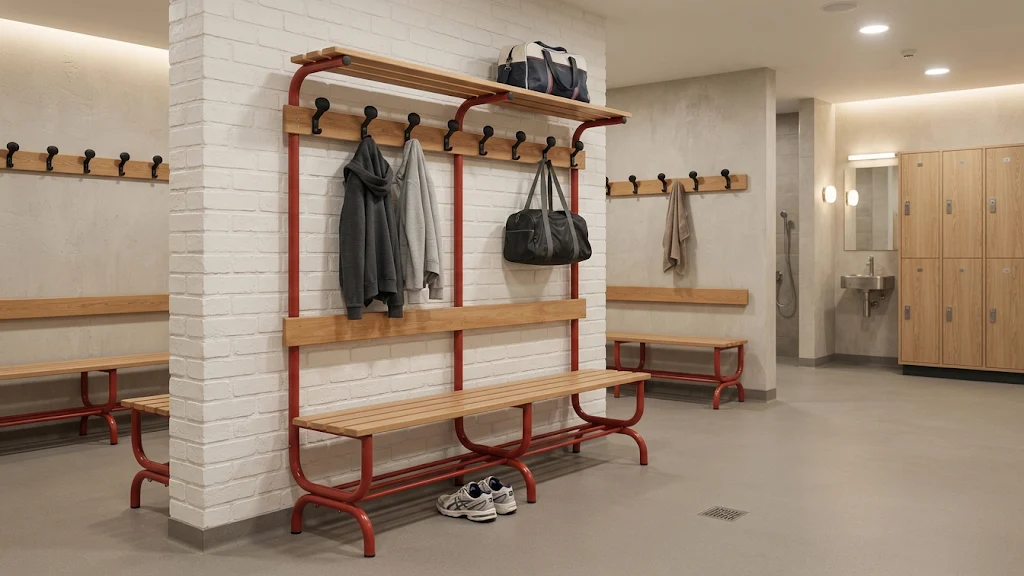
Double / Double-Sided Benches (Front-Back Seat): They have two opposing seating surfaces, generally supported by a central structure. They are designed for installation in the centre of the room and allow the use of both sides of the bench. Some models integrate backrests, coat hangers, shoe racks and upper shelves. The increased seating capacity must be evaluated also considering the depth and surrounding circulation spaces.
Benches with Integrated Coat Hangers and Hat Rack vs. Separate Wall-Mounted Coat Racks:
Structures with Backrest and Coat Hangers: They integrate vertical uprights, coat hooks and, depending on the model, an upper hat rack for storing bags, backpacks and clothes. The Holity catalog features configurations with overall heights of 185 and 190 cm. They represent a functional solution for organizing users' personal belongings, without replacing lockers when necessary.
Freestanding Bench + Wall-Mounted Coat Rack: Allows you to organize the seat and clothing items separately. Holity offers 100 and 200 cm coat racks, also equipped with hat racks. The installation height must be determined by the age group of the users, accessibility, and the characteristics of the supporting wall.
2. Sizing, Modularity and Ergonomics of Spaces (Length, Depth and Height)
The sizing of the benches must take into account the number of users, the layout of the lockers, the maneuvering spaces and the circulation and evacuation needs of the changing room:
Lengths Available in the Catalogue:
Compact Models (35 - 103 cm): The Holity catalogue includes 35 cm individual seats and 70, 80, 100 and 103 cm benches, suitable for small changing rooms, clinics, service rooms and small spaces.
Intermediate Models (120 - 150 cm): They include simple and accessorised benches of 120, 130 and 150 cm, which can be used in school changing rooms, gyms and corporate environments.
Extended Models (200 - 250 cm): 200 cm configurations and 250 cm structures are available, also complete with backrest, coat hanger and shoe rack. They can be used in the changing rooms of sports teams, swimming pools and large companies. The actual number of seats depends on the width available for each user.
Seat Height: The Holity catalogue includes benches with seat heights of approximately 40, 43, 44, 45, 48 and 50 cm . The choice must take into account the height, age and motor skills of the users. The dimensions provided by UNI EN 1729 for school chairs and tables do not constitute a universal requirement for all changing room benches. For structures intended for children, seats specifically sized for the intended age group must be identified.
Depth and Calculation of the Passage Lanes: The single benches available in the catalogue have, depending on the model, depths of approximately 30, 35, 37, 40, 42, 45 and 50 cm, as well as deeper configurations. Double-sided structures generally require more space. The width of the aisles must be evaluated in relation to the arrangement of the furniture, the opening of the locker doors, accessibility needs and the requirements of the escape routes. There is no universal minimum distance applicable to all changing rooms.
3. Comparison of Construction Materials: PVC, Steel, Solid Wood and Laminate
The humidity level of the environment, the frequency of use and the cleaning and disinfection procedures influence the choice of construction material:
Resin and PVC: PVC benches represent a particularly interesting solution for swimming pools, wellness centres, beach resorts and wet changing rooms. The Holity catalogue includes PVC models with a simple seat, backrest and shoe rack, as well as wall-mounted configurations that combine resin and AISI 316 stainless steel. The plastic materials used can offer reduced water absorption and good resistance to humidity. Resistance to chlorine, detergents, high temperatures and any antibacterial or fire-reaction properties must be verified in the individual product documentation. Washing methods must also comply with the manufacturer's instructions.
Painted, Galvanized and Stainless Steel: Many Holity benches feature load-bearing structures in painted tubular steel, combined with seats in wood or other materials. Configurations in galvanized steel with epoxy paint and models with AISI 304 or AISI 316 stainless steel structures are also available. The mechanical resistance and corrosion characteristics depend on the type of steel, surface treatments and conditions of use. The maximum load capacity must be verified in the technical data sheet of the selected model.
Solid Beech Wood: Used for the construction of seats, backrests, hat racks and footrests, beech offers a natural-looking surface and good mechanical resistance. The slats can have rounded edges and protective finishes. To preserve the characteristics of the wood, it is necessary to use compatible detergents, avoid prolonged stagnation of water and periodically check the integrity of the surfaces.
Melamine Wood and HPL Laminate: Holity offers benches in melamine wood, also obtained from recycled material and subjected to water-repellent treatments. Models with HPL laminate seats and stainless steel structure are also available. These materials offer different aesthetic and functional possibilities for professional changing rooms. Resistance to humidity, scratches and disinfectant products depends on the characteristics of the panel, the finishes and the edges.
4. Functional Accessories: Integrated Shoe Rack, Footrests and Coat Hooks
The presence of dedicated accessories allows you to better organize clothes, footwear and personal effects inside the changing room:
Integrated Shoe Rack / Lower Shoe Rack: Positioned under the seat, it can be made using metal tubes, slats or other support elements. It allows you to neatly store sports shoes, work shoes and slippers, helping to keep passageways clear. The height of the shoe rack and the space available for cleaning the floor vary according to the model.
Wooden Footrests: The Holity catalogue includes 100 and 200 cm beech wood footrests, which can be combined with the changing room benches. They offer a raised support surface above the floor. For use in humid environments, it is necessary to check the suitability of the material, the stability of the footrest and the grip characteristics. The footrests must be cleaned and maintained regularly and do not replace infection prevention procedures in collective environments.
Coat Hooks and Support Feet: Models with coat hangers can integrate hooks in PVC, metal or other materials, with different geometric configurations. Some benches have adjustable feet, rubber tips, or scratch guards , which are useful for improving stability, limiting noise, and protecting the floor. The possibility of adjusting the height of the supports and the characteristics of the hooks should be verified for each model.
5. Investment Evaluation Criteria and Layout Planning
The cost of changing room benches varies depending on the size, materials, configuration and accessories included. The Holity catalogue includes seats starting from approximately €78 + VAT and professional configurations that can exceed €1,000 + VAT. Prices are indicative and subject to updates:
Essential Solutions (Indicative range €75 - €150 + VAT): Includes individual seats, compact benches without backrests in veneered wood and some models with a steel structure and wooden seat. Accessories such as beech footrests and coat racks with hat racks are also available in this range. These are solutions to be considered for small company, school and sports changing rooms.
Intermediate Solutions with Accessories (Indicative range €150 - €300 + VAT): Includes steel and beech benches, models with backrests and shoe racks, configurations in veneered wood and benches in PVC for humid environments. Longer solutions and double-sided models are also available, depending on the construction characteristics.
Complete and Contract Solutions (Indicative range over €300 + VAT): Includes benches equipped with coat hangers, hat racks and shoe racks, double-sided configurations for the centre of the room, wall-mounted models and professional solutions in stainless steel and HPL. The catalogue includes 200 cm double benches with full accessories starting from around €945 + VAT and AISI 304 stainless steel configurations with HPL seats starting from approximately €1,002 + VAT. For multiple supplies, it is also advisable to consider the costs of transport, assembly and any fixings.
Request a personalised quote on Holity.co.uk
Organise the changing rooms in your facility with the changing room benches available on Holity.co.uk. Explore the online catalog to find the setup best suited to your spaces: compare the available lengths, from 35 cm individual seats to 250 cm structures, evaluate the presence of a backrest or the double-sided configuration for the center of the room and choose between PVC, painted steel, stainless steel, beech, melamine wood and HPL. Complete the setup with compatible shoe racks, coat hangers, hat racks and footrests.
Request a personalized quote: contact our sales office to receive information on dimensions, materials, available configurations, technical data sheets, any compliance documentation and the commercial conditions applicable for multiple supplies.
Frequently Asked Questions
What is the practical difference between a backless, backed, and double-sided bench?
The backless bench is compact and takes up less space in depth: it is designed to be placed directly against the locker room walls or in front of the lockers, using the wall as a support. The bench with a backrest offers ergonomic back support and is essential when the seat is positioned away from the walls or in areas frequented by the elderly or those undergoing rehabilitation. The double bench integrates two opposing seats with a shared central backrest: it is designed to be placed in the center of large locker rooms, doubling the seating capacity with the same linear length.
What material is best for changing rooms in swimming pools, spas, or high-humidity environments?
For environments saturated with steam, splashes of water, chlorine, and chemical detergents (swimming pools, wellness centers, shower areas, food processing plants), the material of choice is non-toxic PVC resin. Benches made entirely of PVC are 100% waterproof, rust-proof, rot-proof, inhibit bacterial growth, and can be cleaned directly with high-pressure washers. In dry or well-ventilated environments (traditional gyms, schools, offices), painted steel frames with solid beech wood or melamine-faced slats are ideal.
What is the purpose of the integrated shoe rack and footrests in the changing room?
The shoe rack beneath the seat keeps shoes off the floor and neatly organized at each station, freeing up walkways and preventing dirtying of walkways. Footrests (made of beech wood or draining PVC) should be placed in front of the benches or at the shower exit: they insulate bare feet from wet or cold floors, provide a secure, non-slip grip, and reduce the risk of foot fungus.
What are the standard dimensions (length, height, depth) for properly furnishing a changing room?
The standard seat height is between 40 and 45 cm (compliant with the UNI EN 1729 ergonomic standard for adults and children), while the depth varies between 35 and 42 cm for single models (70-85 cm for double-sided models). The most common modular lengths are 100 cm (2-seater), 150 cm (3-seater), and 200-250 cm (4-5-seater). When setting up, always leave a clear path of at least 100-120 cm in front of the bench to allow for easy passage and the opening of locker doors.
What is the difference between solid beech wood slats and veneered wood panels?
Solid beech wood offers a warm, luxurious, and visually striking natural aesthetic, ideal for exclusive sports clubs and executive locker rooms. However, it requires greater attention to water retention and regular maintenance of the protective finish. Engineered wood is made from panels coated with highly resistant melamine resin: it is more affordable, highly resistant to scratches and humidity, available in various color finishes, and very easy to clean on a daily basis.
What features should benches for corporate and industrial changing rooms have?
Benches for corporate and industrial locker rooms must offer stability, resistance to frequent use, and ease of cleaning. Models with a painted steel frame and wooden seat are suitable for dry environments, while PVC or stainless steel benches are particularly suitable for humid environments. Shoe racks, coat hangers, and adjustable feet can improve space organization and facilitate daily maintenance.

 English
 Italian
 French
 German
 Spanish