
mon-fri 9-13 / 14.30-18.30
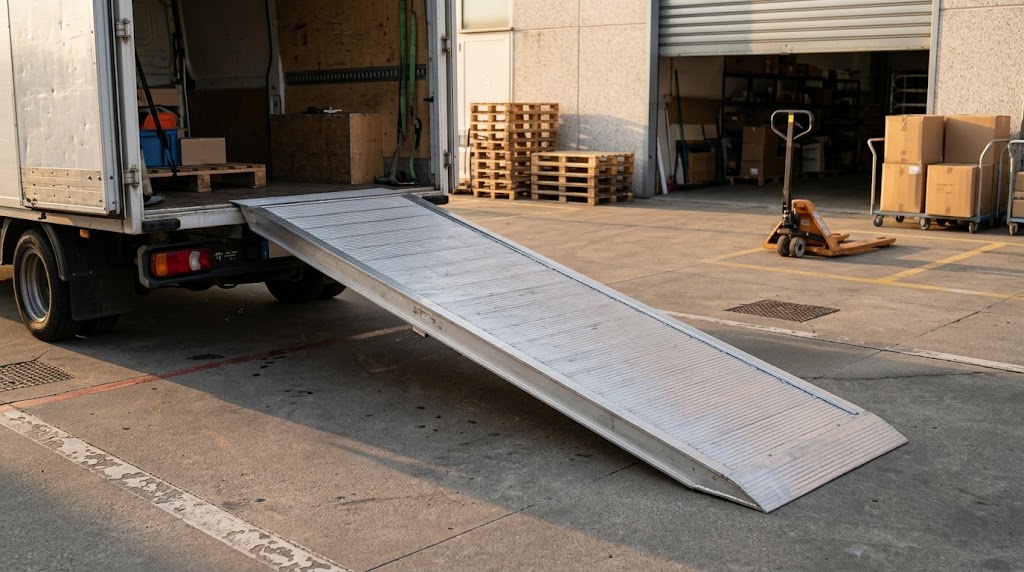
In the logistics, transport, removals, distribution, and professional goods handling sectors, the connection between the support surface and the loading platform of vans, trucks, or other raised surfaces is an important element in making loading and unloading operations easier and safer. Professional loading ramps allow you to overcome differences in level with manual pallet trucks, hand trucks, and equipment equipped with rubber wheels, reducing the need to manually lift loads and making daily tasks easier for operators. Aluminum ramps combine good load capacity with low weight, making them easy to position, remove, and store when not in use. The Holity.co.uk catalogue offers professional ramps and loading platforms with a capacity of up to 1000 or 2000 kg, available in configurations with or without side edges. This purchasing guide analyses the main aspects to evaluate, from the length and slope of the ramp to the capacity, the shape of the platform and the anchoring system, to help you identify the model best suited to your operational needs.
The ramp length should be selected according to the height difference to be overcome and the intended operating conditions. A ramp that is too short in relation to the loading height creates a steeper incline, which can make loading and unloading with pallet trucks, trolleys and other handling equipment more difficult.
Slope (%) = (Height difference ÷ Horizontal distance) × 100
To calculate the horizontal distance required for a given slope:
Horizontal distance (cm) = (Height difference (cm) × 100) ÷ Desired slope (%)
Example: to overcome a height difference of 60 cm with a 30% slope, a horizontal distance of 200 cm is required. The actual length of the inclined ramp is slightly greater, at approximately 209 cm. It is therefore advisable to choose a ramp of an appropriate length and always check the dimensions, load capacity and operating conditions specified by the manufacturer.
The presence or absence of side edges is one of the main elements to consider when choosing a loading ramp, because it affects the freedom of movement of the forklift and lateral containment during transit:
The capacity represents one of the fundamental parameters in the choice of a professional ramp and must be verified on the technical data sheet of the individual model, also considering the conditions under which the load is applied:
The efficiency and practicality of a professional ramp also depend on the characteristics of the structure, the transit surface and the system used to connect it to the loading platform:
The range available on Holity.co.uk includes professional aluminium loading ramps and platforms with prices which, at the time of verification, are approximately between €703.50 and €1,053.00 + VAT. Prices may vary over time and it is therefore advisable to always check the updated value directly in the product sheet:
Make the loading and unloading operations of your business more efficient by choosing a professional loading ramp suited to the characteristics of the vehicles and equipment used. In the Holity.co.uk catalogue you can compare aluminium models with or without side edges, capacity of 1000 or 2000 kg and different sizes, identifying the most suitable solution based on the height difference, the width of the trolley and the expected handling methods.
Are you a logistics manager, a transport company, a mover, a business or do you need to manage professional supplies for public bodies and structures? Request a personalized quote: the Holity team can support you in checking the technical characteristics of the available models and in choosing the ramp best suited to your specific loading, sizing and usage needs.
How do you calculate the correct length of a loading ramp to avoid excessive slopes?
The percentage slope is calculated by dividing the difference in height by the horizontal development and multiplying the result by 100. To determine the necessary development, you can then multiply the difference in height by 100 and divide it by the desired slope. For example, with a difference in height of 75 cm and a 30% slope, the horizontal development is equal to 250 cm. The actual length of the inclined ramp is slightly greater, approximately 261 cm. The value obtained must however be compared with the technical specifications of the ramp and the equipment used.
When is it appropriate to choose a ramp "with edges" rather than one "without edges"?
Ramps with lateral edges are recommended when greater lateral containment of the wheels of manual pallet trucks, trolleys and other rubber-wheeled equipment is desired. The versions without edges, on the other hand, offer greater freedom of lateral movement and may be more practical when the dimensions of the trolley require a surface without raised elements. In both cases, it is important to check the useful width of the platform in relation to the equipment used.
What is the difference between static and dynamic load capacity on a loading ramp?
The static load capacity generally refers to a load applied without movement, while during transit additional stresses may occur due to acceleration, braking, vibrations and weight distribution. However, if the ramp's technical data sheet does not expressly distinguish between static and dynamic load capacity, it is not correct to independently assign this classification. For Holity models, it is necessary to refer to the nominal load capacity indicated in the technical data sheet and the relevant reference pitch, which for several products is equal to 1000 mm.
Is it possible to use standard aluminium ramps to load machines with steel tracks?
The use of vehicles with metal tracks should not be taken for granted on standard aluminium ramps. Steel pads can exert concentrated loads and damage the surface of the platform. Before using a ramp with tracked vehicles, it is therefore necessary to expressly check the technical documentation for compatibility with this type of equipment and, in the absence of specific indications, request confirmation from the supplier.
How do you lock the head of the ramp to the vehicle floor to prevent it from slipping?
Several models in this category use an anchoring system with an aluminum tongue that can be moved across the width of the platform and rotated at the head. The tongue must be positioned correctly on the support surface following the manufacturer's instructions. The closing caps on some models also help prevent the tongue from accidentally slipping out. Before moving the load, it is always necessary to check the stability of the ramp and the support point.
How does the price range (€703.50 - €1,053.00 + VAT) correlate with the technical characteristics of the ramps?
The price varies mainly according to the capacity, size and configuration of the ramp. In the initial range of the catalogue, there are mainly models with a capacity of 1000 kg, available with or without edges and in various widths and lengths. As the price increases, ramps with a capacity of up to 2000 kg and structures sized for more demanding handling needs are also available. The prices shown are those recorded at the time of verification and are subject to change: it is therefore advisable to always check the individual product sheet before purchasing.
 English
 Italian
 French
 German
 Spanish