
mon-fri 9-13 / 14.30-18.30
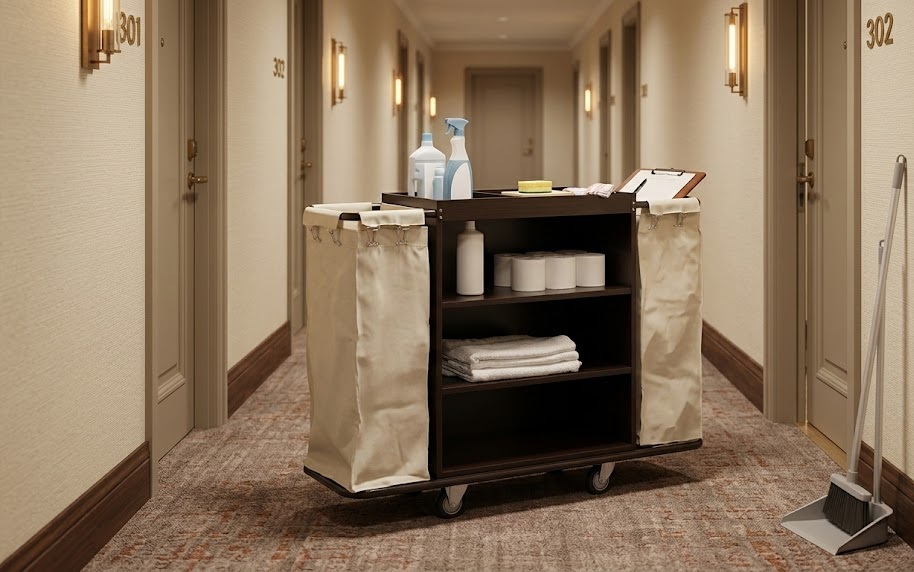
Managing flat and bathroom linens—including collecting soiled items, washing them and distributing clean items to rooms—is one of the most delicate parts of daily work in hotels, B&Bs, resorts, nursing homes and laundries. Are you wondering how to speed up the work of your housekeeping staff, protect the health of workers and offer impeccable service to your guests? A professional laundry cart is not a simple container on wheels, but a real mobile workstation, designed to reduce physical effort and maintain high hygiene standards.
We at Holity specialize in the supply of laundry carts and equipment for hotels and professional laundries: we understand the practical needs of cleaning departments and are ready to help you choose the perfect solution for your facility. In this guide, we'll guide you through practical questions and answers to help you discover the most suitable models. And when you're ready to configure your supply, in the laundry cart catalog on Holity.co.uk you'll find a wide range of solutions ready to adapt to your spaces and workflows.
To choose the right cart, the first step is to analyze the number of rooms or departments to be served in a single shift and the width of corridors and elevators:
Do you manage a small facility, a B&B, or a boutique hotel with just a few rooms per floor?
Opt for compact and easy-to-handle carts with single bags or narrow shelves. They take up very little space in corridors and pass easily through service elevators, still allowing you to serve 4 to 8 rooms before having to unload the linen.
Do you work in a medium or large hotel, a holiday village or a nursing home?
Opt for high-capacity multi-bag trolleys or integrated housekeeping models. They allow you to tidy between 10 and 15 rooms in a single trip, having double or triple supports for collecting used towels and bed linen separately, or for allocating a bag for the room's rubbish.
The type of operation to be carried out determines the internal configuration of the trolley:
Do you only need to collect dirty linen?
The best choice is a simple bag trolley or a laundry basket (which can also be folded to save space in warehouses). In internal laundries and large departments, high-depth baskets with spring-loaded movable bottoms are unbeatable: the internal shelf automatically raises or lowers based on the weight of the load, keeping the laundry always at hand height and avoiding annoying back pain for workers.
Do you need to manage the distribution of clean laundry and the collection of dirty laundry at the same time?
Do you need a multifunctional housekeeping trolley. The central shelves will hold clean, neatly folded sheets and towels, while the external bag holders will isolate used garments, eliminating the risk of cross-contamination in compliance with hygiene and health and HACCP regulations.
The choice of frame directly affects weight, silence and resistance to chemical agents:
Stainless Steel (Inox): It is the choice of choice for high humidity environments (internal laundries, spas, swimming pools) or in hospital settings. It guarantees total resistance to rust and can be disinfected even with aggressive chemical products.
Aluminium and Light Alloys: They combine the high strength of steel with an extraordinary lightness of push, ideal for reducing fatigue during long and extended work shifts.
Polypropylene and Technical Polymers (Hard Plastic): Extremely silent during movement in hotel corridors, they resist impacts without denting the walls and often offer a modular structure that allows you to add or move shelves according to the needs of the day.
How to present the trolley in the corridors in front of guests?
Trolleys with open shelves allow textiles to be collected from both sides, speeding up the work if positioned in the centre of the corridor between two rooms.
Open compartments (closed on three sides) prevent linen from accidentally falling during movements or from collecting dust.
Closed trolleys with rigid doors represent the most elegant and discreet solution for high-level hotels. They completely shield the contents from guests' view during morning tidying up and protect clean linen from dust.
Don't underestimate the type of flooring the trolley will be rolling on:
For indoor use (Carpet, Parquet, Ceramic): Make sure the trolley is equipped with non-marking grey rubber swivel wheels, so as not to leave unsightly dark streaks on the hotel's quality floors.
For outdoor use or uneven floors (Resorts, Villages, Cobblestones): Choose trolleys equipped with large-diameter (125-150 mm) elastic or pneumatic wheels. They absorb bumps in the ground and prevent the load from tipping over when moving outdoors.
Aesthetics and colour coding also play a fundamental role in department management:
On Holity you will find frames and fairings available in elegant furnishing shades such as anthracite, cappuccino, light grey and black , perfect for integrating into the hotel environment.
The collection bags in water-repellent fabric or nylon are available in the colours Midnight blue bag, Bordeaux bag and Grey bag . Using different colours allows you to apply immediate colour coding for the staff (for example: blue bag for sheets, burgundy bag for bath sponges).
The overall dimensions of our models allow you to adapt the choice to your layout:
The range varies in a price range between €87.00 and €1213.00 : from essential and foldable sack trolleys, up to very high capacity closed door workstations for large hotel and healthcare complexes.
Optimizing linen logistics means improving the well-being of your staff and offering guests always impeccable rooms. Choosing professional quality guarantees you a long-lasting investment that complies with workplace safety regulations (Legislative Decree 81/08).
Request a personalized quote today: the Holity team of experts is at your complete disposal to guide you in your choice and formulate a confidential commercial offer.
How does the movable bottom mechanism in laundry trolleys work?
The internal surface of the trolley basket is connected to springs calibrated according to the load. As the trolley fills with heavy laundry, the bottom lowers; as it is emptied, the spring pushes the laundry upwards. This keeps the material always at hip height, eliminating back bending and respecting ergonomic principles (Legislative Decree 81/08).
What characteristics make nylon/PVC bags suitable for collecting used laundry?
Resin-coated polyester or PVC bags are coated internally to be water-repellent and sealed. They prevent the escape of water drops from wet towels, block unpleasant odors and can be disinfected and washed at high temperatures (up to 60-90°C) to eliminate bacterial load.
Why are non-marking wheels essential in hotels?
Traditional black rubber wheels release carbon particles that permanently stain carpets and porous marble during steering. Non-marking gray rubber or polyurethane wheels ensure maximum grip and silence without leaving any marks on precious floors.
How do corner bumpers protect the hotel structure?
The soft rubber spherical bumpers positioned on the four corners of the base act as shock absorbers. In the event of accidental impacts against door jambs, baseboards or corridor walls, they absorb the impact, allowing the cart to slide and avoiding scratches, peeling paint or dents.
Which carts are recommended for facilities that carry out external laundry?
For transport to external laundries, the use of aluminum wheeled cabinets or sealable metal roll-containers is recommended. They completely protect textiles from atmospheric agents, dirt from truck transport and unauthorized access during transport.
 English
  Italian
 French
 German
 Spanish