
mon-fri 9-13 / 14.30-18.30
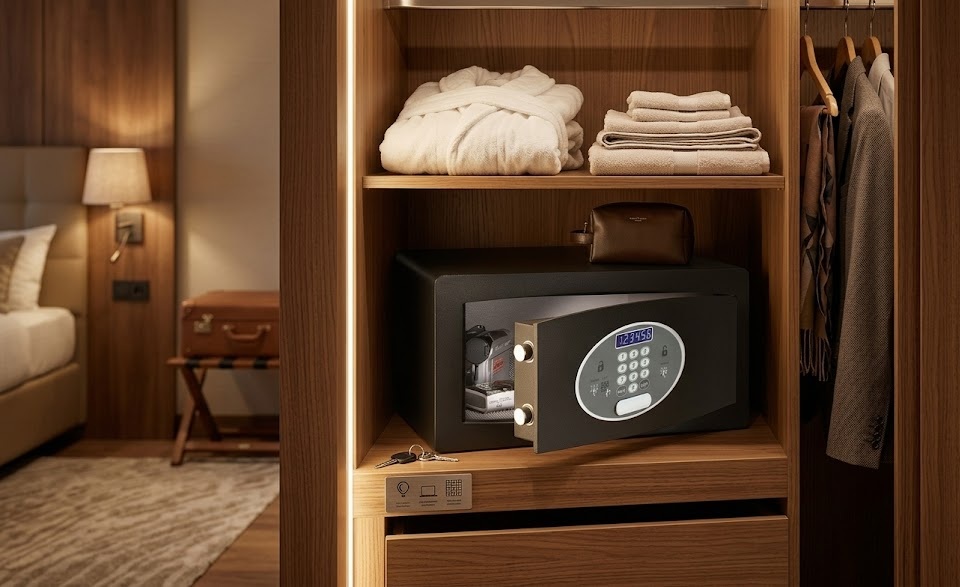
Protecting valuables, confidential documents, cash, and IT devices is a fundamental pillar of operational continuity and passive security for any hospitality facility, business, or professional office. Choosing the ideal professional safe isn't just about purchasing a simple metal container; it involves implementing a security and access control system appropriate to the risk level of your business. Whether you're equipping hotel rooms, a reception area, a jewelry store, a pharmacy, or the headquarters of a multinational corporation, a professional safe acts as a physical barrier against break-ins, reduces insurance premiums, and ensures traceable management of revenue and assets. This buying guide will guide you through the solutions available on Holity.co.uk, analyzing installation types, release mechanisms, volumetric capacities, and dimensional parameters.
The architecture of the room and the presence of load-bearing walls influence the choice of fixing method, which is crucial for resistance to uprooting:
Self-supporting structures equipped with pre-drilled anchoring holes on the base and back.
Designed to be embedded in concrete within a niche created in a load-bearing wall of adequate thickness.
Systems with horizontal sliding on cantilevered telescopic guides.
The unlocking method defines the level of security and management convenience, especially in high-turnover or multi-user contexts:
The professional models integrate specific design features to increase comfort and traceability of operations:
The Holity.co.uk range is divided into three performance levels ( Basic, Premium and Professional ), covering an accessible price range that goes from €37.00 to €476.00.
A wide breakdown of internal volumes is available to accommodate every load: from compact modules (6.7 lt, 7 lt, 8.2 lt, 9 lt, 9.5 lt, 10 lt, 11.5 lt, 12 lt, 13 lt, 15 lt, 16 lt, 17 lt, 19 lt, 20.5 lt), to intermediate capacities (24.5 lt, 26 lt, 28 lt, 30 lt, 32 lt, 34 lt, 35 lt, 36 lt, 37 lt, 38 lt, 40 lt, 42 lt, 44 lt, 46 lt, 47 lt, 48 lt, 50 lt, 52 lt, 54 lt, 56 lt, 58 lt, 60 lt, 62 lt, 64 lt, 66 lt, 68 lt, 70 lt, 72 ... lt, 27 lt, 27.9 lt, 28 lt, 30 lt, 31.5 lt), up to large storage compartments (38.8 lt and 57.9 lt).
Professional safes meet strict international classification standards. The EN 14450 standard defines the requirements for security containers for private/office use (classes S1 and S2). The EN 1143-1 standard classifies high-resistance safes into Grades (from 0 to VI), subjecting the bodies to burglary tests with whisks, oxy-acetylene torches, and explosive charges to establish the maximum insurable values. The locking systems are certified according to the EN 1300 standard. For hospitality facilities, the safes guarantee compliance with the civil code regarding the hotelier's liability for items brought into the room by guests.
Secure your company's assets, offer a protected and confidential storage service to your guests, and adapt your facility to international insurance standards. Browse our catalog to select the type of installation (freestanding, wall-mounted, drawer), the unlocking system (electronic or key), and the capacity in liters suitable for your spaces.
Request a personalized quote today: our sales team is at your disposal to provide you with technical data sheets, approval certificates and confidential quotes for multiple lots.
How does the event recording system (Audit Trail) record emergency openings and protect the hotel from disputes?
The Audit Trail function (event memory) records the latest accesses made to the safe in a non-volatile EEPROM memory chip. In the event of a guest reporting a hypothetical tampering with the safe in the room, the hotel management can download the historical report via a dedicated device or master key. The report shows with pinpoint accuracy the date, exact time, and type of unlocking used (e.g., guest PIN, emergency key, or directional master key). This analytical document constitutes formal expert evidence for authorities and insurance companies, demonstrating whether there was unauthorized access by staff or whether the opening was performed exclusively using the PIN set by the guest.
How does external emergency power work for safes with electronic combination locks when the internal batteries are flat?
Electronic safes are powered by alkaline AA batteries located in an internal compartment. When the charge drops below the safety threshold, the display or an acoustic signal warns the user. If the batteries run out completely with the door closed, the PIN combination remains stored in permanent memory and is not deleted. To unlock the door, the external keypad integrates two metal contacts with positive and negative poles: simply place a common 9V battery (type PP3) on the contacts from the outside to activate the electronic board, enter your secret code, open the door and replace the flat batteries in the internal compartment.
Which anchoring techniques with high-resistance chemical anchors guarantee the anti-uprooting seal of free-standing safes on floors or walls?
To certify a free-standing safe against attempts to uproot and remove it entirely, the anchoring must be performed on solid load-bearing structures (concrete, solid brick or reinforced floor). Through holes are used on the base and back of the cabinet into which threaded rods or steel expansion anchors are inserted. For installations on perforated or less tenacious materials, chemical anchoring is used: a two-component resin (epoxy or vinylester) combined with a mesh socket is injected into the hole. The resin solidifies into a single block with the masonry, offering tear and shear resistance of several tons of force.
How do the increased internal width (up to 520 mm) and transverse development of PC/Notebook safes accommodate electronic devices without damaging power cables?
Safe models marked with the "for notebook" and "for PC and tablet" highlights have an external width of approximately 400-520 mm and a countersunk depth. This transverse geometry is designed to allow the horizontal insertion of laptops with 15" and 17" displays, tablets, and hard cases without having to tilt or force them into the opening. Furthermore, the interior is often lined with scratch-resistant carpet or felt, and several advanced models integrate an internal power outlet or USB port that allows the laptop to be charged while it is safely locked in the compartment.
What is the fundamental difference, in terms of mechanical resistance and alloy elements, between an EN 14450 certified safe (Grade S1/S2) and an EN 1143-1 approved one?
The EN 14450 standard defines the requirements for security containers for residential and low-risk office use, divided into classes S1 and S2, whose attack tests simulate attacks with manual or light burglary tools (crowbars, basic electric drills). The EN 1143-1 standard instead identifies high and very high security storage devices (from Grade 0 to Grade VI). The latter feature multi-layer armoured bodies that alternate drill-proof manganese steels, special concrete conglomerates with metal fibres and thermal barriers against oxy-fuel torches, guaranteeing certified resistance times to heavy cutting tools and angle grinders, essential for high values and high-coverage insurance policies.
How does the modularity of the range (€37.00 - €476.00) match the thickness of the steel of the door, the locking bolts and the designer finishes?
The price range is directly related to the metal mass, the complexity of the lock and the workmanship of the carpentry. The entry-level range (€37.00 - €100.00) includes very compact freestanding safes with a key lock or basic keypad for the storage of small items. The mid-range (€100.00 - €250.00) covers the majority of models for hotels and offices with motorized electronic locks, laser-cut doors with thicknesses of 4 to 6 mm, 20 mm cut-resistant nickel-plated steel bolts and internal LED light. The top-of-the-range range (up to €476.00) includes high-capacity safes (over 30-50 litres) with Audit Trail systems, notebook preparation, designer external finishes with anti-fingerprint embossed paint and perimeter passive security certifications.
 English
  Italian
 French
 German
 Spanish