Buying Guide: How to Choose the Best Luggage Racks and Holders for Hotels, B&Bs, and Hospitality Facilities
Furnishing rooms in a modern hospitality facility requires a perfect balance between aesthetic elegance, maximum functionality, and protection of your furniture investment. In this context, luggage racks and holders for hotels are not simply optional accessories, but are essential for ensuring guest comfort, improving hygiene, and preventing costly damage to furniture and walls. By allowing you to unpack and rearrange your luggage at an ergonomic height without having to bend down, these supports prevent suitcases—whose wheels accumulate dust and germs during airport and road trips—from being placed directly on bedspreads, armchairs, or desks. This buying guide was created to support hotel managers, B&B managers, and other professionals. Breakfast and interior designers in choosing the ideal model within the Holity.co.uk catalogue, analysing typologies, metallic and wooden finishes, ranges of frequency of use and millimetric dimensional dimensions.
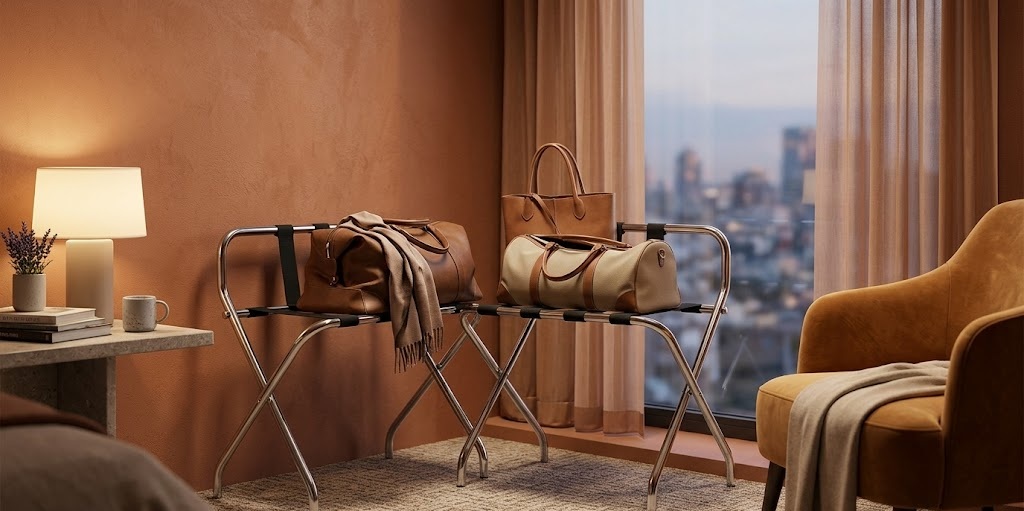
Structural typologies and variants: with side, without side and folding
The mechanical configuration of the suitcase rack must be compatible with the size of the room and the type of covering of the supporting walls. Our selection is divided into specific construction variants:
Suitcase rack with rear side (bumper)
Equipped with a backrest or a raised vertical backrest at the rear of the frame.
Advantages: The side acts as a rigid mechanical spacer, preventing the open suitcase from sliding backwards and impacting directly against the wall. This avoids stains, scratches and the formation of dark rings on plaster, paint or valuable wallpaper.
Ideal for: Rooms with delicate walls, wallpaper or fabric coverings, and rooms where the luggage rack is positioned close to the wall.
Luggage racks without side panel
Continuous horizontal plane structures without a rear riser.
Advantages: They offer maximum support flexibility for oversized luggage, golf bags or large soft holdalls, which can protrude freely beyond the edges of the frame without geometric constraints.
Ideal for: Positioning in the centre of the room, at the foot of the bed or inside dedicated niches and wardrobes where there is no direct contact with painted walls.
Folding and compact models
Systems equipped with central joints that allow the structure to be closed like a book when not in use.
Advantages: They drastically reduce the depth when closed (up to just 50 mm), allowing the support to be stored inside the wardrobe or behind the door, freeing up precious floor space in compact rooms and making daily cleaning easier for housekeeping staff.
Materials, colour finishes and strap texture
The choice of materials influences both the perceived image of the room and its resistance to continuous impacts and sanitisation operations:
Structures in steel and fine metals
The steel models guarantee extraordinary mechanical longevity and high resistance to deformation. The finishes range from the classic chrome and matt black for minimal and contemporary environments, up to highly aesthetically pleasing finishes such as brass, gold, gold, rose gold and white . The metal surface is extremely easy to disinfect and immune to superficial scratches.
Solid wood structures
Made of noble woods such as beech and mahogany, the wooden luggage racks convey warmth, classic elegance and a welcoming atmosphere. The protective varnishes applied to the wood protect the surface from humidity and accidental scratches, allowing for perfect chromatic integration with the traditional furnishings of the room.
Type and colours of support straps
The high-strength straps constitute the primary support surface for the luggage. Made of high density nylon for superior tensile strength or in elegant leather for the luxury collections, they are available in various colour shades to coordinate with the frame: black, grey, cognac and white.
Product ranges and technical strengths
To meet the needs of both small family-run B&Bs and the rigorous requirements of large luxury hotel chains, the catalogue is divided into three range levels:
Basic Range: Functional, essential and economical solutions, ideal for dynamic accommodation facilities and holiday homes.
Premium Range: The perfect balance between attention to interior design, sophisticated metal finishes and high density straps.
Professional Range: Heavy-duty products designed for the high-end hotel industry. They include models with a higher capacity capable of supporting heavy loads (up to 50-60 kg) without oscillating, compact space-saving models and versions with an additional lower shoe shelf.
Millimetre dimensional dimensions
Planning the insertion of the luggage rack within the furnishing layout requires checking the millimetric parameters reported in our technical data sheets:
Height: from 415.00 mm to 740.00 mm. Heights around 500-600 mm guarantee maximum ergonomics for unpacking suitcases without straining the spine.
Width: from 370.00 mm to 680.00 mm, sized to accommodate everything from cabin trolleys to large hold luggage.
Depth: from 50.00 mm (for the book-style folding models) up to 590.00 mm (for the open-extension models with a riser or double shelf).
Focus on the intended use: the ideal luggage rack for every facility
Boutique Hotels and Luxury Resorts: We recommend choosing luggage racks in solid wood with a mahogany finish or in steel in rose gold, gold or brass, combined with cognac-coloured leather straps. This combination conveys an immediate sense of exclusivity, enriching the suite's furnishings.
High-Rotation Business Hotels: The choice of choice falls on foldable models in stainless steel or chrome with bumper rails and high-strength black nylon straps. They guarantee maximum resistance to intensive daily use, extremely easy disinfection and total protection of the walls.
B&Bs, Guest Houses and Small-Dimension Rooms: The winning option is represented by compact and foldable models without a rail or with an integrated second shelf for shoes, which can be conveniently stored inside the wardrobes during periods of non-use of the room.
Request a personalized quote on Holity.co.uk
Raise the standard of hospitality in your rooms, protect your furnishings from wear and tear and offer an ergonomic and impeccable service to your guests. Explore the wide range of hotel luggage racks and suitcase holders available on Holity.co.uk, filtering products by material (steel or wood), color-decorative finish, and presence of a rear panel.
Are you a hotel manager, a HoReCa purchasing manager, or an interior designer looking to furnish an entire facility with dedicated quotes? Request a personalized quote today: our sales team is at your disposal to provide you with technical data sheets, samples, and confidential quotes for customized contract supplies.
Frequently Asked Questions
How does the presence of the bumper protect the wall coverings and reduce the maintenance costs of the rooms?
When a guest opens a hard-sided suitcase placed on a traditional luggage rack, the hinged lid tends to tip backward 180 degrees. If the rack is placed against a wall, the constant impact of the suitcase's metal hinge causes peeling plaster, deep scratches, and unsightly black marks. The rear bumper acts as a rigid mechanical stop integrated into the frame: it intercepts the luggage lid before it can touch the wall, maintaining a safe distance. This eliminates the need for periodic repainting and preserves valuable wallpaper.
What mechanical characteristics differentiate high-density nylon strapping from leather strapping in heavy-duty structures?
The high-density nylon straps are made with a synthetic weave with an extremely high breaking load, with no residual elasticity, ensuring they won't deform even under the weight of 50 kg luggage. They are completely resistant to moisture, resistant to liquid stains, and can be quickly cleaned with disinfectant detergents. The leather straps, on the other hand, are made of contoured, extra-thick hide with perimeter reinforcement stitching: they offer a high-end aesthetic and tactile quality, ideal for luxury settings, although they require the occasional use of leather-specific moisturizers to maintain their softness and prevent cracking over time.
How does the opening mechanism of folding models work to ensure stability and avoid accidental closing during loading?
Folding luggage racks for professional use feature a crossed X-frame with case-hardened steel rotation pins and anti-friction bushings. The stability of the open surface is not only achieved by weight balance, but is also ensured by the constant mechanical tension exerted by the upper straps, which act as stoppers when the rack is fully opened. Furthermore, many models integrate rubber limit switches or mechanical safety locks at the base or joints that prevent the frame from suddenly closing if the luggage is moved or tipped to one side.
Why do electroplated finishes such as chrome, rose gold, or brass offer superior protection against hotel disinfectants?
Electroplating processes involve the electrolytic deposition of microlayers of precious metals (chrome, brass, gold) onto the previously nickel-plated steel frame. This treatment creates a continuous, extremely hard, and completely non-porous metallic film. Unlike standard paint finishes, the electroplating does not react chemically with the alcohol-based solutions or broad-spectrum disinfectants used by cleaning staff for daily sanitization, ensuring that the frame's shine or color tone does not dull or flake over time.
How does integrating a lower shelf (shoe rack) optimize livability in small bedrooms?
In B&Bs or hotel rooms where floor space is limited, the accumulation of shoes and small backpacks on the floor creates visual clutter and reduces circulation space. Luggage racks equipped with a second lower shelf (made of additional straps or a tubular steel grid) take advantage of the verticality of the support. This allows guests to place their main suitcase on the upper shelf and remove their shoes, placing them in the compartment below, keeping all personal belongings off the floor and making it easier for housekeeping to vacuum.
How do articulated non-slip ebonite rubber feet protect delicate parquet or marble floors?
The lower ends of the legs of professional luggage racks feature high-density rubber (or ebonite) feet with non-slip contours. These elements serve a dual purpose: first, they increase the coefficient of friction on the floor, preventing the rack from slipping on extremely smooth surfaces like polished marble when heavy luggage is placed forcefully on it; second, they cushion the load, preventing direct contact with the metal or hard wood from scratching, scuffing, or gouging delicate parquet floors.

 English
 Italian
 French
 German
 Spanish