
mon-fri 9-13 / 14.30-18.30
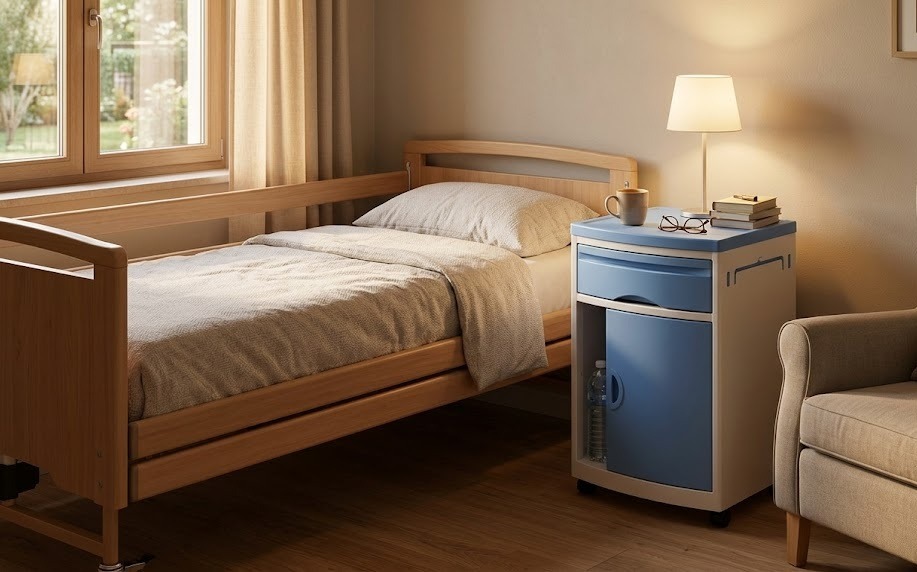
Properly planning the layout of a hospital room requires integrating furnishing elements that optimize medical operations while accommodating the limited mobility of bedridden patients. Bedside tables are not simply containers for personal effects; they are true logistical devices for local therapeutic support. Improper positioning or geometric sizing that is not coordinated with the hospital bed's lifting dynamics can slow down emergency nursing interventions or compromise the patient's independence. This buying guide is designed to support healthcare directors, designers, and purchasing managers in selecting the ideal models from the Holity.co.uk catalog, analyzing the impact of metric variables, the ergonomics of storage areas, and material sanitization flows.
In the medical and clinical furniture sector, the structural categorization of bedside tables is mainly developed around the presence of specific accessories for hydration and the arrangement of proximity medical devices.
Engineered solutions to centralize the storage of fluids and exclude the risk of accidental falls caused by reflex movements or tremors of the patient.
Advantages: Our store offers 9 solutions equipped with bottle holder housing. This configuration includes thermoformed cavities or external baskets in steel rod integral with the body, positioned on the lateral profile of the cabinet. It allows for the safe stabilization of bottles of water, bottles of saline solutions or therapeutic rinse liquids, keeping them always within reach of the patient and freeing up the upper surface of the top for diagnostic equipment.
Disadvantages: The lateral bulk of the bottle holder requires a slight additional space in the separation between the bed and the wall.
Ideal for: Long-term care wards, geriatric clinics and post-operative rehabilitation facilities.
Models with a linear and compact design, focused on the maximum geometric cleanliness of the external walls to optimise the floor space.
Advantages: With 32 variants in the catalogue, it represents the most versatile and widespread purchasing choice. The completely smooth side profiles eliminate accidental snagging points for staff gowns or bed covers and allow the furniture to be fitted precisely to the hospital bed chassis, facilitating logistics in multi-bed rooms.
Disadvantages: They require the positioning of glasses and bottles on the upper shelf, reducing the usable area for tablets or medical devices.
Ideal for: General surgery departments, day hospitals, short-term observation boxes and multiple hospital rooms with a high bed density.
---
To structure a functional and safe hospital room, it is essential to set the choice by calibrating the geometric cursors and economic parameters based on the layout of the rooms and the type of patients hosted.
The zenith height of the furniture must be able to coordinate with the elevation ranges of modern electric beds to allow smooth and safe transitions of objects. Our professional range covers a height in millimetres between 500.00 mm and 1100.00 mm. Low configurations (500.00 - 650.00 mm) are ideal for alignment with intensive care beds or lowered beds for the protected lifting of fragile patients; conversely, models extending up to 1100.00 mm often integrate telescopic arms and hydraulically operated servo-passing serving trays at the top, transforming the bedside table into a dining table or lectern for the bedridden patient.
The depth directly affects the freedom of maneuver and the transit of IV poles, mobile lifts and therapy trolleys. On our store it is possible to select a depth in millimetres from a minimum of 330.00 mm up to a maximum of 540.00 mm. The slim 330.00 mm formats minimize the perimeter spatial footprint and are suitable for filter corridors or confined rooms; The increased depths of up to 540.00 mm offer spacious cabinet stations, capable of internally housing even small medical refrigerators for medicines or heat-sensitive personal effects.
The horizontal development defines the extension of the upper shelf and the volume of the lower drawers. The catalogue offers extensive millimetric flexibility, with a length between 390.00 mm and 1250.00 mm. While the standard modules gravitate around 400-500 mm of front width, the maximum dimensions up to 1250.00 mm identify special combined monoblock solutions (bedside table + built-in fully disappearing over-bed table), which eliminate the presence of two separate pieces of furniture in the room, halving the floor space.
The procurement of healthcare furniture devices must guarantee maximum structural robustness with proper long-term amortization. Our online catalog effectively maps any tender specifications, structured within a flexible price range that varies from €108.00 to €1148.00. The entry-level solutions (€108.00) allow you to equip the room with stable and essential modules in technopolymers or melamine with one drawer; the premium range (up to €1148.00) includes advanced multifunctional hospital systems, made with coupled stainless steel structures and injection-molded ABS plastic bodies, equipped with shielded twin wheels and 360° rotatable servo-assisted serving trays.
---
Intensive Care Units, Resuscitation and Infectious Diseases Departments: In these very high-risk biological settings, the choice must fall on monoblock bedside tables in high-density ABS plastic or stainless steel, strictly without external bottle holders to facilitate spray disinfection. The surfaces must tolerate continuous chemical shock washing and the height must be reduced (500.00 - 600.00 mm) to avoid obstructing the perimeter monitors and pulmonary ventilators.
Assisted Living Facilities (RSA) and Geriatric Clinics: The priority in this scenario is maintaining autonomy and visual comfort. We recommend using melamine-coated bedside tables with warm, coordinating finishes, equipped with a side bottle holder (essential for encouraging the elderly to stay hydrated), drawers with soft-closing anti-crush mechanisms, and a balanced height of approximately 750-850 mm for a comfortable side grip.
General Surgery and Standard Hospitalization Wards with High Turnover: The winning configuration includes mobile bedside tables mounted on four swivel casters (at least two of which have an independent foot brake). The modules must include an upper drawer for cutlery and a lower compartment with a solid door and adjustable internal shelves, optimizing logistical flexibility during rapid room assignment changes.
---
Increase the level of postural comfort for your patients, protect the health of your ward staff, and adapt the hospital rooms to the most modern hygiene standards. In the Holity.co.uk catalog, you'll find a specialized selection of medical and hospital bedside tables, engineered to withstand the intensive mechanical stresses of daily clinical flows.
Use our side sliders to configure the exact millimetric height, depth, and length measurements suitable for the cubic capacity of your rooms, and select the ideal type with or without bottle racks based on the level of storage required. Contact our customer service today to receive complete technical data sheets, dimensioned overall drawings, and personalized technical advice tailored to your facility.
---
How do double-sided (front-to-back) power-operated drawer systems optimize assistance maneuvers in intensive care units?
Advanced hospital-grade bedside tables integrate special drawer units equipped with double-sided power-operated telescopic guides. This engineering feature allows the drawer to be extracted from both the front and rear of the cabinet. In situations of clinical emergency or bed blockage, nursing staff can instantly access medications or medical devices stored in the bedside table by positioning themselves from the rear, without having to physically move the cabinet or go around the bed chassis, speeding up intervention times.
What dynamic and structural balances differentiate industrial twin casters from fixed feet in counteracting the patient's orthostatic thrusts?
Geriatric patients or those undergoing rehabilitation tend to use the top of the bedside table as an orthostatic support point to balance their weight when getting out of bed. Models equipped with fixed feet distribute forces exclusively in a vertical direction, ensuring maximum static stability but complicating floor cleaning. Professional mobile variants adopt twin swivel wheels in nylon or polyurethane with a total locking brake: the braking system simultaneously blocks both the rotation of the wheel and the 360° directional joint, neutralising transverse thrust vectors and preventing dangerous slipping of the furniture under the weight of the patient.
How is the telescopic excursion engineered in models up to 1100.00 mm high to ensure the absence of mechanical oscillations of the overbed table?
The multifunctional bedside tables reaching a vertical height of 1100.00 mm integrate a telescopic column in extruded aluminum or galvanized steel within the chassis, servo-assisted by a hydraulic gas spring. This column supports a cantilever arm equipped with an adjustable serving tray. To eliminate mechanical play and dynamic pitching of the table when loaded with heavy dishes or books, the internal linear guides are coupled with self-lubricating Teflon sliding bushings with millimetric tolerance, evenly distributing the bending moments on the base structure.
How do ABS plastic injection molding processes eliminate the trap effect for biological fluids and chemical disinfectants?
Bedside tables made of medical-grade ABS plastic are molded in high-pressure industrial presses, creating monolithic one-piece bodies without joint lines, molecular porosity or structural cracks. This material configuration eliminates the so-called "trap effect" at its root: accidentally spilled biological fluids (blood, urine, organic fluids) or concentrated cleaning solutions cannot infiltrate the cabinet walls. As a result, broad-spectrum sanitizers can act uniformly on perfectly smooth surfaces, ensuring aseptic conditions and facilitating the removal of biofilms.
How does the choice of a reduced depth of 330.00 mm affect the anti-tip stability of the bedside table when the lower door is opened to 90 degrees?
The reduction in structural depth to just 330.00 mm responds to the need to preserve floor space in access corridors and narrow multiple rooms. To prevent the cantilevered opening of the lower door or the extraction of the chest of drawers from shifting the overall center of gravity beyond the front stability line, triggering the frontal tipping of the furniture, the chassis is engineered by expanding the width of the base or by embedding anti-tip metal counterweight plates in the lower compartment, keeping the projection of the center of gravity always confined within the axis of the wheels.
How does the extension of the length up to 1250.00 mm correlate with the logistical optimization of the floor space for a single bed?
The extended display modules reaching 1250.00 mm in length map complex integrated systems in which the bedside table and the variable-height overbed table constitute a single combined piece of furniture. When the lunch tray is not in use, a compass or bayonet mechanism allows it to fold vertically and be completely hidden inside a lateral slot in the bedside table frame. This logistical architecture eliminates the floor space required by a second, independent tray trolley, freeing up vital square meters around the bed for emergency medical staff maneuvers.
 English
  Italian
 French
 German
 Spanish