
mon-fri 9-13 / 14.30-18.30
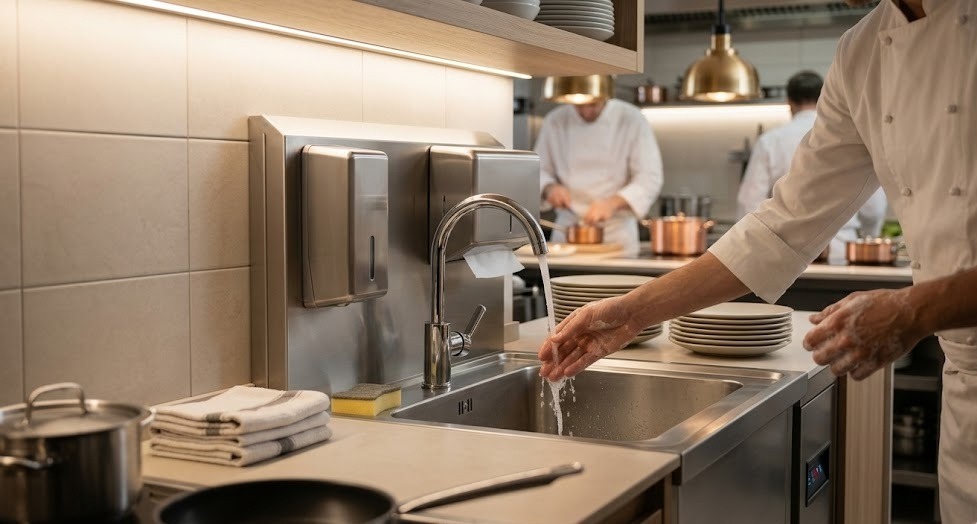
In professional kitchens, food processing facilities, medical practices, pharmacies, and public establishments, proper hand hygiene management is the first step in preventing cross-contamination and complying with HACCP and workplace safety protocols. Choosing a suitable professional stainless steel hand sink doesn't simply mean installing a generic sink, but rather equipping yourself with a device engineered to minimize manual contact, optimize water consumption, and withstand intensive disinfection cycles. A well-positioned water point that complies with hygiene and health regulations speeds up team workflows, protects consumer health, and avoids fines during health inspections. This purchasing guide will guide you through the Holity.co.uk online catalogue, analysing "hands-free" activation systems, installation types (wall-mounted, cabinet-mounted, free-standing), integrated accessories and dimensional parameters.
Health regulations require the use of devices that prevent direct contact of used hands with taps and knobs. The dispensing mechanism defines the level of hygiene and operational usability:
This is the most widespread standard solution in the HoReCa sector and in the meat/pastry processing sector.
Mechanical operation system guided by foot pressure.
The extremely high hygienic profile technology designed to completely eliminate body contact.
Models equipped with manual taps, clinical lever (operated with the elbow) or dual-control mixer. They are mainly used in bathrooms reserved for the public, in service areas or in offices where the law does not require a strict femoral control.
The architecture of the room and the presence of wall or floor drains influence the choice of base:
Models fixed directly to the wall using brackets or steel expansion bolts.
Floor-standing stations equipped with a lower compartment closed with a hinged or sliding door.
Self-supporting structures mounted on stainless steel tubes, possibly equipped with a perforated or solid lower shelf.
"Plug & play" solutions that do not require connection to the water mains or to the sewer drain pipe.
Multi-function appliances with two compartments that integrate an upper basin for hand hygiene and a lowered basin equipped with a stainless steel bucket support grid, ideal for filling buckets and cleaning sponges for the waiting staff.
To transform the simple water point into an integrated sanitation center in compliance with HACCP specifications, professional hand basins can accommodate additional components directly welded or fixed to the rear splashback:
Since these are equipment intended for direct contact with foodstuffs and exposed to a constant presence of humidity and disinfectants, the choice of metal alloy is fundamental:
The variety of the offer on Holity.co.uk allows you to calibrate the choice based on the precise size of your laboratory or commercial kitchen, selectable via our navigation filters:
The installation of hand sinks in businesses open to the public and to the food trade must comply with strict legal requirements:
The range available in our store allows us to satisfy both small adaptation jobs and large industrial kitchen setups, moving within a price range between €77.00 and €2002.00:
Adapt your business to HACCP hygiene and health regulations, protect the health of your customers, and optimize the work of your team with the professional solutions available on Holity.co.uk. Explore our online catalog to select the ideal model: set the operating system (knee, pedal or electronic control), define the configuration (wall-mounted, cabinet-mounted or free-standing) and insert the accessories necessary for your laboratory.
Request a personalized quote today: our team of experts is at your complete disposal to provide you with technical data sheets with prices, certifications of conformity for the ASL and reserved offers for multiple orders.
How does the timed knee control prevent cross-contamination and reduce water consumption in the catering industry?
When processing raw foods (meat, fish, eggs), the operator's hands become covered in organic residues and bacteria. If the operator were to touch a traditional knob to turn on the water, they would deposit germs on the faucet, only to recover them when the faucet is turned off. The knee control completely eliminates the use of hands: by pushing the front valance with the thighbone, the water flows for a pre-set time (usually 7-15 seconds) through a mechanical timed shut-off valve, allowing soaping and rinsing without touching any surfaces with the hands and preventing the faucet from being left open inadvertently, reducing water waste by 40%.
What features make freestanding wheeled handwashing sinks the obligatory solution for food trucks and street markets?
Food service activities on mobile vehicles or temporary stalls (festivals, fairs, food trucks) are subject to the same HACCP regulations as fixed restaurants, but often do not have connections to the water or sewer systems. Freestanding hand sinks solve this problem by integrating two isolated 10-20 litre tanks within the structure. An electric pump or a foot-operated hydraulic pump draws clean water from the first tank and conveys it to the tap, while the second tank collects the used wastewater, allowing compliance with hygiene requirements and obtaining health permits for street vending.
Why do HACCP regulations prohibit the use of the same sink for washing hands and washing food or dishes?
Sinks intended for washing vegetables, fish, or accumulated dishes can harbor bacterial loads deriving from soil, decomposing food residue, or aggressive dish detergents. If an employee were to wash their hands in the same sink, the force of the splashing water would transfer the bacteria from the hands to the soaking food, or vice versa. Local health authority guidelines require a clear physical separation: the hand-washing point must be a water point dedicated *exclusively* to the operator's personal hygiene and must be located near the workstation.
How is the optimal thermostatic mixer setting calculated to prevent burns and ensure the degreasing action of the soap?
Hand washing with only cold water is ineffective at removing animal or vegetable fats from the fingers. On the other hand, water temperatures above 50°C risk causing burns to the operator and encourages them to quickly move away from the hands before they are completely soaped. The thermostatic mixer premixes the hot and cold water coming from the mains connections, delivering a constant temperature flow calibrated between 38°C and 42°C. This temperature dissolves the fats, facilitating the action of the soap, guarantees thermal comfort for the operator and avoids energy waste.
What operational differences are there between AISI 304 stainless steel tubs with a satin finish compared to those with a polished/mirror finish?
Satin-finished AISI 304 stainless steel is subjected to a mechanical brushing process that creates a directional, opaque micro-texture. This finish hides fingerprints, limescale deposits left by drying water, and microscopic surface scratches caused by rubbing with sponges or utensils, maintaining an impeccable appearance over time. The polished or mirrored finish offers a very high-shine visual impact, but requires constant drying with microfiber cloths to avoid water stains and makes scratches from wear more visible.
How can the wide price range in the catalog (from €77.00 to €2002.00) be explained in relation to the size of the tubs and electronic components?
The pricing structure depends on the amount of stainless steel used, the presence of cabinets, and the degree of hydraulic automation. Entry-level options (€77.00 - €200.00) include compact wall-mounted handrinse basins with mechanical knee or knob operation. The mid-range (€200.00 - €500.00) includes handrinse basins complete with a closed cabinet with a door, combined pedal-operated models, and simple movable stations. Top-of-the-range prices (up to €2002.00) are reserved for autonomous, electrified sanitation stations with integrated water heaters, walls equipped with automatic soap and paper dispensers, and multi-station handrinse basins with electronic photocell operation for hospital and pharmaceutical use.
 English
  Italian
 French
 German
 Spanish