
mon-fri 9-13 / 14.30-18.30
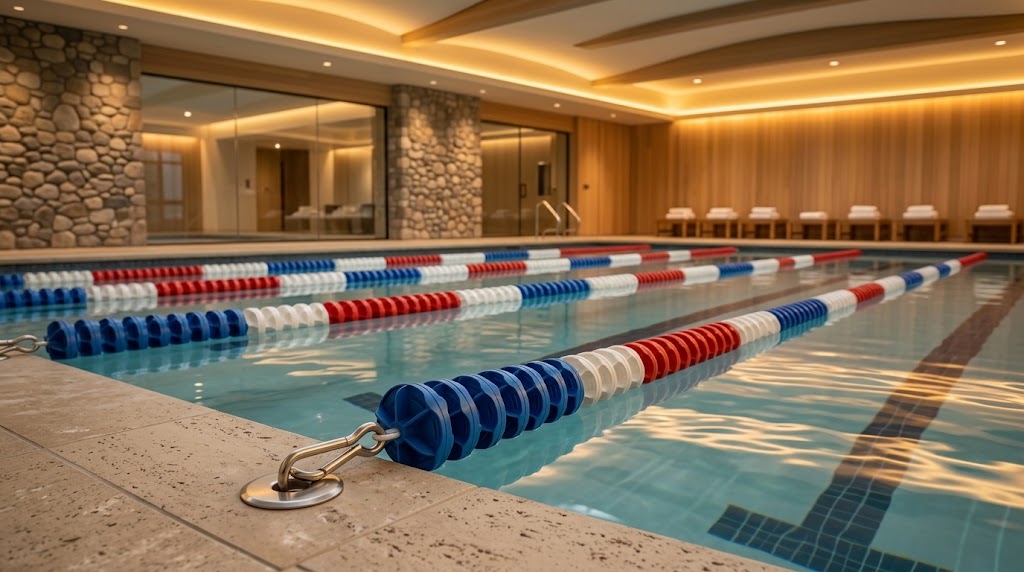
Within a professional swimming facility, wave management and proper water distribution are key factors in the efficiency of activities and the performance of athletes. Choosing the ideal floating lap pools isn't just a matter of purchasing plastic dividers; it's the equivalent of installing a hydrodynamic engineering system designed to eliminate turbulence, absorb wave energy, and ensure swimmers' safety. Whether it's an Olympic center for official competitions, a municipal swimming pool for swimming lessons, or a resort pool, the selection of wave breakers, support cables, and tensioning systems must ensure maximum durability against the effects of chlorine and UV rays. This purchasing guide will guide you through the solutions in the Holity.co.uk catalogue, analysing disc diameters, standard lengths, anchor cables, regulatory colour codes and price ranges.
The shape of the plastic modules inserted along the cable determines the dampening capacity of the surface waves induced by the strokes:
They use polyethylene floating buoys alternating with plastic spacers.
Made up of a continuous succession of independently rotating turbines or hydrodynamic discs.
The external diameter of the wave breaking modules defines the percentage of damping of the wave motion, selectable on Holity.co.uk via the range options:
The length of the floating line must correspond exactly to the distance between the anchor points to the walls of the pool, net of the dimensions of the compensation springs and tensioners:
The lanes intended for competitive swimming must follow precise colour schemes to visually orient the swimmer during progression and turns:
The taut stability of the lane requires fastening hardware of the highest metallurgical quality:
The range available on Holity.co.uk allows you to satisfy both completion purchases and complete supplies for Olympic swimming centres, moving within a price range between €575.00 and €2194.00 for a single complete line:
Maximize the hydrodynamic efficiency of your pool, adapt your tub to World Aquatics competition regulations and offer your customers perfect swimming conditions. Explore the Holity.co.uk online catalog to configure your floating lane: set the desired length (20, 25, 30 or 50 meters), select the diameter of the wave breakers (85, 120 or 150 mm) and identify the cable system suitable for your system.
Request a personalized quote today: our sales team is at your complete disposal to provide you with technical data sheets, anchoring diagrams, material certifications and reserved offers for the complete supply of all competition courses.
How do rotating wave breakers dissipate water turbulence compared to traditional floating balls?
Traditional spherical floating balls act as a continuous rigid wall: when the wave produced by the swimmer impacts the balls, the mass of water is bounced back into the same lane or crosses the line, invading the adjacent lane. Racing wave breakers instead integrate a series of hydrodynamic blades and discharge holes driven by independent rotating hubs. The wave penetrates inside the disc, causing it to rotate on its axis: this rotation converts the kinetic energy of the water into mechanical friction, dampening the turbulence by 90% and leaving the surface of the water perfectly flat.
Why is AISI 316 stainless steel cable essential compared to AISI 304 steel in pools with chlorine or salt disinfection?
In indoor and outdoor swimming pools, the concentration of free chlorine, combined with the evaporation of isocyanuric acid or saline electrolysis, creates an extremely corrosive microenvironment. Standard stainless steel (AISI 304) exposed to chlorinated water for long periods of time suffers from pitting and stress corrosion cracking, which weaken the cable strands until they suddenly break under tension. AISI 316 stainless steel contains 2-3% molybdenum, a chemical element that develops a water-repellent passivation film that is unaffected by chlorides, ensuring a secure and permanent mechanical seal.
How is the correct cable tension calculated and why are compensation springs mandatory in cup anchors?
A lane with little tension tends to warp in the center, losing its wave-breaking capacity and invading the swimming path; Conversely, an over-tensioned lane applies excessive static traction to the cups built into the pool's head walls. The AISI 316 stainless steel compensation springs positioned at the end of the lane act as dynamic shock absorbers: they absorb sudden traction peaks generated by the starting dives and the impact of the athletes' strokes, maintaining constant tension in the line without damaging the ceramic structure of the pool.
What precautions and procedures should be followed to correctly store floating lanes on lane reels?
To prolong the useful life of the HDPE discs and prevent the crystallization of chemical residues, when the lane is removed from the pool for special events or extraordinary cleaning, it must be thoroughly rinsed with a jet of fresh drinking water to remove chlorine and limescale deposits. When winding the line on the stainless steel reel, the cable must be distributed without kinks. The trolley with the wrapped lanes must finally be stored in a technical room protected from continuous direct sunlight and away from heat sources exceeding 50°C to avoid thermal deformation of the discs.
How does the price range in the category (€575.00 - €2194.00) correlate with the metric development of the line and the diameter of the wave breaking discs?
The price structure is determined by the quantity of HDPE resin used to mould the discs, the diameter of the modules, the overall length of the AISI 316 stainless steel cable and the presence of professional tensioning hardware. The entry-level range (€575.00 - €900.00) includes 20 and 25 metre lanes with compact diameter discs (85-120 mm) intended for short training pools. The mid-range price range (€900.00 - €1500.00) includes 25-meter lanes with ultra-high-performance 150 mm discs and 50-meter long lines for training. The top-of-the-line prices (up to €2194.00) include 50-meter Olympic-size lanes with 150 mm discs compliant with World Aquatics/FIN standards, complete with AISI 316 stainless steel ratchet tensioners, oversized shock absorbers, and regulatory color coding for international competitions.
 English
  Italian
 French
 German
 Spanish