
mon-fri 9-13 / 14.30-18.30
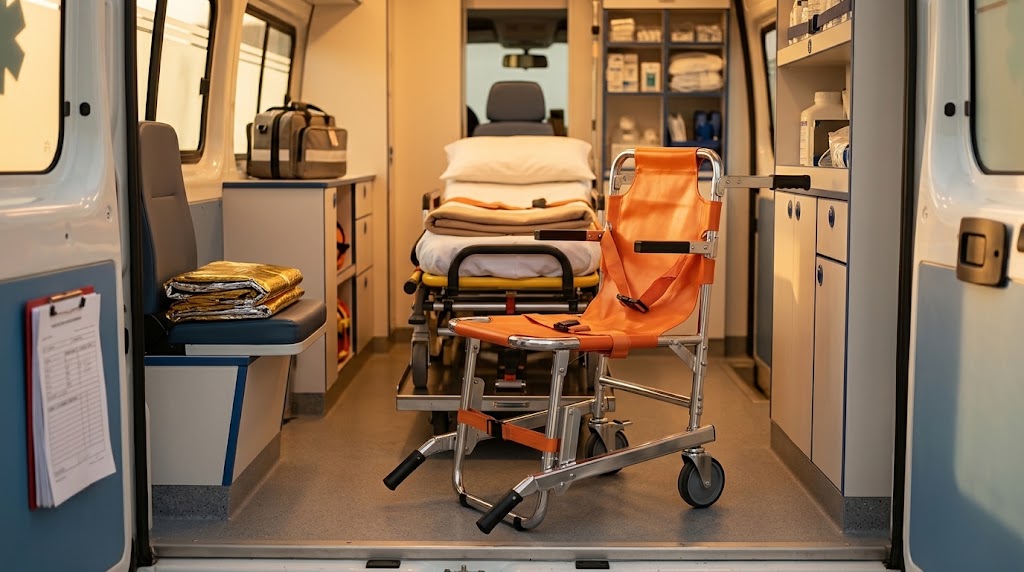
In emergency settings, healthcare facilities, schools, public offices, and multi-story buildings, managing the transport of patients, the elderly, or people with reduced mobility along escape routes is a fundamental pillar of the evacuation and safety plan. Choosing the right evacuation chair doesn't mean simply purchasing a transport aid, but rather equipping yourself with an emergency medical device capable of eliminating the risk of falls down stairs, preventing musculoskeletal injuries to workers, and ensuring rapid and dignified evacuation. From small company emergencies to intensive hospital care, the evacuation chair must combine a lightweight structure, a high payload, compact wall storage, and full compliance with European medical device regulations. This purchasing guide will guide you through the Holity.co.uk catalogue, analysing construction types, kilogramme capacities, stair braking systems, overall dimensions and current regulatory frameworks.
The architecture of the sedan chair must be selected based on the conformation of the escape routes (presence of narrow stairs, corner landings or long flat corridors) and the level of assistance required:
The classic, compact and essential solution for quickly overcoming differences in level and stairs.
Designed to offer maximum stability both on steps and on horizontal walking surfaces.
Advanced systems equipped with high-grip rubber tracks or pads with integrated friction that slide on the edge of the steps.
Multifunctional systems equipped with central joints that allow the backrest to be reclined and the leg supports to be extended.
The sizing of the sedan chair must be carried out by analyzing the type of user and the maximum recommended operating load:
Since these are devices intended for use in harsh conditions and in contact with biological liquids or atmospheric agents, the materials must guarantee resistance and ease of sanitisation:
The purchase and installation of evacuation chairs in public and work environments is subject to strict legal requirements:
The Holity.co.uk online catalogue allows you to satisfy both the regulatory compliance of a single company complex and the preparation of emergency medical fleets, moving within a wide price range between €247.00 and €6580.00:
Secure your building, adapt your Evacuation Plan to current regulations and guarantee rapid and ergonomic rescue for people with reduced mobility. Explore the online catalog on Holity.co.uk to find the most suitable sedan chair: set the required useful load (from 90 to 254 kg), select the wheel or track configuration and check the millimetric dimensions for wall storage.
Request a personalized quote today: our sales team is at your complete disposal to provide you with quoted technical data sheets, CE/MDR certifications and reserved offers for batch orders.
How does the track or rubber pad system eliminate the operator's lifting effort when descending stairs?
In traditional wheelchairs, rescuers must support the patient's entire static weight as they descend steps. Wheelchairs equipped with high-friction rubber tracks or adjustable glides exploit the continuous support of the track on 2 or 3 steps simultaneously. The patient's weight creates grip that generates a friction braking force: the operator simply has to guide and lightly push the chair down the incline of the stairs, without having to lift the structure from the ground and reducing the strain on the spine by 90%.
What characteristics differentiate a transport chair classified as a Medical Device (MDR) from a generic transport aid?
A transport chair approved as a Class I Medical Device according to EU Regulation 2017/745 (MDR) is subjected to rigorous laboratory tests required by the UNI EN 1865-1 standard. These tests verify resistance to static and dynamic loads with a safety factor of 150%, anti-tip stability on slopes, biocompatibility and non-toxicity of the seat covers, and the absence of sharp edges or finger pinch points. Certified products guarantee the legal compliance required for use in medical, hospital, and emergency settings.
How is the useful load capacity required for safety equipment in a public or healthcare facility calculated?
To ensure an adequate safety margin for anthropometric variations in the population or assisted population (including the additional weight of winter clothing, blankets, or portable medical equipment), it is recommended never to go below the standard load capacity of 150-180 kg. In bariatric facilities, specialized hospital departments, or metropolitan emergency stations, the choice of chairs with a useful load capacity of 200 kg to 254 kg is strongly recommended.
What accessories are essential to ensure the stabilization of the patient's head and trunk during evacuation?
During a rapid descent down a staircase, jolting stresses can cause imbalances of the torso or cervical injuries in people who lack muscle tone or are unconscious. To ensure safe transport, the chair must be equipped with a set of quick-release restraint belts included for the chest, pelvis and ankles, combined with a padded headband adjustable via Velcro positioned on the backrest, which keeps the patient's head in a neutral and aligned position.
How do the overall dimensions when closed (up to 180 mm deep) affect the ease of installation in fire niches?
Escape routes and fire corridors are subject to severe restrictions on minimum walkable width prescribed by fire prevention regulations. A folding evacuation chair with a reduced stowed depth (180-250 mm) can be hung on the wall using the appropriate support bracket inside wall-mounted protective cabinets without invading the usable width of the corridor or landing, keeping the escape route clear and ensuring the immediate availability of the aid when the compartment is opened.
How does the price range in the category (€247.00 - €6580.00) correlate with the presence of electric motors and very high-capacity frames?
The price structure is determined by the mechanical complexity, the presence of electrified components and safety certifications. The entry-level range (€247.00 - €600.00) includes essential manual evacuation chairs with 2-4 aluminum wheels and loads up to 150 kg. The mid-range price range (€600.00 - €2000.00) includes braked tracked stair chairs, stretcher-convertible versions, and high-capacity bariatric models up to 250 kg. The top-of-the-line prices (up to €6580.00) are reserved for rechargeable battery-powered electric evacuation chairs, equipped with motorized tracks that allow for effortless stair climbing and descending, for hospital and high-tech contract rescue applications.
 English
  Italian
 French
 German
 Spanish