Buying Guide: How to Choose Dog Waste Receptacles, Litter Boxes, and Dog Stations for Parks and Street Furniture
In the management of public parks, municipal gardens, sidewalks, dog walking areas, pedestrian walks, tourist locations and outdoor spaces of campsites, residences and pet-friendly facilities, the availability of dedicated points for the collection of dog waste contributes to the decorum and hygiene of shared environments. dog waste containers, also called dog waste bins or dog waste bins, allow you to dispose of the bags used to collect animal feces. They can be installed individually or combined with hygienic bag dispensers, forming complete stations commonly called Dog StationThe presence of these devices facilitates the proper disposal of waste by dog owners and handlers, especially in highly frequented areas. The effectiveness of the service, however, also depends on the location of the containers, the availability of bags, and the frequency of emptying and cleaning. The catalog of Holity.co.uk The collection includes wall-mounted or pole-mounted bag dispensers, waste bins, and integrated stations with containers, dispensers, and, in some models, a sign. Products are available in painted or galvanized steel, polyethylene, and other materials suitable for outdoor use. This purchasing guide analyzes types, capacities, mounting methods, materials, opening systems, regulatory requirements, and price ranges to help municipalities, green space managers, and urban design designers choose the most suitable solution.
1. Types of collection systems: bag dispensers, dedicated bins and complete DogStations
The choice of location depends on the number of users, the presence of existing bins, and the level of service you wish to offer. It's important to distinguish between devices intended solely for bag distribution and those designed for waste collection:
Sanitary bag dispenser (standalone): These dispensers are designed to hold and dispense bags for dog waste collection. They can be installed on walls, fences, or poles using compatible mounting systems. The Holity catalog includes models in steel, painted sheet metal, and ABS, with different capacities, including dispensers for 200, 350, and 500 bags. Actual capacity depends on the size of the bags and the intended dispensing system. Some products are equipped with a lock to protect the refill compartment. These solutions are particularly useful for integrating existing collection stations, but do not necessarily include a bin for disposing of used bags. Before purchasing, it is advisable to check the compatible refill format and whether the bags are included.
Dog waste containers (dedicated bins): These bins are designed to collect bags containing dog waste. The catalog offers models with different capacities, including versions for 15, 23, 35, 40, 50, 60 and 85 liters, depending on the product. They may have a lid, a protected opening, a removable internal bin, or a bag fastening system. Some include a lock to limit access to the emptying compartment. The shape of the waste opening can help discourage the introduction of bulky waste, but it does not automatically prevent all improper use. The choice of capacity must take into account the expected number of deliveries and the frequency of collection.
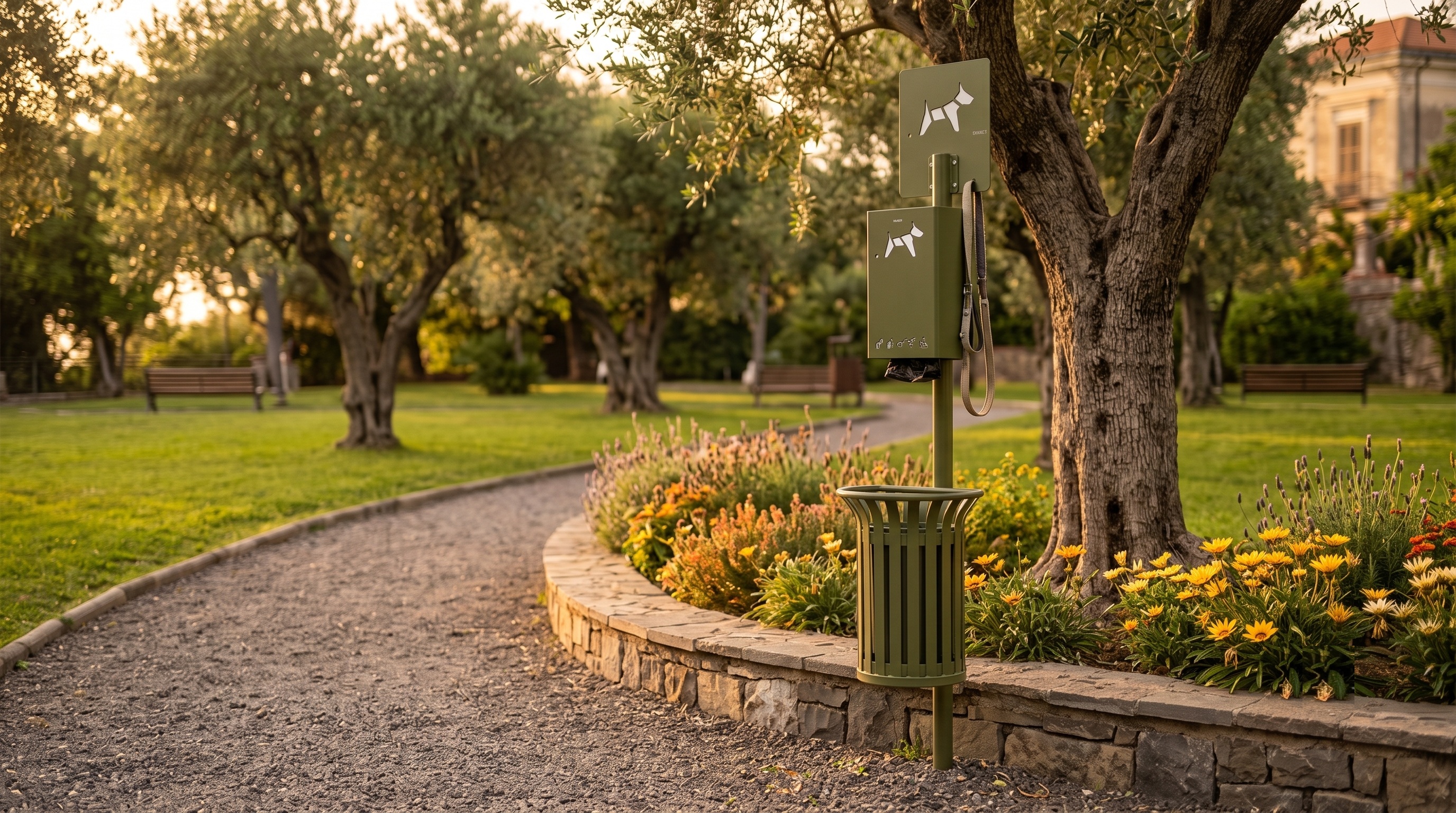
DogStation complete (integrated "all-in-one" systems): These stations combine a bag dispenser and a container for collecting dog waste. They can consist of a freestanding column, a pole-mounted structure, or coordinated modules mounted on the wall or floor. Depending on the model, a DogStation can include:
A sign or information panel identifying the location and inviting you to collect dog waste, where provided.
A sanitary bag dispenser, with variable capacities and dispensing systems; some models allow for free dispensing, while others use controlled systems, including coin-operated ones.
A bin dedicated to the disposal of used bags, with different capacities, opening systems, and emptying methods depending on the configuration.
DogStations allow bag distribution and waste collection to be concentrated in the same area, making it easier for residents to use. To ensure the station's functionality, it is still necessary to organize bag refills, bin emptying, and periodic maintenance.
2. Fixing and installation systems: wall-mounted vs. ground-mounted (on a pole to be buried or bolted)
The installation methods for dog waste containers depend on the model, the supporting material, and the characteristics of the area. Before assembly, it is necessary to check the weight of the equipment, the required stability, the dimensions, and the manufacturer's instructions.
Wall / Wall Mounting: Some dispensers and bins are designed to be installed using holes, brackets, or mounting plates on walls, pillars, and other suitable vertical surfaces. This configuration can be useful in urban centers, along pedestrian walkways, and at dog park entrances, when space is limited. The anchoring system must be chosen based on the wall's consistency and the weight of the device, including the waste it contains. It is also important to ensure that the installation does not obstruct the passage of pedestrians and people with reduced mobility. Installation on public or condominium structures may require authorization from the competent authority.
Ground fixing (on independent column/upright): DogStations and freestanding litter bins can be equipped with a pole or a support structure designed for installation in parks, gardens, and open spaces. Fixing methods vary depending on the model and type of surface:
Extension of the pole to be buried: Some posts are designed for installation in the ground, possibly using a concrete foundation. The size of the excavation and installation depth must be determined based on the structure, the nature of the soil, and the manufacturer's instructions. There is no universal depth of 30-50 cm that applies to all DogStations. The fixing must ensure adequate stability, but cannot automatically be considered resistant to any attempt at damage or uprooting.
Flanged base plate with dowels: Some models have a perforated base designed for attachment to solid surfaces using mechanical or chemical anchors. This solution can be used on concrete foundations or other compatible structures. The size and type of anchors must be chosen based on the characteristics of the substrate and the manufacturer's specifications. The presence of an asphalt or stone surface does not guarantee the suitability of the anchor without adequate verification of the subfloor.
Fixing to existing pole using collars/brackets: Some dispensers and containers can be mounted on existing poles using collars, brackets, or other dedicated accessories. Before purchasing, please check the compatible pole diameter, the support's load-bearing capacity, and the availability of the mounting system. Not all products are suitable for poles with a diameter of 50-60 mm, and the use of signage or public lighting elements requires verification of applicable permits and safety requirements.
3. Construction materials and environmental durability: galvanized steel vs. polyethylene (HDPE) and ABS
Outdoor dog waste bins and dispensers are exposed to rain, sunlight, humidity, temperature fluctuations, and frequent use. The material affects their weather resistance, cleaning, and maintenance requirements:
Galvanized and painted steel: Steel is used for litter bins, bollards, posts, and dispensers for public spaces. The Holity catalog includes models in painted steel and galvanized steel, some with additional surface treatments. Galvanizing helps protect the metal from corrosion, while painting can improve weather resistance and allow for different color finishes. It's important to distinguish hot-dip galvanized products from those treated with other treatments, checking the manufacturer's specifications. Resistance to impact and vandalism also depends on the thickness of the sheet metal, the geometry of the structure, the connections, and the fastening methods. A universal lifespan of 10-15 years or the absence of deformation and corrosion cannot be guaranteed without considering the installation environment and maintenance.
High Density Polyethylene (HDPE injection molded or rotational molded): High-density polyethylene is used to make some DogStation baskets and components, including through rotational molding. It's a rust-resistant plastic that offers good resistance to humidity, impacts, and various substances commonly found in outdoor environments. Actual performance depends on the formulation, thickness, additives, and conditions of use. Outdoor models may include treatments or stabilizers to protect against UV degradation, but not all products have the same characteristics. Surfaces can be cleaned with detergents compatible with the manufacturer's recommendations; the use of high-pressure washers is not automatically permitted for every component.
ABS technopolymer for dispensers: ABS is used in some bag dispensers and dog waste container components. It offers rigidity and allows for the creation of casings and openings of various shapes. The catalog includes dispensers in thermoformed ABS and models with lids made of this material. Weather resistance depends on the formulation and any surface treatments. ABS should not be automatically considered waterproof to heavy rain or resistant to unlimited exposure to sunlight: it is necessary to verify the declared intended use and the installation conditions specified by the manufacturer.
4. Hygienic features: odor-proof lids, safety locks and warning sign
The functionality of a dog waste container depends on the ease of bagging, the protection of the collection compartment, and the simplicity of emptying. The features vary depending on the model and must be evaluated considering the frequency of use and environmental conditions:
Swing lids, hoppers and odor-proof closures: Some dog waste bins use swing lids, protected openings, or hopper systems designed to limit exposure of the waste inside. These devices can help:
Odor limitation: A protected opening or a lid that snaps back into place after disposal can reduce the spread of odors compared to a fully open bin. However, it doesn't guarantee an airtight seal or the absence of fumes, especially during warmer months or when the bin remains full for extended periods.
Reducing access by insects and animals: Lid systems can prevent birds and other animals from directly accessing waste, but their effectiveness depends on the geometry of the openings and the condition of the container. Not all lids completely prevent insects or small animals from entering.
Weather protection: Lids and top covers can limit rainwater entry into the collection compartment. Actual protection depends on the type of opening, any seals present, and exposure to wind. For outdoor installations, it's also a good idea to check cleaning procedures and the presence of drainage systems.
Emptying with key lock: Several bins and DogStations are equipped with locks that restrict access to the internal compartment and any spare bags. The catalog includes both traditional key locks and triangular lock systems, depending on the model. They can be opened via a door, lid, or by removing an internal container. These solutions can facilitate emptying and reduce direct handling of waste, but they do not eliminate hygiene risks for workers. Collection procedures, training, and protective equipment must be defined based on the risk assessment required by Legislative Decree 81/2008, without requiring the use of a specific type of lock.
Integrated signpost (strengths: signpost): Some DogStations include an information panel with pictograms or text identifying the dog waste collection location. The sign can make it easier to locate the drop-off point and remind users of the importance of picking up their pet's waste. The signage can be integrated into the structure or provided as an accessory, depending on the product. Not all signs include references to municipal ordinances or fine amounts; any customized regulatory information must be consistent with the regulations actually in force in the area where it is installed.
5. Catalog dimensions and economic planning
The Holity range includes compact dispensers, single bins, and integrated DogStations of various sizes. The dimensions must be evaluated based on the available space, mounting method, and accessibility of the station for residents and maintenance personnel.
Height: Compact dispensers can have small dimensions, with heights in the order of 250-450 mm, while baskets and containers on poles can exceed 1000 mm. The catalogue includes DogStations with signage that reach an overall height of approximately 2280 mmThe measurement must be verified for each product, distinguishing the height of the container alone from that of the entire support structure.
Front width: Wall-mounted bag dispensers can be relatively narrow, while bins and DogStations are larger. The catalogue includes dispensers with widths of approximately 120-300 mm and containers or integrated structures that can reach or exceed 500 mm. It is also important to consider the space required for door openings and refueling operations.
Depth / Overall Size: The depth varies depending on the container's shape, the presence of protruding lids, and the installation method. Some wall-mounted dispensers are just a few centimeters deep, while built-in bins and stations can take up several dozen centimeters. Before installation, it's important to check the product's overall dimensions and the clearance required for pedestrian passage, user maneuvering, and emptying.
The price of dog waste containers available on Holity.co.uk varies based on type, materials, capacity, mounting method, and included accessories. As a reference for the category, you can consider a indicative range from approximately €126.00 to over €1,900.00, excluding VAT, subject to change depending on available products and catalogue updates:
Entry price range (approximately €126.00 - €300.00, excluding VAT): It includes various wall-mounted and pole-mounted bag dispensers, models in painted steel, sheet metal, and ABS, as well as some compact bins and basic combination systems. This range includes dispensers with a capacity of several hundred bags and products designed for various mounting methods. The price must be evaluated considering the inclusion of mounting accessories and any refills.
Mid-range (approximately €300.00 - €750.00, excluding VAT): It includes polyethylene and steel dog waste bins, 35, 40, 50, and 60-liter containers, and larger capacities depending on the model, as well as numerous DogStations with integrated dispensers. Some products include locks, removable internal bins, signage, or floor anchoring systems. The presence of these features must be verified in the technical data sheet, as not all stations automatically include the same accessories.
High-end (from approximately €750.00 to over €1,900.00, excluding VAT): The catalog includes DogStations and professional bins with more complex structures, models in galvanized or painted steel, larger stations, and configurations with special bag dispensing systems. The catalog also features solutions with coin-operated dispensers, integrated bins, and structures designed for street furniture. Price doesn't necessarily depend on bin capacity: materials, workmanship, finishes, accessory options, and the complexity of the installation system also play a role. For public supplies, it's also important to consider transportation, installation, maintenance, and the availability of compatible refills.
Request a personalized quote on Holity.co.uk
Organise the collection of dog waste in parks, public gardens, dog walking areas and along pedestrian paths with the dog waste containers Available on Holity.co.uk. Browse the catalog to compare bag dispensers, dedicated bins, and complete DogStations, evaluating capacity, materials, and installation methods. Choose between wall-mounted models, pole-mounted bins, and ground-anchored stations, ensuring they are equipped with locks, protective covers, and signage where necessary. To design an effective service, also consider the number of users, the distribution of the stations within the area, and the expected frequency of bag refilling and bin emptying.
Request a personalized quote Contact the Holity.co.uk sales team for information on available models, technical features, supply conditions, and compatible accessories. Comparing capacities, materials, fastening systems, and maintenance methods allows you to identify the best solutions for managing dog waste in public and private spaces.
Frequently Asked Questions
What is the fundamental difference between a standalone dispenser, a litter box, and a complete DogStation?
A standalone dispenser is designed to hold and dispense dog waste bags. It can be wall-mounted, mounted on an existing pole, or mounted on a dedicated stand, depending on the model. It does not necessarily include a waste bin.
A dog waste bin, on the other hand, is a container for collecting used bags. The Holity catalog offers models with varying capacities, from small containers to 50, 60, or 85-liter versions. Some are equipped with a lid, lock, or removable inner container.
A complete DogStation combines a bag dispenser and a waste bin in a single location, often using a column or pole-mounted structure. Some models also include a sign. Not all DogStations have the same features: before purchasing, it's a good idea to check the capacity, included accessories, mounting method, and bag dispensing system.
How does the lid locking system work to limit odors and the entry of rain and animals?
Dog waste bins can be equipped with swing lids, protected openings, hopper systems, or other devices that limit direct exposure to waste.
A lid that closes after disposal can help reduce the spread of odors and prevent birds or other animals from accessing the contents. Top covers can also limit the ingress of rainwater.
These systems, however, do not automatically guarantee an airtight seal, complete elimination of odors, or absolute protection against insects and water infiltration.
Effectiveness depends on the design, proper functioning of the lid, and frequency of maintenance. To prevent waste buildup and unpleasant odors, it is important to organize periodic emptying, especially during warm periods and in heavily frequented areas.
Which material is most resistant for installations in marine environments or areas exposed to severe corrosion?
In coastal locations and high-humidity environments, high-density polyethylene (HDPE) containers can be an attractive solution, as the material does not rust and offers good water resistance.
Actual resistance depends on the polymer formulation, any UV stabilizers, and the conditions of use. Not all HDPE containers offer the same resistance to discoloration or aging.
For metal models, it is best to consider galvanized steel with protective treatments appropriate for the installation environment or stainless steel of an appropriate quality. In environments with high chloride exposure, AISI 316 stainless steel can generally offer superior localized corrosion resistance compared to AISI 304, but the choice should be based on actual conditions and product availability.
Before purchasing, it is advisable to check the declared material, the type of surface treatment, and the manufacturer's cleaning and maintenance instructions.
What are the legal requirements in Italy for picking up dog waste, and what penalties are involved?
In Italy, the Ministry of Health ordinance of August 6, 2013, on the protection of public safety from dog attacks, with subsequent amendments and extensions, requires anyone walking a dog in urban areas to pick up feces and to carry suitable collection tools.
The regulation was further extended by the ordinance of July 16, 2026, published in the Official Journal on September 5, 2026, with an extension of its validity for twelve months from that date.
The obligations apply to those physically walking the dog, not just the animal's owner.
Administrative fines may depend on the regulations and ordinances of individual municipalities, as well as the legislation applicable to the specific violation. There is no single national fine ranging from €25 to €500 applicable to all areas.
To find out the actual fines, please consult the applicable municipal regulations. The presence of public dispensers and containers facilitates collection, but does not replace the individual obligation to have the necessary tools.
How should a DogStation be anchored to the ground to reduce the risk of tipping over and damage?
The mounting system for a DogStation must be chosen based on the model, the weight of the structure, the installation surface, and the manufacturer's instructions.
In parks and natural terrain, posts designed for underground installation can be used, possibly with concrete foundations. The depth of the excavation and the dimensions of the foundations must be determined based on the structure, soil characteristics, and expected stresses.
On solid surfaces, some models can be secured using a perforated base plate and mechanical or chemical anchors. Ensure the support is suitable: the presence of asphalt, stone, or paving does not automatically guarantee secure attachment.
There is no universal depth of 30-50 cm or one type of anchor suitable for all DogStations.
Proper anchoring contributes to stability, but does not guarantee complete protection against vandalism or attempted removal. For public installations, periodic inspections of the fixings are also recommended.
How does the price range of the category (around €126.00 - over €1,900.00) correlate with the construction features?
The price of dog waste bins available on Holity varies depending on the type, materials, bin capacity, installation system, and included accessories. These price ranges are indicative, excluding VAT, and are subject to catalog updates.
The entry-level range, from approximately €126.00 to €300.00, primarily includes wall-mounted or pole-mounted bag dispensers, painted steel and ABS models, some compact bins, and basic combination configurations. It is ideal for integrating existing bins or equipping areas with limited waste collection needs.
The mid-range, from approximately €300.00 to €750.00, includes numerous polyethylene and metal bins, bins with varying capacities, and DogStations equipped with integrated bag dispensers. Some models include locks, signage, and floor anchoring systems.
The high-end range, from approximately €750.00 to over €1,900.00, includes containers and integrated stations with more elaborate structures, different materials and finishes, and specific features, including some controlled bag dispensing systems.
Price does not necessarily depend on capacity: a particular structure or a complex dispensing system can impact the cost more than the bin's volume.
For a proper cost comparison, it's also important to consider the cost of bag refills, accessory compatibility, transportation, installation, and periodic maintenance.

 English
 Italian
 French
 German
 Spanish