
mon-fri 9-13 / 14.30-18.30
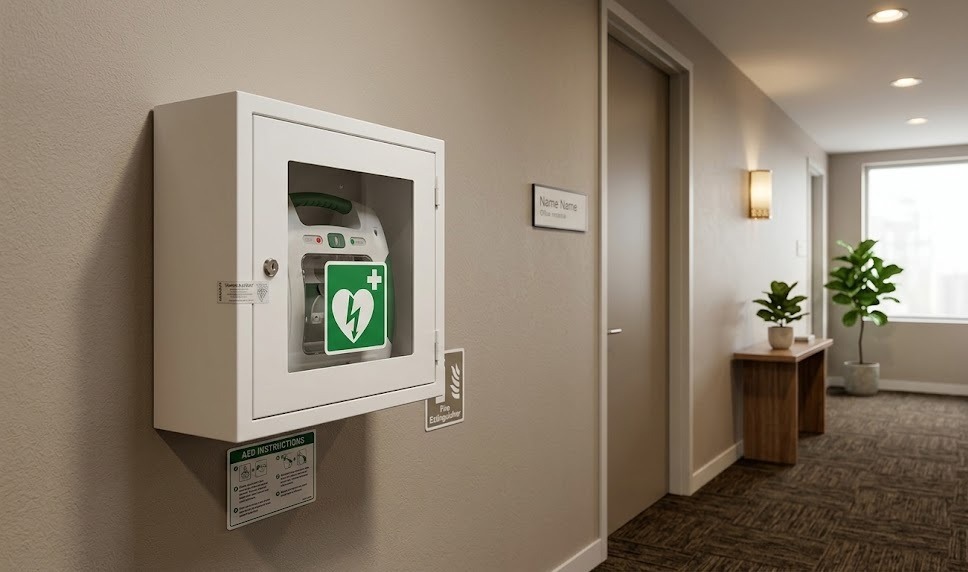
Installing a cardioprotection station within companies, sports facilities, schools, shopping centers, or public spaces is a life-saving decision. However, the effectiveness of an Automated External Defibrillator (AED) depends directly on its immediate availability and the perfect condition of its electronic components and disposable pads. Choosing the right defibrillator cabinet doesn't mean buying a simple storage case, but rather equipping yourself with an active and passive protection device capable of isolating the AED from temperature changes, dust, and humidity, signaling its emergency removal, and preventing tampering or theft. This buying guide will help you evaluate the models in the Holity.co.uk catalog, analyzing the distinction between indoor and outdoor use, millimeter dimensional measurements, thermoregulation systems, and current legal regulations.
The primary factor driving cabinet selection is where the cabinet will be placed, as environmental stresses vary dramatically between indoor and outdoor environments:
Designed to protect the AED in covered, air-conditioned, and weather-protected locations (e.g., company corridors, gyms, hotel lobbies, schools, and public offices).
Developed to ensure the defibrillator operates outdoors (squares, public parks, stadiums, stations and company driveways), exposed to rain, frost, solar heat and vandalism.
The online catalogue allows you to filter the display cases based on their volumetric dimensions and the method of fixing in the environment:
The integration of electronic components in the cabinet increases the responsiveness of the rescue chain and protects the medical equipment:
The variety of offers on Holity.co.uk allows you to calibrate your spending based on the destination context, moving within a price range between €78.00 and €623.00:
The installation of an AED cabinet must comply with specific legal parameters to guarantee the traceability and accessibility of the device:
Make your facility a safe and cardioprotected place, protect your defibrillator from temperature changes and adapt your company or public entity to the requirements of Law 116/2021. Explore our online catalog to select the most suitable cabinet model: set the type (for indoor or outdoor), define the millimetric dimensions and choose the necessary alarm or heating systems.
Are you the company safety manager (RSPP), a school principal, the manager of a sports center or do you need to place an order for the Public Administration via MePA / Consip? Request a personalized quote today: our sales team is at your complete disposal to provide you with technical data sheets, IP certifications and reserved offers for multiple orders.
How does the thermostatically controlled cabinet heating system prevent premature discharge of the AED lithium battery in winter?
The lithium batteries used by semi-automatic defibrillators suffer a sudden decline in performance when the ambient temperature drops below freezing. Prolonged cold increases the battery's internal resistance, reducing its residual charge and risking compromising the AED's ability to deliver a high-voltage electric shock during resuscitation. The outdoor cabinet with heating integrates a ceramic plate or cartridge connected to an internal thermostat: when the temperature of the cabinet drops below +5°C, the heater automatically switches on, maintaining the internal air around +10°C/+15°C, protecting the battery chemistry and the fluidity of the conductive gel of the plates.
What waterproof characteristics (IP54 / IP55 rating) must an outdoor cabinet installed in coastal or rainy areas have?
The IP (Ingress Protection) rating defines the cabinet's insulation against solid objects and liquids. A cabinet with an IP54 rating guarantees effective protection against dust and splashes of water from any direction. The IP55 rating offers a higher level, sealing the cabinet against direct water jets and high-intensity driving rain. In seaside locations exposed to salt spray, in addition to the IP55 rating, it is essential that the cabinet body be made of stainless steel (AISI 304/316) or high-density resins that are resistant to salt corrosion.
Why does the magnetic microswitch audible alarm sound when the door is opened, and how does it help the rescue chain?
The audible alarm integrated into the cabinet is activated by a magnetic contact located on the door frame. When the rescuer opens the door to remove the AED, the contact is interrupted and a 90-100 dB siren immediately activates. This signal serves two crucial functions: on the one hand, it draws the attention of other people present or healthcare personnel inside the building to call 112/118 and assist the operator; on the other, it discourages attempts at theft or vandalism towards the medical device.
How do you check if the dimensions of the chosen cabinet are suitable for containing your specific defibrillator model?
To check dimensional compatibility, you need to measure the three external dimensions of the defibrillator including its rigid or semi-rigid protective bag. The technical data sheets for the cabinets on Holity.co.uk show both the external dimensions of the frame and the useful measurements of the internal compartment. A standard cabinet with a length between 350 and 400 mm, a height between 350 and 450 mm and a depth between 150 and 200 mm is suitable for housing over 95% of the AEDs on the market (Zoll AED Plus, Philips HeartStart, Cardiac Science Powerheart, Mediana, etc.).
How does the price range of the catalogue (€78.00 - €623.00) correlate with the presence of thermal systems, visual sirens and floor lamps?
The cost structure is determined by the technology integrated into the cabinet and the carpentry materials. The entry-level range (€78.00 - €150.00) includes basic indoor wall-mounted cabinets in metal or ABS without heating. The mid-range range (€150.00 - €350.00) includes indoor or outdoor cabinets equipped with an audible siren, flashing light, and snap-lock systems. The top-of-the-range prices (up to €623.00) include insulated outdoor cabinets with automatic thermostatic heating, armored stainless steel frames, and freestanding, high-rise, freestanding totem stations for street furniture.
 English
  Italian
 French
 German
 Spanish