
mon-fri 9-13 / 14.30-18.30
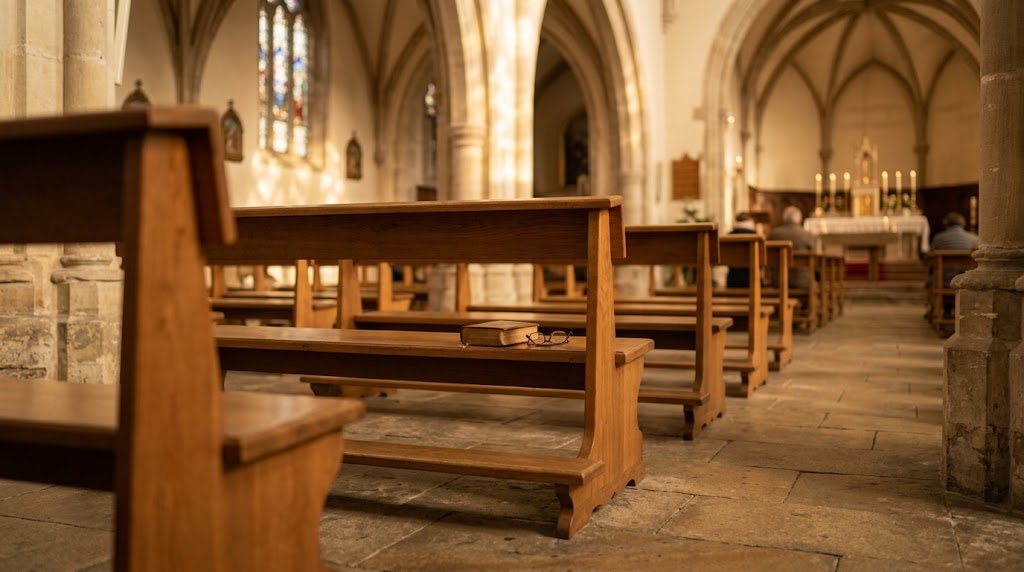
The choice of church pews affects the organization of the nave, the comfort of the faithful, and the coherence of the furnishings with the liturgical space. The Holity catalog includes 125, 150, and 200 cm seasoned wood models, with or without kneelers and in various finishes. To choose correctly, it is useful to evaluate length, configuration, type of wood, accessories, space between rows, and the support or fixing methods required by the project.
The Holity range offers a choice of beech, ash, and oak finishes, in natural or dark tones depending on the model. The choice must take into account, above all, the aesthetics of the room, how it will match with other furnishings, and the characteristics stated in the technical data sheet.
It is not correct to establish an absolute hierarchy of quality between the essences. Durability and stability also depend on seasoning, thickness, workmanship, assembly, finishing and environmental conditions.
The catalogue offers both benches with kneelers and versions without this element. The choice depends on the intended liturgical use, the available space and the configuration of the nave.
These are suitable when you want to integrate a support directly into the bench for moments of celebration that require kneeling. Some models can be customized, upon request, with a liftable or padded kneeler.
These offer a simpler configuration and can be useful in chapels, liturgical rooms or areas where you want to leave greater freedom in the space in front of the seat.
Depending on the model, book rests, anatomical or semi-anatomical seats, padding, commemorative plaques and bag hooks may be available upon request. Optional extras must be verified on the individual product sheet.
The Holity category includes benches of 125, 150 and 200 cm. The length must be chosen in relation to the width of the aisle, the number of rows planned, the corridors and the spaces required for the movement of people.
It is not appropriate to assign a fixed number of seats to each length without considering the actual width required for each user and the overall design of the room.
The Holity models consulted are equipped with non-slip rubber pads at the base. The possible fixing to the floor should not be considered mandatory or excluded a priori: it should be evaluated based on the pew, the floor, the use and the project. In historic or protected buildings, any interventions on the flooring must be verified with the competent professionals and bodies.
The arrangement of the pews must be designed considering passageways, escape routes, accessibility and characteristics of the place of worship. There is no universal distance between the rows valid for every church: depth of the pew, presence of the kneeler, geometry of the nave and applicable requirements can modify the required space.
If it is necessary to provide spaces for people in wheelchairs or other accessibility needs, the dedicated spaces must be integrated into the plan without obstructing the passageways. Any fire reaction requirements or surface treatments must also be verified in the product documentation and in the applicable fire safety project, without automatically considering them present on all pews.
The price of a church pew depends on length, configuration with or without a kneeler, chosen finish and requested options. Since prices and availability may change, it is preferable to compare the models in the catalogue rather than using rigid price ranges as a selection criterion.
For supplies of multiple rows, it is useful to first define the floor plan, the number of pews, the required lengths and accessories, so as to request a quote consistent with the overall setup.
Explore the selection of church pews on Holity and compare the models by length, presence of a kneeler, wood finish and available accessories.
For supplies intended for parishes, chapels, religious institutions or other places of worship you can request a personalized quote indicating quantities, required measurements, configuration and desired finish.
Which wood should I choose for a church pew?
Beech, ash and oak offer different aesthetic aspects. The choice should be made considering the finish, the combination with the existing furnishings and the construction characteristics of the individual model, without presuming that one type of wood is always superior to the others.
Is a pew with or without a kneeler better?
It depends on the liturgical use and the available space. The model with a kneeler integrates the support into the pew; the one without a kneeler leaves more space in front of the seat.
Is it mandatory to fix the pews to the floor?
There is no single answer that is valid for every installation. The need for fixing must be assessed in relation to the structure of the bench, the floor, the layout and the project requirements.
What distance should be left between the rows?
It is not correct to indicate a universal value. The distance must allow for sitting, possible use of the kneeler and passage, while respecting the accessibility and escape needs foreseen for the space.
What optional features are available?
Depending on the model, book shelves, padding, anatomical or semi-anatomical seats, commemorative plaques, bag hooks and special configurations of the kneeler may be requested. Availability must be verified before ordering.
 English
 Italian
 French
 German
 Spanish