
mon-fri 9-13 / 14.30-18.30
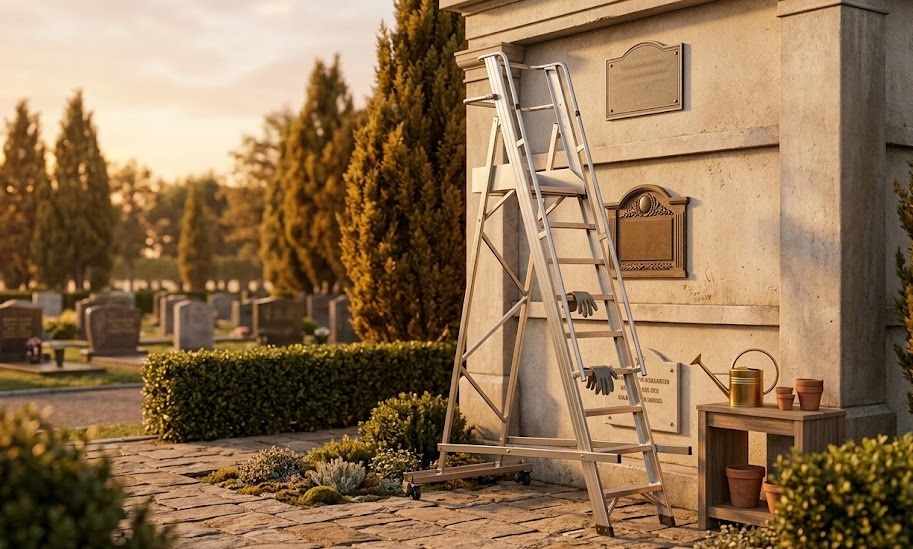
Managing cemetery areas and maintaining columbaria require highly specialized equipment, designed to ensure safe access to the burial niches located in the upper rows. Choosing the right cemetery ladders, particularly those with a bunk or platform configuration, isn't just a logistical decision; it's a strategic investment aimed at protecting the safety of both workers and visitors (often the elderly), while also providing decorum and stability. Whether you're a municipal administration responsible for public cemetery services or a manager of private monuments and chapels, having stable, lightweight, and weather-resistant ladders is essential for carrying out cleaning tasks, replacing votive lamps, and caring for floral arrangements with complete peace of mind. This buying guide is designed to help you navigate the various models in our online catalog at Holity.co.uk, analyzing construction types, safety features, and industry regulatory requirements.
In the panorama of professional cemetery equipment, external and internal ladders differ mainly based on the geometry of the structure and the ability to adapt to the specific architectural barriers of the site.
These represent the standard and most widespread configuration, equipped with a predefined height and a large upper walkable surface protected by containment elements.
Advantages: They offer exceptional stability and a comfortable workstation at height, surrounded by a safety guardrail on three sides. They allow the operator or visitor to work with both hands free, eliminating the risks typical of traditional domestic ladders.
Disadvantages: Having a fixed height and size, they require predefined storage spaces and linear routes free of fixed obstacles on the ground.
Ideal for: Modern columbaria arranged in rows at constant heights, wide avenues, newly built cemeteries and straight loggias.
Advanced engineered systems with an operating surface that protrudes (cantilevered) from the support base and the lower uprights.
Advantages: They allow you to get millimetre-closer to the wall of the columbaria, safely overcoming obstacles on the ground, such as protruding historic tombstones, monumental flower boxes, steps or low walls delimiting the tombs.
Disadvantages: Geometrically more imposing structures that require a greater radius of manoeuvre and horizontal transit space in corridors.
Ideal for: Historic cemeteries, monumental areas rich in artistic elements on the ground and cemetery sections with fixed perimeter obstacles.
Flexible solutions equipped with extendable uprights that allow you to adjust the height of the work surface according to the needs of the moment.
Advantages: Maximum versatility of use. With a single professional tool it is possible to work on rows of niches placed at different heights, optimising the economic investment and reducing the overall number of equipment to be purchased.
Disadvantages: They require periodic checking of the locking and telescopic sliding mechanisms to ensure their perfect long-term efficiency.
Ideal for: Cemetery structures articulated on multiple levels, small municipalities with optimised budgets or multi-row family chapels.
To configure a long-lasting and efficient supply of professional ladders, it is essential to base your search by analysing the millimetric parameters and construction details of the frames.
The first parameter to calculate is the maximum working height required, estimated by adding the average height of the operator to the height of the last usable step (the upper platform). The number of steps must be proportionate to the construction you intend to reach to allow work on the burial niches while maintaining the torso in a natural and ergonomic position, without forcing the user to lean over the parapet.
The plan geometry of the ladder must be compatible with the layout of the internal routes. In cemeteries with narrow avenues or confined corridors, it is preferable to opt for compact models or models equipped with retractable stabilisers that do not obstruct circulation. The availability of space-saving closing systems facilitates storage in narrow warehouses or service rooms, protecting the ladder from the elements.
Since these are equipment intended primarily for outdoor use, the choice of metal is crucial. High-strength ribbed extruded aluminum represents the gold standard: it guarantees an unbeatable ratio between structural lightness (allowing a single operator to move the ladder effortlessly) and maximum mechanical strength against bending. Furthermore, aluminum is naturally immune to oxidation and rust caused by constant exposure to rain, frost and atmospheric humidity.
Mobility along driveways requires adequate wheels: larger diameter wheels facilitate transit on gravel, uneven road surfaces or bumpy pavements, while smaller wheels are suitable for smooth marble or concrete surfaces. A fundamental safety requirement is the presence of self-braking type wheels: when the user climbs onto the first step, the weight compresses a spring system that retracts the wheels or activates a mechanical lock, causing the base of the ladder to rest firmly on the non-slip rubber pads on the ground and making it completely immobile.
Large Municipal Cemeteries and Open-Air Avenues: The use of fixed ribbed aluminium step ladders is recommended, equipped with large-diameter self-braking wheels for mixed terrain or gravel and large platforms with integrated tool trays. They offer maximum durability and resistance to intensive wear and tear from visitors.
Historic Cemeteries, Loggias and Monumental Galleries: The ideal choice is cantilevered models or those equipped with adjustable stabilizers and independent feet to compensate for unevenness. They allow for maintenance and cleaning operations to be carried out in the upper rows by moving close to the wall without risking hitting or damaging the artistic tombstones, flower boxes or monuments placed at the base of the columbaria.
Family Chapels and Confined Service Depots: In these environments characterised by limited space, the optimal solution involves the use of folding or telescopic ladders with variable heights. They can be folded up to a few centimetres when not in use, optimising internal logistics without obstructing public passageways.
Ensure maximum safety for workers and visitors, adapt your facility to the accident prevention protocols of the Consolidated Act and optimize the management of your columbaria with the professional products from Holity.co.uk. In our online catalog you will find a complete and certified assortment of cemetery staircases, bunk ladders and cantilevered models in high-quality aluminum, designed to withstand intensive use cycles in maximum stability conditions.
Use our side navigation filters to select the number of steps and configure the perfect floor height for your architectural needs. Do you represent a municipality, a municipal cemetery services company or do you need a dedicated quote for complex tender specifications and purchases through Public Administration portals (MePA)? Contact our customer service today to receive complete technical data sheets and a personalized quote tailored to your project.
What are the advantages of ribbed aluminum for cemetery stairs?
Ribbed extruded aluminum guarantees the perfect balance between structural lightness and mechanical resistance. This material allows for the construction of solid stairs that do not undergo permanent deformation under the weight of the user, but remain light enough to be moved easily along paths by a single person, naturally resisting rust caused by external humidity.
What does it mean for a cemetery staircase to comply with Legislative Decree 81/08?
Compliance with Legislative Decree 81/08 certifies that the staircase meets all the safety requirements prescribed by the Consolidated Law on health and safety in the workplace. It ensures that the equipment is equipped with efficient fall arrest systems, non-slip steps and certified stability to protect operators who carry out professional activities at height.
How do self-braking wheels in step ladders work?
Self-braking wheels integrate an intelligent load-sensitive spring system. When the ladder is empty, the wheels remain active to allow for smooth and rapid movement; as soon as the operator places their foot on the first step, the weight compresses the spring, causing the wheels to retract and bringing the base of the ladder to rest directly on the stable rubber pads, making it immobile during the ascent.
What is the ideal working height for a five-row columbarium?
To work comfortably on the fifth row of a columbarium (located approximately 3-4 metres high), a ladder that offers a height to the upper platform of approximately 2-2.5 metres is recommended. This height allows the operator to intervene on the burial niche while maintaining an upright and natural posture of the torso, working in total comfort inside the parapet cage.
Can cemetery ladders be used on gravel or sloping ground?
Yes, many professional models are designed with larger diameter wheels and large stabilizing bases specifically to tackle gravel paths or the uneven road surfaces of outdoor cemeteries. In the case of steep slopes, the use of variants equipped with independent adjustable feet is highly recommended to compensate for any unevenness in the ground and to ensure the ladder is perfectly level.
What safety accessories are essential for high step ladders?
For ladders that reach high heights, the continuous protective parapet on three sides (at least one metre high), the lateral handrail along the ramp to facilitate grip and the rear locking chain on the platform are considered necessary safety requirements. These elements create a total protective cell around the user, allowing him to operate with both hands free.
 English
  Italian
 French
 German
 Spanish