
mon-fri 9-13 / 14.30-18.30
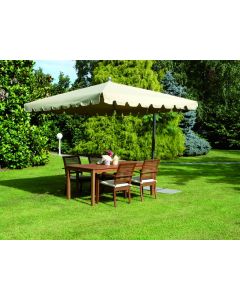
Umbrella Montura aluminum and fabric in polyacryl-based T swivel and tilt available in various colors
Cantilever umbrellas represent a solar protection solution particularly valued in HoReCa environments and residential outdoor spaces because their offset frame allows for maximizing the shade area without occupying useful walking surface. Unlike central pole umbrellas, these models offer superior positioning flexibility, allowing for tilts and rotations that adapt to the sun's movements throughout the day.
The structural versatility of cantilever umbrellas makes them suitable for bars, restaurants, hotels, public gardens, and hospitality facilities where space is a critical factor. Modern acrylic fabrics, often treated to be water-repellent, guarantee protection not only from solar radiation but also from precipitation, thus extending the seasonal period of use.
Choosing a side-post cantilever umbrella proves decisive in contexts where space optimization is essential. Compared to traditional central pole umbrellas, the offset structure allows for a more efficient distribution of the shaded area, eliminating the central pole that takes up usable floor space. This aspect is crucial in commercial environments such as bar and restaurant terraces, where every square meter has economic value. The tilting and rotating capacity allows for following the sun's path, ensuring constant protection from 8 AM to 6 PM without the need to move heavy structures.
From an operational standpoint, cantilever umbrellas offer tangible advantages: the opening mechanisms via crank, pulley, or tilting system reduce physical effort during daily use, a significant factor for the staff of busy facilities. Water-repellent treated acrylic fabrics also protect during light precipitation, prolonging the usage season and improving guest comfort. For environments with high aesthetic demands, noble materials such as wood and painted aluminum provide natural elegance, transforming the protective function into a design element.
The cantilever umbrella market presents a wide variety of constructions, responding to different functional and contextual needs. Models with a fixed aluminum T-base represent the most economical and quick-to-install solution, ideal for temporary spaces or frequent layout rotations. These umbrellas maintain acceptable stability thanks to the weight of the base itself, though they require regular checks in case of high winds. Fixed-arm models, without joints, guarantee maximum structural solidity but less positioning flexibility, making them more suitable for permanent installations where the solar angle has been assessed in advance.
Tilt-swivel variants represent the optimal compromise for most applications: they allow 360° rotations and tilts up to 45°, covering dynamic solar protection needs. Tilting models, with a left and right tipping system, offer additional wind protection by folding the umbrella when gusts reach critical speeds. Wooden versions with a side arm maintain a superior aesthetic value in high-end environments, although they require periodic maintenance. Finally, multiple or telescopic umbrellas, with sizes up to 6x6 meters, meet the coverage needs of large surfaces, common in resorts, major hotel structures, and equipped public spaces.
The selection of a cantilever umbrella must preliminarily consider three fundamental technical parameters: the surface to be covered measured in square meters, the prevailing solar exposure, and the recurring climatic conditions at the specific location. For a standard bar terrace of 20-30 square meters, 2.5x2.5 square or 2.5x3 meter rectangular models guarantee sufficient coverage without excessive side overhangs that could cause aerodynamic problems. Assessing the average wind speed at the installation site determines the choice between fixed, tilting, and rocking models: in coastal or mountainous areas with frequent gusts, opting for systems with automatic tipping reduces the risk of structural damage.
The most common mistake is underestimating the base material: a lightweight aluminum base requires the addition of ballast (gravel, concrete) weighing at least 40-50 kg to ensure stability in moderate wind conditions. In permanent contexts, such as hotel or restaurant terraces, it is preferable to opt for wall mounting or chemically fixed bases. The choice of fabric directly affects maintenance and durability: 350-gram treated acrylic offers a balance between UV protection, waterproofness, and manageable weight; versions exceeding 400 grams guarantee better resistance but increase the structural load. For protected environments (courtyards, enclosed gardens), umbrellas with simple manual opening are sufficient; for open and high-traffic spaces, crank or pulley mechanisms simplify daily operations.
Cantilever umbrellas, even if they do not fall into the category of permanent fixed structures, must comply with safety and quality standards defined mainly by European and Italian regulations. The UNI EN 13561 standard establishes safety requirements for portable solar protection structures, including aerodynamic stability tests, material resistance, and joint solidity. For installations in public spaces open to the public (commercial terraces, beach areas), structures must undergo periodic inspection to check the wear status of poles, ribs, and fabrics, especially after significant weather events.
The manager's civil liability requires that the structures be maintained in safe conditions: a damaged or unstable umbrella that fails during use can expose the operator to legal disputes. Regarding wall installation, it is mandatory to verify that the masonry is capable of supporting the expected loads (generally 300-500 kg for medium-large models), potentially requiring structural consolidation. In coastal municipalities and areas classified as high-wind zones, some local regulations impose limits on the maximum allowed weight of the structure or require technical conformity declarations. The fabric must comply with fire reaction regulations (Euroclass C or higher in public environments) and preferably have UV resistance certifications to ensure long-term durability.
Explore all products in the category and compare the available solutions to find the one best suited to your operational context. The correct choice of a cantilever umbrella depends on a careful evaluation of functional needs, spatial constraints, and specific environmental conditions of your installation.
A fixed-arm umbrella maintains the initial angle without the possibility of adjustment, suitable for spaces where solar exposure is constant. The tilt-swivel umbrella allows movements up to 45° and 360° rotations, allowing it to follow the sun throughout the day. This versatility makes the latter preferable for the majority of HoReCa applications.
For a standard terrace of 30-40 square meters, 2.5x2.5 meter square models or 2.5x3 meter rectangular models guarantee adequate coverage for 4-6 people per umbrella. In tighter spaces (20 sqm), 2x2 meter formats are sufficient; for large terraces, considering multiple umbrellas rather than a single large model improves operational flexibility.
A fixed base requires a minimum ballast of 40-50 kg distributed evenly. For permanent installations, prefer wall mounting or fixing to a reinforced concrete base. In windy climates, choose tilting models that fold automatically, or umbrellas with side tension cables that stabilize the structure during gusts.
350-gram treated acrylic represents the optimal quality-price standard, offering UV protection greater than 90% and lasting water repellency. Versions at 400+ grams guarantee greater resistance but increase structural weight. Always check fire reaction certifications (minimum Euroclass D) for regulatory compliance in public spaces.
Yes, if subjected to regular maintenance. Modern acrylic fabrics withstand 3-5 years of continuous exposure; painted aluminum structures require annual oxidation checks; wood needs seasonal protective treatments. In marine areas, salinity accelerates degradation: check metal connections every 6 months.
The cost ranges from 600 to 3,500 euros for the product, plus 200-800 euros for specialized installation depending on the wall complexity and the type of anchoring required. For structural solidity checks of the wall, consult a civil engineer; additional costs are added if preventive wall consolidation work is necessary.
Modern umbrellas with water-repellent treated acrylic fabric offer protection against light and moderate rain; however, they are not absolutely waterproof. Standing water on the surface can seep through the seams. For total protection from heavy rain, add PVC side curtains or choose fixed solutions like polycarbonate canopies.
Clean the fabric every 6-8 weeks with water and neutral soap; check joints and tension cables monthly. In winter, fold the canopy or choose the most protected position possible. Inspect poles, ribs, and rotation mechanisms annually; lubricate joints with silicone grease. Immediately replace damaged ropes or canopies to prevent sudden failure.
 English
 Italian
 French
 German
 Spanish