
mon-fri 9-13 / 14.30-18.30
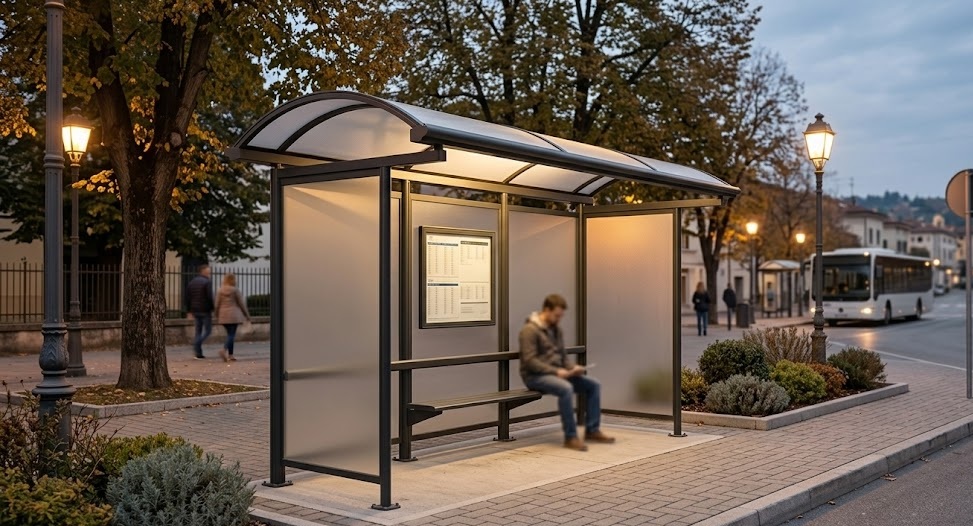
A citizen or commuter's experience in a public space is defined by the details, and the public transport stop is one of the key points they interact with on a daily basis. Choosing the right bus shelters isn't just a matter of urban decor, but a strategic investment in terms of durability, safety, and community comfort. Whether for a municipal administration, a transport company, or a private complex, the consistency and quality of street furniture immediately conveys care for the area, accessibility, and professionalism. This buying guide is designed to help you navigate the various models in our catalog, analyzing structural types, specific dimensions, and materials, allowing you to select the ideal product to optimize maintenance costs and improve the waiting experience for users.
On our e-commerce site, the main classification of bus shelters is based on the management of rainwater runoff, a crucial factor in ensuring the comfort and protection of passengers on rainy days.
This variant represents the most complete and widespread solution for street furniture, designed with an integrated rainwater collection and drainage system.
Advantages: They channel water towards the uprights or special drains, avoiding annoying frontal or lateral dripping right at the point of passenger entry and exit. They guarantee greater structural protection and superior comfort for those sheltering inside.
Disadvantages: They require a little extra periodic attention to clean the gutter from leaves or debris to maintain its efficiency.
Ideal for: High-traffic stops, urban areas and extra-urban lines where passengers stop for long periods and require maximum protection from the elements.
Models characterised by a slimmer and more essential structural line, in which the covering is shaped or inclined to allow water to flow naturally towards the back or external sides.
Advantages: Extremely clean and minimal design, easy installation and zero maintenance, as there are no drainage channels that risk becoming blocked.
Disadvantages: The free flow of water requires careful study of the positioning with respect to the pavement to prevent the runoff from disturbing the surrounding pedestrian passage.
Ideal for: Modern contexts, low-budget installations, areas with low rainfall or pavements where the space behind the shelter allows natural drainage onto the ground without hindrance.
To structure a public furniture project that perfectly responds to the available space and resists wear and tear over time, it is essential to analyse the specific dimensional and technical parameters of our range.
The choice of the ideal shelter must be based on the actual measurements of the sidewalk or parking space. Our filter system allows you to configure the structure to the millimetre based on three fundamental axes:
The choice of material defines the aesthetics of the urban context and the structural resistance to vandalism and corrosive agents:
Each shelter must be installed ensuring maximum stability and public safety. The ground fixing systems using tie rods or plates to be bolted onto concrete plinths ensure structural resistance against strong gusts of wind and snow load, complying with current building and urban planning safety regulations.
Narrow sidewalks and busy city centers: The perfect combination is a shelter with a reduced depth (e.g. 123 cm) and a compact length of 227 cm, preferably without a gutter if integrated into spaces with an ultra-minimalist design, so as not to take up precious space from pedestrian traffic.
Interchange hubs and school/hospital stops: In high-density contexts, it is essential to focus on shelters with a gutter, with longer lengths (from 314 cm to 319 cm) and extended depths, guaranteeing comfortable internal seating and total protection from pouring rain for large groups of people.
Peripheral or weather-exposed areas: We recommend adopting imposing structures with heights of 255 cm and systems with integrated guttering, capable of handling large volumes of water and offering a safe and comfortable visual reference point along major roads.
Don't let the street furniture of your city or company be neglected. Renovate rest areas and public transport stops with our range of professional bus shelters on holity.co.uk. Use the navigation filters to select the type with or without guttering and set the exact dimensions of length, height and depth you need.
Are you a public administration, a transport company or a designer and need a dedicated quote? Contact our customer service team today: our team is at your complete disposal to provide you with a personalized quote, technical support for specifications and assistance with purchasing in the public procurement sector.
How do you calculate the road clearance and the useful depth of the pavement before installing the shelter?
During the planning phase, it is essential to consider both passenger safety and residual pedestrian traffic. The Highway Code and regulations on the removal of architectural barriers require maintaining a clear corridor on the pavement (generally at least 150 cm) to guarantee the passage of wheelchairs and pushchairs. Using our depth filters (from 123 cm, 167 cm up to 319 cm), you can select the perfect overhang that ensures optimal shelter while leaving road and pedestrian traffic completely free from obstacles.
What certifications are provided to support structural loads (snow and wind pressure)?
All bus shelters for public use in the catalogue are supplied complete with technical documentation and structural calculation reports drawn up in compliance with the Technical Construction Regulations (NTC) and the Eurocodes. Static and dynamic load tests certify the stability of the metal structure and the roofing against snow accumulations and strong gusts of wind, an essential requirement for testing and approval of the project by the municipal technical offices.
Why is laminated safety glass preferred over ordinary glass in public infill walls?
Laminated safety glass infill meets stringent passive safety and accident prevention requirements. In the event of a violent impact or vandalism, the internal PVB (Polyvinyl Butyral) film holds glass fragments cohesively to the structure, preventing the dispersion of sharp shards that could injure waiting citizens. Furthermore, this material offers unalterable transparency over time, improving visibility and perceived safety at night.
Are the shelter uprights and frames prepared for the passage of electrical or smart systems (e.g. information displays, LED lights or USB ports)?
Yes, many of the advanced and modular professional models have hollow uprights or integrated internal conduits, specifically designed to allow the hidden and protected passage of electrical cables. This structural predisposition facilitates the electrification of the stop for the connection of digital timetables, LED lighting systems or USB charging ports for mobile devices, without compromising the aesthetics and safety of the structure.
How does rainwater runoff work in models marked "without gutters"?
The variants without gutters do not cause water to stagnate on the roof, but exploit a calculated geometric inclination of the canopy (single pitch or cantilevered curve). This design allows rainwater to slide and flow away in a natural and unified way towards the rear or external sides of the structure. It is the ideal configuration for installations in which the canopy borders green areas or draining land behind, eliminating any burden of cleaning the drains.
What documents do you provide for Public Administration purchases and for tender procedures (MePA)?
holity.co.uk is fully enabled to operate on the Public Administration purchasing portal (MePA) and on the main regional e-procurement circuits. For every street furniture supply, we provide complete financial flow traceability, an updated DURC (Contribution Regularity Document), material compliance declarations, and compliance with Minimum Environmental Criteria (CAM) for metal recyclability, simplifying the bureaucratic management associated with issuing CIG (Central Income Guarantee Fund) and direct or tendered contracts.
 English
  Italian
 French
 German
 Spanish