
mon-fri 9-13 / 14.30-18.30
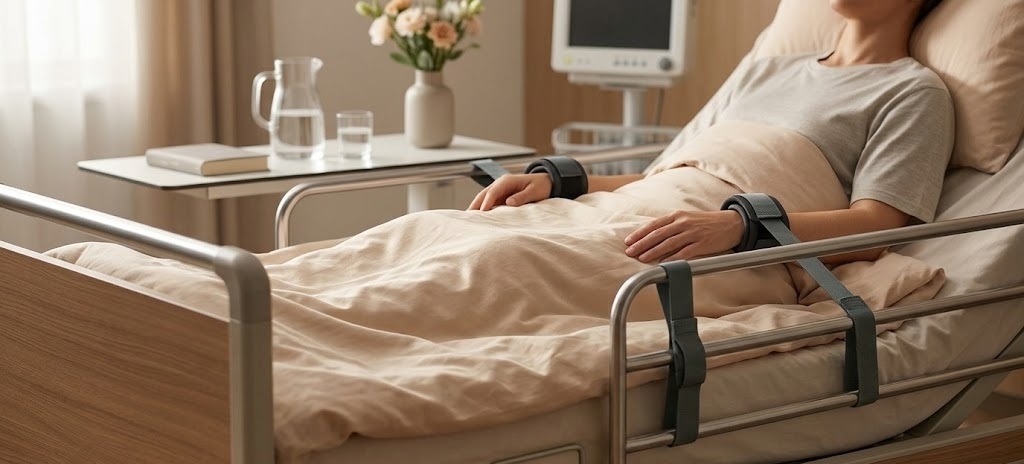
The clinical management and postural stabilization of patients confined to bed due to cognitive deficits, psychomotor agitation, or severe neurological dysfunctions require the adoption of medical devices capable of combining absolute safety with respect for the individual's dignity. Choosing the right bed belts and restraints is not a simple decision regarding furniture or pure containment, but represents a biomechanical and therapeutic evaluation aimed at minimizing the risk of harmful falls and preventing self-harm. In critical departments such as intensive care, geriatric units, nursing homes (RSA), or in complex home care settings, the application of these devices must ensure uniform pressure distribution, avoiding vascular complications or skin lesions. This purchasing guide was created to guide you through the various solutions available in the Holity.co.uk catalogue, analysing closing kinematics, fabric compatibility and millimetric parameters of anatomical adjustment.
The panorama of bed stabilisation devices is divided into diversified macro-constructive typologies, engineered to offer partial, total or selective postural control of the limbs.
These represent the fundamental modules for the perimeter control of the patient's centre of gravity, designed to prevent slipping or attempts to climb over the sides of the bed.
Advantages: This configuration adapts perfectly to the morphology of the trunk, allowing controlled freedom of movement for prone or lateral decubitus. The large contact surface reduces localised pressure, ensuring excellent stability of the torso during night-time or daytime rest.
Disadvantages: They require a rigorous anthropometric measurement of the chest circumference to avoid the onset of respiratory constrictions.
Ideal for: Geriatric patients with space-time disorientation, subjects affected by degenerative dementia or with reduced postural awareness.
Devices aimed at the controlled blocking of the upper or lower limbs, developed to prevent the involuntary removal of vital devices.
Advantages: They allow the action of the arms and legs to be limited without applying total restraint to the patient's torso. They are equipped with soft internal anti-rubbing padding that protects the peripheral vascular districts and fragile skin tissues from friction trauma.
Disadvantages: The application requires constant monitoring of the limbs to exclude alterations in peripheral circulation.
Ideal for: Patients in intensive care or post-operatively who tend to remove catheters, probes, endotracheal tubes or intravenous infusion lines.
Engineered configurations for complex clinical conditions, where involuntary movements take on violent kinetic vectors.
Advantages: The retractor models keep the lower limbs in a stationary separated position, preventing pathological postural crossings. The reinforced rigid corsets offer an insurmountable mechanical barrier against extreme torsional thrusts, eliminating the probability of the device becoming dislodged.
Disadvantages: Maximum degree of motor limitation, to be associated with strict fixed-term care protocols.
Ideal for: Acute states of psychomotor agitation, emergency psychiatric departments and patients with chorea or involuntary ballistic movements.
---
To structure an effective protection protocol and avoid iatrogenic complications, it is essential to set up the research by calibrating the geometric and economic parameters based on the physical characteristics of the patient.
The height of the abdominal band defines the distribution surface of the weight force exerted by the patient. Our catalogue offers targeted geometric modularity, structured on standard widths between 14 cm and 22 cm. The 14 cm variants are indicated for light restraints or for small and pediatric builds, offering a fair amount of dynamic freedom; Conversely, 22 cm supports are essential in the presence of moderate or severe agitation, as they increase the pressure relief area and prevent dangerous axial rotation of the trunk on the bed.
The locking interface must be selected based on the patient's level of cooperation and the risk of autonomous tampering with the device:
The bed fastening straps must be able to adapt to the different types of hospital networks (articulated, fixed or bariatric). The catalogue includes widely adjustable circumference ranges ranging from 70 cm up to 130 cm for the abdominal belts, while the wrist and ankle supports cover diameters from 15 cm to 30 cm, ensuring a perfect anatomical fit for both pediatric profiles and bariatric patients.
The sustainability of healthcare investments must be able to be connected with the need to have durable devices, washable at high temperatures and resistant to extreme mechanical traction. Our professional range meets any budget, offering a flexible price range from €26.00 for individual limb immobilization straps or replacement accessories, up to €526.00 for complete dual-zone, multi-position kits with coded magnetic closure, also available in multiple packs of 2 to optimize operating costs for large hospital facilities.
---
Prolonged contact of fabrics with the skin of bedridden and often incontinent patients requires the use of hypoallergenic and breathable yarns. Our belts use advanced material compositions: from 100% natural cotton, soft and temperature-regulating, to polypropylene and padded polyester, which offer extremely high linear tensile strength (up to test loads exceeding 200 kg) and do not retain organic moisture. For patients with extremely fragile skin, compromised vascularization, or at high risk of pressure ulcers, variants lined with Merino wool are available, a natural fiber capable of minimizing lateral shear friction and evenly distributing contact pressure, integrating padding with a minimum thickness of 5 mm in critical pressure areas.
---
Intensive Care, Resuscitation, and Emergency Departments: The priority in this scenario is selective immobilization of the limbs to safeguard infusion lines and endotracheal tubes. The use of padded polypropylene wrist and ankle straps with sliding or quick-release Velcro closures is recommended, which allow immediate access to the vascular districts by nurses in the event of a medical emergency.
Geriatric Facilities, Nursing Homes and Day Centers: In settings where the patient experiences disorientation or attempts to get up involuntarily at night, the optimal choice is trunk belts with a 14 cm or 22 cm corset in natural cotton, equipped with magnetic safety buttons. This configuration prevents falls by allowing the patient to turn onto their sides, maintaining comfort and reducing anxiety.
Home Care and Private Rehabilitation: For the home management of temporarily non-self-sufficient or confused patients, single-piece models with a trident buckle or Velcro closure represent the most balanced solution in terms of ease of use for family caregivers, ensuring effective protection during nighttime rest without requiring the use of complex magnetic keys.
---
Increase the safety levels of your hospital rooms, eliminate morbidity rates related to falls from bed and guarantee your nursing staff an ergonomic, reliable and clinically validated work tool. In the Holity.co.uk online catalogue you will find a specialized and certified assortment of soft bed restraint systems, developed to withstand continuous cycles of intensive use and industrial thermal washing.
Use our side navigation filters to set the adjustable circumference radius required for your users, select the height of the abdominal corset and configure the executive budget (€26.00 - €526.00) consistent with your procurement plans. Contact our customer service team today to receive complete technical data sheets, mechanical resistance parameters and personalized advice tailored to your care needs.
---
How does the calculation of surface pressure distribution differentiate the therapeutic action of a 14 cm corset compared to a 22 cm one?
The physics of restraint is based on the distribution of vector forces expressed by the patient's body mass in motion. A corset with an abdominal height of 14 cm concentrates the retention force on a narrow anatomical band, making it ideal for containing smaller builds or for exercising light postural recall. The 22 cm variant significantly expands the contact surface area, reducing the specific localized pressure on the soft tissues and abdominal organs; This increase prevents crushing injuries and prevents the belt from shifting or migrating vertically towards the rib cage in the event of forceful pushes.
What kinematic features differentiate a coded magnetic locking system from a common mechanical buckle in terms of active safety?
Mechanical buckle or Velcro fastening systems offer rapid activation but can be manipulated and opened independently by patients who retain partial fine finger mobility, making them unsuitable in the presence of severe mental confusion. The magnetic safety button introduces an active safety barrier: the mechanism is locked via a metal bayonet coupling that can only be disengaged by applying a coded magnetic key to the top of the button. This principle excludes any attempt at self-opening and ensures that only authorised healthcare personnel can change the device's configuration.
How do industrial washing temperatures at 60°C affect the molecular stability of polypropylene yarns and the tightness of magnetic buttons?
The sanitization of restraint devices complies with strict hygiene and health protocols for the elimination of pathogens and biological contaminants. The polypropylene and heat-set polyester yarns are extruded to withstand continuous washing cycles in the washing machine at 60°C without undergoing hydrolysis, geometric shrinkage, or wear of the textile weave, while maintaining the nominal breaking load of 200 kg. It is essential to underline that, before placing the device in the spin cycle, the magnetic buttons and their release keys must be removed to preserve the integrity of the internal permanent magnets, while models lined with Merino wool require washing at 30-40°C to avoid felting the natural protective fibers.
What millimetric adjustment parameters of the perimeter loop prevent the onset of neurological entrapment or peripheral ischemia when using wrist supports?
The application of limb straps (wrist and ankle straps) requires a calibrated mechanical balance to avoid compromising arteriovenous blood flow and prevent compression of the ulnar or radial nerve. The eyelets and sliding buckles supplied in the catalogue allow for millimetric adjustment of the circumference (15-30 cm); the clinical rule dictates that, once tightened, the thickness of the 5 mm internal padding remains soft and it is possible to easily insert a finger between the fabric and the patient's skin, ensuring the patency of the blood vessels while preventing the hand from slipping out.
Is it possible to integrate the use of abdominal restraint straps with dynamic alternating pressure anti-decubitus mattresses without altering their inflation cycles?
Yes, the perimeter anchoring straps of our corsets are designed to be attached directly to the rigid metal frame or to the fixed sides of the hospital bed, and never to the mobile structure of the mattress. This assembly scheme allows the straps to pass laterally over the anti-decubitus mattress without compressing its internal pneumatic cells. The mattress can thus continue to perform its alternating inflation and deflation cycles for the prevention of sores, while the patient remains stabilized in the center of the bed in complete therapeutic safety.
How does the catalog's price range (€26.00 - €526.00) reflect the thickness of the protective padding and the number of pieces included in the contract package?
The modularity of the prices responds directly to the engineering complexity and supply configuration of the device. The entry-level prices (starting at €26.00) map the single immobilization devices for the limbs, linear strap extensions, or replacement magnetic buttons. Moving towards the intermediate range, standard cotton abdominal corsets with mechanical closures are placed. The top-of-the-range price (up to €526.00) includes industrial contract supplies for clinics and hospitals, including complete dual-zone multi-position kits (trunk + limbs simultaneously) made with anti-decubitus Merino wool-lined sheets, increased padding thicknesses of over 5 mm, and multiple coded key magnetic systems, often distributed in double packs of 2 pieces to optimize management costs in large departments.
 English
  Italian
 French
 German
 Spanish