
mon-fri 9-13 / 14.30-18.30
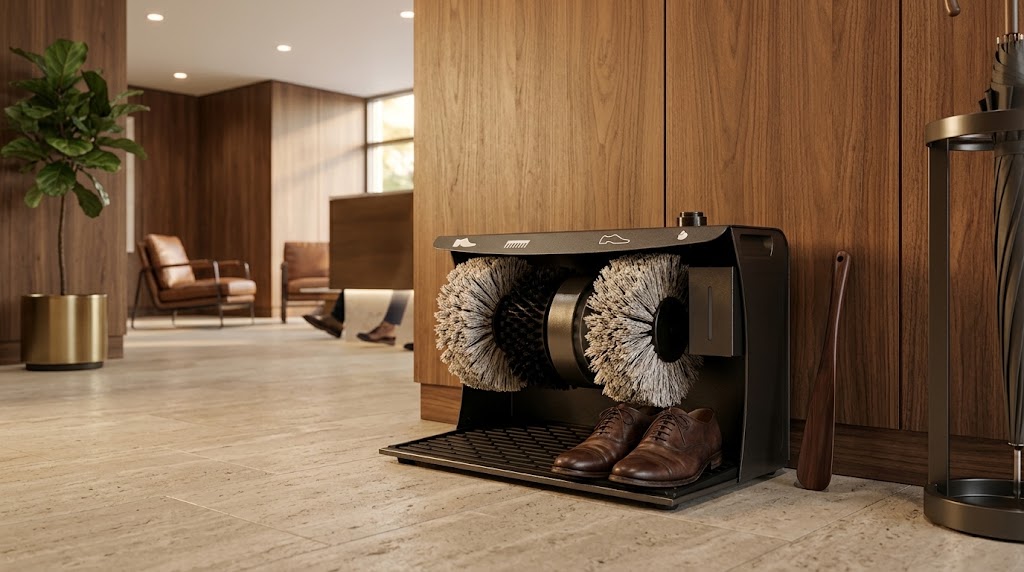
An automatic shoe shiner can provide a useful courtesy service in hotels, offices, business centers, banks, and other representative environments. The available machines differ in size, number of brushes, activation system, power, body material, and the presence of a polish dispenser. The choice should therefore start from the installation location and the expected frequency of use, comparing the features of the individual model.
Positioned in a lobby, near elevators, or in another accessible area, the shoe shiner allows users to remove surface dust and polish compatible footwear without resorting to manual brushes. However, it should not be automatically considered suitable for all materials or types of shoes.
Not all automatic shoe shiners work the same way. Some Holity models use a foot or proximity sensor combined with a timer, while others have an activation button or a timed cycle.
Models with a sensor start the motor when they detect the user's presence and stop it according to the system provided by the machine. In models with a button, however, the start is controlled directly by the user. Before purchasing, therefore, check the activation method indicated in the technical data sheet.
The number of brushes does not automatically identify a more or less professional machine. What matters above all is their function.
2-brush models: can include a brush for pre-cleaning and one for polishing. Some Holity shoe polishers adopt this configuration, even on large and highly powered machines.
3-brush models: can use one brush for pre-cleaning and two dedicated to the post-cleaning phase. The material, size and function of the individual brushes must be checked on the product.
It is therefore incorrect to consider the three brushes as a universal "professional standard" or to assume that they are always separate for black and brown shoes if this function is not expressly stated.
Many shoe polishers have an integrated container for the polish product. The range includes, for example, 0.75 litre tanks and ball valve or roll-on dispensing systems.
The polish is not necessarily included with the machine and the type of compatible product must be checked in the manufacturer's instructions. It should therefore not be taken for granted that any polish is neutral, universal or suitable for all footwear.
The structure can be made of different materials, including wood, stainless steel, painted steel or aluminium. The choice can also be made based on the furnishings, but the material alone does not determine durability, intensity of use or performance.
Compact models may be suitable when available space is limited, while column versions or those equipped with a support bar/handle require a larger area. Before purchasing, always compare the width, depth and height with the intended installation location.
Some shoe polishers integrate a vertical bar or handle that offers the user a place to support themselves while cleaning the shoe. This feature can be useful on taller machines, but is not present on all models.
Where available, also check the overall size of the structure and ensure that the positioning leaves enough space to use the machine without interfering with passageways.
Shoe polishers are available in the range with different power ratings, for example 100 W, 130 W, 150 W and 240 W. Wattage is a useful figure for comparing products, but should not be used alone to establish quality, polishing speed or suitability for intensive use.
To evaluate a machine, consider together the power, declared rotation speed, brush size, activation system, structure and instructions for use provided by the manufacturer.
Being electrical appliances, shoe shiners must be used according to the manufacturer's instructions and connected to a power supply compatible with that indicated in the technical data sheet.
It is important to position them on a stable surface and in a place where the machine and power cable do not create obstacles to passage. Any markings, conformities, protection classes or safety devices must be verified in the documentation for the specific model.
It is not correct to deduce fire-resistance properties simply because the structure is metal, nor to automatically attribute thermal protections or other undeclared features to each machine.
In hotels and office buildings, it may be useful to choose a visible but not obstructive area, such as a side part of the hall, an area near the elevators, a lounge or a service space accessible to guests.
The chosen location must have adequate power supply and enough space to allow the user to approach and use the brushes comfortably.
The price of an automatic shoe shiner can depend on structure, size, power, number and size of brushes, activation type, dispenser, finish and other construction features.
Since prices and availability may change, it is preferable to compare the models in the catalog rather than associating fixed price ranges with certain power or configurations.
Explore the selection of automatic shoe shiners for hotels, offices and professional facilities on Holity and compare size, power, number of brushes, activation system, material and dispenser to identify the model best suited to the installation location.
For multiple supplies or professional purchases you can request a personalized quote indicating quantity, intended use and required characteristics.
Can an automatic shoe polisher be used on any type of shoe?
No. The shoe material, type of brush and polishing product must be compatible. For delicate leathers, suede, suede, nubuck or particular materials it is advisable to follow the instructions of the shoe and machine manufacturer.
Two or three brushes: which configuration is best?
There is no absolute best configuration. It is more useful to check the function of the brushes: pre-cleaning, cleaning or polishing. Sizes and materials can also vary between models.
Is the polish always included with the machine?
No. Some shoe polishers have a dispenser but the polish may not be included. Always check what is included and which product is compatible with your model.
Does more wattage automatically mean a better shoe polisher?
No. Power is only one factor to consider. You should also consider rotation speed, brush size, machine configuration and usage instructions.
What maintenance does it require?
It depends on the model. Generally, you need to keep the brush area clean and check the polish level if a dispenser is present. Maintenance frequency and method should follow the manufacturer's instructions.
 English
  Italian
 French
 German
 Spanish