Buying Guide: How to Choose Armored and Security Cabinets for Businesses, Weapons, Documents, and CCTV Systems
In offices, commercial businesses, professional studios, public facilities, and private spaces, protecting confidential documents, valuables, weapons, and electronic equipment requires storage solutions suited to the characteristics of the assets and the risks to be prevented. Armored cabinets, also called security cabinets or armored cabinets, are structures generally made of steel and equipped with locking systems designed to limit unauthorized access to the contents. Compared to compact safes, many cabinets offer greater internal space, allowing you to organize folders, binders, long guns, video recording devices, and other equipment. Burglary resistance, however, depends on the construction features and any certifications of the individual product: the commercial designation "armored" does not automatically guarantee a certain level of security. The Holity.co.uk catalogue includes monoblock armoured cabinets, rifle and pistol cabinets, armoured display cabinets, security filing cabinets and protected containers for DVR and NVR video recorders. Models with key locks, electronic combinations, biometric systems and configurations with internal safe are available. Some products declare conformity to European standards EN 14450 or EN 1143-1, with different resistance levels. This purchasing guide analyses types, closures, burglar-proof features, dimensions, anchoring systems, regulatory references and price ranges to help company managers, professionals, business managers and public purchasers choose the most suitable safety cabinet.
1. Construction types and intended uses: monoblock, rifle cabinet, display cabinets, filing cabinets and CCTV boxes
The choice of the armored cabinet must start from the type of goods to be stored, their size and access requirements. The different configurations have specific internal fittings and security features:
Monoblock armored cabinets for offices, companies and commercial activities: These are security structures designed to store documents, records, valuables and other company assets. The Holity catalogue includes monoblock models in sheet steel with declared thicknesses of 2, 3 or 4 mm, depending on the product, and single or double door configurations. Some cabinets have adjustable internal shelves, double-bit locks and locking systems with multiple bolts. For example, the h76_103 model offers an internal capacity of 190 litres, while other products have larger dimensions and volumes. The choice must consider the internal usable space, the number of documents or objects to be stored, and the shelf capacity, if stated. Not all models include separate lockers or shelves with a capacity of 50-100 kg. It is also important to distinguish construction sturdiness from certified burglary resistance: a cabinet with thick sheet metal does not necessarily have an EN 14450 or EN 1143-1 classification.
Gun and firearm cabinets: Gun cabinets are designed to store long guns, while safes and gun cabinets are sized and equipped for handguns. The Holity catalog offers models for 3, 5, 7, 8, 10, 11, and more guns, as well as compact pistol cabinets. Gun cabinets can include shaped barrel supports, protective coverings, shelves, and internal lockers with separate locks. The presence of a safety deposit box must be verified for each product and is not a universal requirement for all private owners. Weapon storage must comply with the due diligence requirements established by Italian law and any specific requirements applicable to the owner. Before purchasing, it is necessary to check the actual capacity, considering the length of the weapons, the presence of optics, stocks, and accessories. Some Holity models declare EN 1143-1 Grade 0 or Grade I certification, but the classification cannot be automatically extended to the entire range.
Armored display cabinets for display and collecting: Armored display cabinets allow you to keep certain goods visible within a structure equipped with protective elements. The Holity catalog includes models for displaying weapons and collectibles, including the h03_25 display cabinet for seven rifles, described with a special steel structure and 19 mm bulletproof glass. Glass characteristics must be verified in the technical documentation: resistance to manual attack according to EN 356 and ballistic resistance are different properties, governed by specific tests and standards. It is therefore incorrect to automatically consider glass declared shatterproof as bulletproof or vice versa. The presence of LED lighting, wood paneling, or other display accessories depends on the model. For display cases, it is also necessary to verify the load capacity, internal dimensions, locking systems, and intended use declared by the manufacturer.
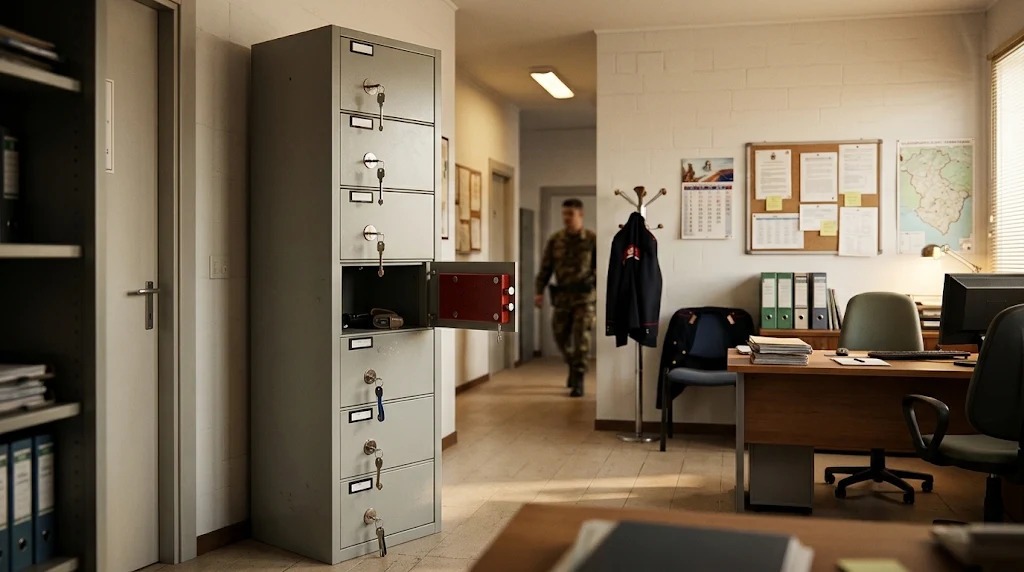
Security filing cabinets for documents and confidential items: Security filing cabinets are structures divided into one or more compartments, designed to organize the storage of documents, keys, small objects, or other materials requiring controlled access. The Holity catalog includes modular filing cabinets with one, three, and seven compartments, with double-bit locks and special steel structures. The h03_29 model, for example, features a single compartment measuring approximately 31.8x33x20 cm, while the h03_30 model includes seven compartments. Some versions have slotted doors and internal electrical outlets for specific operational needs. However, not all filing cabinets have independent locks for each compartment or access recording systems. The physical separation of documents can contribute to their organization, but does not automatically guarantee compliance with confidentiality regulations. Key management, personnel authorizations, and storage procedures must also be considered.
Armored cabinets for CCTV video recording: These containers are designed to protect equipment used in video surveillance systems, such as DVRs, NVRs, and related components. The Holity catalog includes compact boxes, monoblock cabinets, and structures designed for rack equipment. The h03_34 model, for example, includes a 19" rack housing with 13 units, while other products have natural ventilation shutters or electric fan systems. The choice must consider the size of the equipment, the space for connections, cable management and heat dissipation. A shielded enclosure does not automatically guarantee the correct cooling of electronic devices: ventilation must be adequate for the heat dissipated and the environmental conditions. The presence of tamper-proof sensors, dust filters or thermostatic fans must also be verified for the individual model. The use of a protected cabinet can contribute to the physical security of the records, but does not automatically equate to GDPR compliance of the system.
2. Locking systems and security locks: key lock vs. electronic combination
The locking system affects the access methods, the management of credentials and the ease of use. Its effectiveness depends on its integration with the cabinet structure and the characteristics declared by the manufacturer:
Key security lock (double bit and possible EN 1300 compliance): The key lock is a mechanical solution widely used in armoured cabinets and gun cabinets. The Holity catalogue includes models with a double bit lock, also combined with locking systems with multiple deadbolts. This configuration does not require batteries for ordinary operation, but it does require careful management of the storage of keys and any copies. Not all double bit locks are necessarily certified according to EN 1300, nor do all of them include controlled duplication keys, captive key systems or specific protection against drilling. The presence of a manganese steel plate or other anti-drill elements must also be verified for each product. Before purchasing, it is advisable to check the type of lock, any declared classification and the procedures provided for replacing or managing the keys.
Digital electronic combination lock: Cabinets with electronic locking allow opening via code or other authentication system provided by the manufacturer. The Holity catalogue includes models with a double bit lock. There are gun safes with electronic keypads, gun safes with electronic locks and at least one compact model with biometric recognition. The available functions vary significantly and may include:
Keyless access management for ordinary use: Opening by code can reduce the need to distribute physical keys to multiple operators. However, it does not eliminate all risk of unauthorised access: the codes must be kept confidential and changed when necessary. Some models also include a mechanical emergency key, which still requires secure management.
Administrator and user codes: Certain electronic locks allow you to configure different credentials for administrators and users. This option is not available in all products and does not automatically imply the registration of access by name. Before purchasing, it is advisable to check how many codes can be stored and which management functions are actually available.
Temporary block after incorrect attempts: Some electronic systems may provide a delay or temporary block after repeated entry of incorrect codes. The presence of the Its function and duration depend on the model. It is not correct to universally attribute to all keypads a block after three or five attempts, nor to consider this measure sufficient to prevent any attempt at manipulation.
Power supply and emergency procedures: Electronic locks can operate using internal batteries and have specific procedures in the event of insufficient power. Some products have external contacts for a temporary battery or an emergency key. Not all use 9V batteries and not all maintain the same functionality in the absence of power. Before purchasing, it is important to check the manufacturer's instructions regarding battery replacement, code memory and emergency opening methods.
3. Mechanical engineering, deadbolts and anti-burglary features
The burglary resistance of a security cabinet depends on the combination of structure, door, lock, locking systems and installation. The characteristics of the individual components can contribute to the robustness, but do not by themselves allow for the attribution of a certified resistance class:
Sheet metal thicknesses and structure boxed: The Holity catalogue features cabinets made with steel sheets of different thicknesses, including 2, 3 and 4 mm models. Some products use monoblock structures, while others feature multiple walls or specific reinforcements. Doors can also have different configurations: for example, the h7606 model is described as having an 80 mm reinforced door. The overall thickness of the door does not necessarily coincide with the thickness of the external sheet metal and does not allow the level of burglary resistance to be deduced. It is necessary to check the construction of the assembly, any certifications and the conditions envisaged for installation. Likewise, the presence of a double wall or insulating materials does not automatically guarantee certified fire resistance. Fire performance must be documented through specific tests and classifications.
Cylindrical bolts and multi-point locking systems: Various Holity armoured cabinets use locking systems with metal bolts, sometimes connected to rack or triple expansion mechanisms. These devices allow for lock the door at multiple points on the frame, contributing to the mechanical resistance of the lock. The number, diameter, material and arrangement of the bolts vary depending on the product. Not all models use rotating cylinders, 18-25 mm bolts or three-sided locks. The presence of rotating elements may represent a construction feature declared by the manufacturer, but should not be interpreted as an absolute guarantee against cutting or break-ins. For a reliable assessment of the protection, it is necessary to consider the complete structure and any certification of the product according to relevant testing standards.
Anti-tear profiles and hinge-side protection: Some safety cabinets include fixed bolts, anti-tear profiles, reinforced hinges or other solutions designed to prevent forced opening of the door. The Holity catalogue includes models with anti-tear hinges and dedicated protections, especially among the higher-quality rifle cabinets. The characteristics must be verified individually: not all structures have a continuous wolf's beak profile or bolts on the hinge side. These elements can contribute to mechanical protection, but their presence does not guarantee the impossibility of forcing. Also in this case the actual resistance must be evaluated considering the complete locking system, the installation and any certified tests.
4. Metric development, weights and structural anchoring
Before purchasing a strongbox it is necessary to check the available space, the weight of the structure and the installation conditions. Any anchoring can help to prevent overturning and unauthorised removal, but must be carried out according to the manufacturer's instructions and the characteristics of the support:
Dimensional coordinates in the catalogue:
Height: The range includes compact containers with a height of 81 mm, such as some horizontal gun cabinets, and larger cabinets that reach approximately 2000 mm. The choice must also consider the space required for opening the doors and the possible presence of internal compartments or shelves.
Front width: The catalogue includes narrow models, such as some rifle cabinets of 250 mm, and two-door cabinets with a width of up to approximately 1160 mm. It is important to check the internal useful width, which may be significantly less than the external width in the presence of reinforced walls and locking systems.
Overall depth: The depth varies according to the intended use: compact containers for guns or small objects may have reduced overall dimensions, while cabinets for documents, long weapons and CCTV equipment require larger dimensions. The catalogue includes models with external depths of approximately 250, 400, 500, 600 and 650 mm. , in addition to other configurations. It is also necessary to check the internal dimensions and the spaces required for cables, shelves or accessories.
Cabinet weight and load-bearing capacity of the floor: The weight of strongboxes varies considerably depending on the size, the thickness of the materials and the presence of multiple walls. The Holity catalogue includes compact safes weighing a few dozen kilograms as well as structures with a greater mass. For example, the h718_43 gun holder model is declared as weighing 48 kg. Before installing a particularly heavy cabinet, it is also advisable to consider the load of the stored goods and the characteristics of the floor. In existing buildings, especially when there are doubts about the load-bearing capacity of the floor, a technical assessment may be necessary. It is not correct to establish that simply positioning near a load-bearing wall automatically makes the installation safe: the distribution of the loads must be verified in relation to the structure of the building.
Mechanical anchoring and installation instructions: Various strongboxes Holity cabinets are designed for fixing using holes in the bottom or back, depending on the product. Anchoring can help reduce the risk of removal and tipping, but not all models necessarily have holes on both sides. There is no universal rule that requires simultaneous fixing to the floor and wall with M10 or M12 anchors for all strongroom cabinets. For certified products, any anchoring requirements contained in the instructions may be relevant for maintaining the conditions required by the certification. The choice of fixing elements must consider the weight of the cabinet, the support material, the distances from the edges and the manufacturer's instructions. Installation on lightweight walls, non-structural floors or unsuitable surfaces requires particular attention. When necessary, it is advisable to entrust the installation to qualified personnel.
5. Regulatory framework: GDPR privacy and EN standards
The choice of a strongroom cabinet can be linked to needs Different regulations, but it is necessary to distinguish the custody obligations, the organizational security measures and the technical certifications of the product. The applicable provisions depend on the type of goods and the intended use:
Protection of video surveillance data (EU Regulation 2016/679 - GDPR): The General Data Protection Regulation requires the adoption of technical and organizational measures appropriate to the risks of processing, in accordance with the principle of controller accountability. Article 32 concerns the security of processing, but does not universally require that every DVR or NVR recorder be placed in a locked, armored cabinet. Physical protection of equipment can be a useful measure to limit access and tampering, especially when the devices are installed in places accessible to unauthorized personnel. GDPR compliance, however, also depends on authorizations, credential management, image retention, IT protection, access control, and other measures. appropriate. The cabinet must also guarantee ventilation compatible with the equipment contained within. The sole installation of an armoured CCTV box does not therefore certify the conformity of the entire video surveillance system.
European standards for burglary resistance (UNI EN 14450, EN 1143-1 and EN 1300): To evaluate the security level of a cabinet, it is important to distinguish the certifications of the complete product from those of the lock alone. The relevant technical standards include:
UNI EN 14450 (levels S1 and S2): Defines requirements and test methods relating to the burglary resistance of the safe storage units included in its field of application. In the Holity catalogue, for example, there is the h718_43 gun safe, declared compliant with EN 14450-S2. The classification must be verified through the product documentation and cannot be automatically attributed to other cabinets with similar characteristics.
UNI EN 1143-1 (burglary resistance levels): Concerns security storage units such as safes and strongrooms, with classifications based on standardized tests. The Holity catalog includes gun cabinets certified to EN 1143-1 Grade 0 and Grade I, as well as a gun safe declared to Grade III. The certified level allows for comparison of products subjected to specific tests, but does not guarantee the impossibility of burglary. The choice of the necessary level must consider risk, value of the goods, any requirements and insurance conditions.
UNI EN 1300: Concerns the classification of high security locks intended for secure storage units, according to specific requirements and tests. The conformity of the lock does not equate to the burglar-proof certification of the entire cabinet. To choose correctly, it is necessary to check both the classification of the furniture and that of the locking system, when declared by the manufacturer.
6. Economic planning and spending ranges
The Holity catalogue includes armoured cabinets and security containers with different prices in relation to size, type, materials, locking system and declared certifications. At the date of the inspection, the assortment has an indicative price range from approximately €138.00 to €8,840.00, excluding VAT, subject to variations based on availability, offers and catalogue updates:
Entry level range (approximately €138.00 - €450.00, excluding VAT): It includes compact armoured filing cabinets, handgun cabinets, essential rifle cabinets and small office security cabinets. The Holity catalogue includes, for example, the single-compartment filing cabinet h03_29 for €138.00 + VAT, the pistol cabinet biometric h31_250 and the h76_103 security cabinet with a volume of 190 litres. These products have different dimensions and intended uses and should not be considered equivalent in terms of burglary resistance. The choice must take into account the type of lock, internal dimensions, material and any certifications actually declared.
Intermediate range (approximately €450.00 - €1,800.00, excluding VAT): Includes various monoblock armoured cabinets, gun racks, multi-compartment filing cabinets and protected containers for CCTV systems. The catalogue includes, for example, the h200_13 gun cabinet declared EN 1143-1 Grade 0, the h0316 DVR container with ventilation and the h03_34 video surveillance cabinet with 19" rack. Double-bit and electronic locking systems are available, depending on the product. The price depends on the structure, capacity, interior layout, and technical features, but does not automatically correspond to a specific level of certification. Before purchasing, it is also advisable to check the mounting arrangements, included accessories, and maintenance methods.
High-end (approximately €1,800.00 - €8,840.00, excluding VAT): This includes larger cabinets, armored display cabinets, certified gun safes, double-walled structures, and models with specific protection features. The catalog includes, among others, the h03_25 gun display cabinet, the h718_44 gun safe, certified to EN 1143-1 Grade III, Grade I gun cabinets, and products described as heat-insulating or fire-resistant. It is important to distinguish between burglar-proof certification and thermal protection: a cabinet declared fireproof does not automatically have a 30- or 60-minute fire resistance classification. Fire performance must be verified through relevant tests and standards, such as EN 15659 or EN 1047-1 where applicable. For a complete economic evaluation, it is advisable to consider transport, floor handling, installation, anchoring systems and any insurance or documentary requirements.
Request a personalized quote on Holity.co.uk
Protect confidential documents, valuables, weapons and electronic equipment with the armoured and security cabinets available on Holity.co.uk. Consult the catalogue to compare monoblock office models, rifle and pistol cabinets, armoured display cabinets, multi-compartment filing cabinets and containers for DVRs and NVRs. Choose the configuration in relation to the intended use, evaluating internal dimensions, type of lock, capacity and anchoring systems. Products with double-bit, electronic, and biometric locks are available, as well as models with burglar-proof certifications declared according to EN 14450 or EN 1143-1. Before purchasing, it is important to check the characteristics of the individual product, any regulatory requirements, and the conditions necessary for correct installation. The choice of a security cabinet must be based on an assessment of real needs and not just on the thickness of the steel or the commercial name.
Request a personalized quote from the Holity.co.uk sales team to receive information on available models, technical characteristics, supply conditions, and purchasable accessories. For specific needs, you can request dimensional details, information on locking systems, anchoring options, and, where available, burglar-proof certifications for each product. Comparing capacity, documented protection level, and installation method allows you to identify the most suitable armored cabinet for storing your goods and organizing your space.
Frequently Asked Questions
What is the fundamental difference between a safe and a traditional safe?
The main difference lies in the internal volume and intended use. A traditional safe is a compact, space-saving unit (often built into a wall or floor) designed to house small, highly valuable items (cash, valuable watches, ingots, jewelry). A vault, on the other hand, offers far greater storage capacity (up to 2 meters in height and over 1 meter in width). It allows for the orderly arrangement of accounting files, hanging files, racked long gun collections, commercial samples, or video recording servers across multiple shelves, combining high mechanical resistance to burglary with convenient day-to-day logistical management of space.
Is it better to choose a double-bit key lock or a digital electronic combination lock?
The choice depends on the frequency of opening and the number of authorized operators. The EN 1300-certified double-bit key lock guarantees extraordinary mechanical reliability, is completely immune to power outages or electronic failures, and is the recommended choice for sporadic openings (collectors, seasonal archive cabinets). The digital electronic combination is ideal for shared offices, service armories, or businesses with repeated daily openings: it allows quick access by entering a 6-9 digit PIN code, eliminates the risk of loss, theft, or clandestine duplication of physical keys, and offers timed anti-tampering lockout functions after incorrect key entries.
Why and how is it mandatory to anchor the armored cabinet to the floor or masonry?
Structural anchoring is an essential security feature: thieves equipped with transport trolleys or pallet trucks can load the entire cabinet and remove it, then break into it elsewhere with ease using heavy industrial tools. All professional security cabinets have pre-drilled fixing holes in the back panel and base. Proper installation involves simultaneous fastening on two orthogonal planes (to the load-bearing wall and the floor) using heavy-duty steel expansion bolts or threaded rods coated with two-component chemical resin (diameter M10/M12), ensuring a pull-out resistance equivalent to several tons.
What requirements must a CCTV video surveillance vault meet under GDPR?
The General Data Protection Regulation (GDPR 2016/679) requires adequate technical measures to protect personal data (images recorded by security cameras) from unauthorized access, theft, or malicious alteration. The CCTV equipment cabinet must have a solid metal structure, locked and reserved exclusively for the designated manager, with natural ventilation slots or forced-air fans equipped with filters to prevent overheating of the DVR/NVR, which operates 24/7. It must also be equipped with tamper sensors connected to the burglar alarm system.
How does the price range of the category (€138.00 - €8840.00) correlate with the construction features?
Pricing varies depending on volume, sheet metal thickness, burglar-proof certification, and integrated accessories. The entry-level range (€138.00 - €450.00) includes wall-mounted CCTV boxes, single gun cabinets, and basic 3-5-capacity, key-operated gun racks made of 2 mm sheet metal. The mid-range (€450.00 - €1,800.00) includes single- or double-door office-style cabinets for Dox filing cabinets, 5- to 10-capacity gun cabinets complete with ammunition safes and digital locks with three-way deadbolts, and video surveillance racks with thermostatically controlled fans. The top-of-the-range range (€1,800.00 - €8,840.00) includes high-quality, bulletproof display cabinets with EN 356-certified glass for collectibles, large, double-walled fireproof cabinets, modular filing cabinets and filing cabinets with multiple compartments, and ultra-high-strength EN 1143-1-certified structures for gunsmiths, banks, and public institutions.

 English
 Italian
 French
 German
 Spanish