
mon-fri 9-13 / 14.30-18.30
Pet welfare has become a central concern in the design of modern urban recreational spaces and accommodations. Choosing the right dog agility courses isn't simply a matter of installing a series of obstacles; it's a matter of planning a comprehensive infrastructure designed to stimulate the physical well-being, coordination, and balance of dogs, while also promoting healthy interaction with their handlers. Whether you're enhancing a dog park in a public park, setting up a professional dog training center, or creating a pet-friendly space in a farmhouse or resort, having safe and certified equipment is essential. This buying guide is designed to help you navigate the various models in our catalog, analyzing construction materials, regulatory requirements, and spatial sizing criteria to ensure a long-lasting and safe investment for the community.
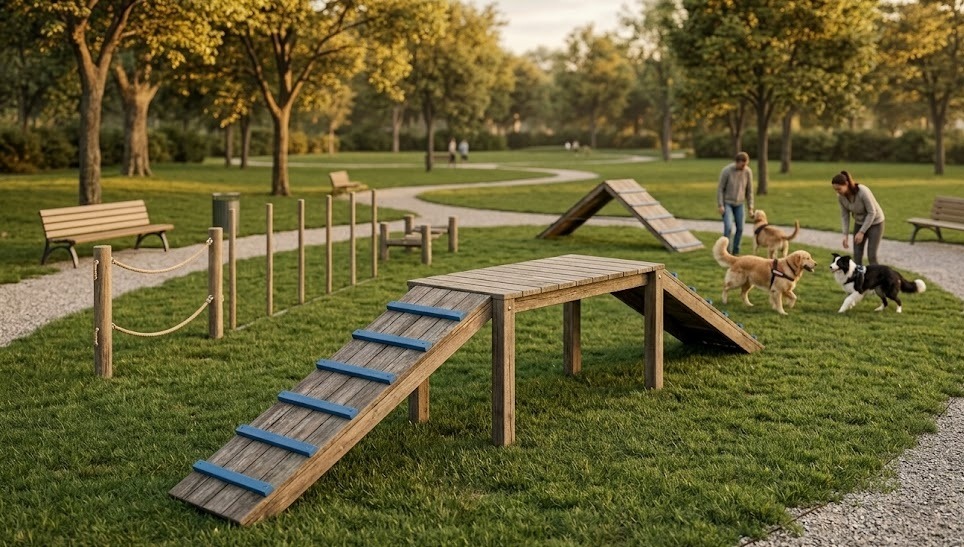
In the dog training equipment market, dog agility courses are divided into different functional categories, each designed to train a specific motor or cognitive skill of the animal.
These represent the basic and most iconic modules of agility, developed to train elevation, distance calculation and visual precision.
Advantages: They allow for an ideal educational progression, starting from simple single jumps adjustable in height up to advanced structures such as wall jumps or arches with suspended circles. They stimulate the dog's vertical and lateral concentration.
Disadvantages: They require a correct landing surface to cushion the repeated impacts of the paws, especially for larger breeds.
Ideal for: Any configuration, from basic installations in public parks to professional training schools.
Structured modules that develop in height, designed to test and improve balance, proprioception and overcoming fears of heights.
Advantages: The platforms offer stable surfaces for transitions and pauses between exercises, with heights varying from 39 cm to over 70 cm. The oscillating bridges introduce an element of controlled instability that increases the animal's motor adaptation and self-confidence.
Disadvantages: They require rigorous verification of the anti-slip treatments on the walking surface to avoid accidental falls in case of rain.
Ideal for: Dog training centers, equipped dog areas and educational-pedagogical courses for search and rescue dogs.
Equipment aimed at developing lateral flexibility, rapid changes of direction and the dog's reactivity in covered spaces.
Advantages: Slaloms with poles (fixed or mobile) develop the agility of the animal's spine. Closed tunnels, made of recycled plastic or flexible materials, simulate exploration scenarios in complete safety, forcing the dog to trust the owner's vocal commands.
Disadvantages: Closed tunnels require periodic monitoring to clean the inside of accumulated leaves, mud or debris.
Ideal for: Professional training centers and densely populated urban parks.
To set up an efficient agility area and avoid rapid deterioration of the structures, it is essential to base the choice on well-defined technical and dimensional parameters.
Since these are permanently installed outdoor equipment, exposed to rain, sun, soil moisture and vandalism, the choice of material is the factor that has the greatest impact on the life of the investment:
The layout planning must be based on the size of the available area and the morphological characteristics of the dogs:
The underlying terrain directly influences the safety of the dog's joints. A well-maintained natural turf is ideal for absorbing impacts up to standard heights. In the presence of high jumps or in intensively used areas subject to premature wear of the lawn, the installation of shock-absorbent rubber flooring (with thicknesses of 15 mm to 25 mm) dramatically reduces the risk of joint injuries and prevents the formation of dangerous mud puddles.
Equipment intended for installation in public spaces and unattended common areas must strictly comply with the safety requirements set out in the EN 1176 standard (the European regulation applied to outdoor play and fitness equipment). This standard guarantees the absence of sharp edges, cutting elements or areas where animals' paws and heads could be trapped. Metallic materials must meet hot-dip galvanizing standards (ISO 1461 standard with a minimum thickness of 70 micrometers), while plastic components must be non-toxic, BPA-free and compliant with the fire reaction class (minimum B2 according to DIN 4102). For public operators, regulatory compliance and the CE marking are fundamental requirements for legal protection in the event of accidents or disputes.
Municipal dog areas and urban public parks: The only option is complete sets in EN 1176 certified HDPE and galvanized steel. Fixed, robust, vandalism-resistant modules should be preferred, capable of withstanding the elements without requiring constant maintenance and suitable for a heterogeneous user base of dogs of all breeds and sizes.
Dog training centers and professional training schools: In this case, the priority is modularity and educational flexibility. Height-adjustable obstacles, mobile slaloms, and complex modules (such as walls or advanced swinging bridges) are preferable. The variety of equipment allows instructors to continually configure new courses for athletic and educational preparation.
Accommodation facilities and semi-private gardens: For hotels, campsites, or farmhouses looking to create a "pet-friendly" corner for their guests, treated pine wood modules represent an ideal solution in terms of budget and landscape aesthetics. They offer a welcome service that increases the perceived value of the facility with a natural visual impact.
Offer a professional solution to the exercise needs of our four-legged friends and enhance your outdoor spaces. On holity.co.uk, we offer a complete assortment of professional dog agility obstacles and courses, designed in full compliance with international safety guidelines. Our range covers flexible modular solutions within a price range that is suitable for both small private budgets and major redevelopment projects for municipal tender specifications.
Use our lateral search tools to evaluate individual modules or to request complete path configurations. Are you a public administration, an architect or the owner of a dog training centre and need a dedicated quote for multiple quantities, support for Public Administration e-procurement (MePA) or EN 1176 compliance technical data sheets? Contact our customer service today to receive dedicated advice tailored to your space.
How is the risk of entrapment of the animal's head or paws assessed according to the construction parameters of the EN 1176 standard?
The EN 1176 standard imposes rigorous geometric controls to prevent the dog from getting its neck, head or paws trapped in the cavities of the equipment. Rigid openings between 89 mm and 230 mm are structurally prohibited to prevent head entrapment. Furthermore, all corner gaps or joints between HDPE panels and metal frames must have tolerances less than 8 mm or greater than 25 mm, eliminating the risk of the animal's footpads or claws getting stuck while running.
What chemical-physical specifications must HDPE polymer have to withstand summer heat stress and protect the dog's paws?
HDPE modules for professional street furniture are extruded with the integration of special UV-stabilizing masterbatch additives (usually UV8 grade or higher). This treatment prevents molecular degradation and color fading caused by the solar spectrum. From a thermal perspective, HDPE boasts low conductivity and high inertia compared to metals: it does not accumulate extreme radiant heat, ensuring that the walking surfaces of platforms and walkways maintain safe temperatures for your dog's digital pads even in the height of summer.
How do the slope angle and finish of ramps (such as the palisade or walkway) ensure biomechanical grip?
To ensure dynamic stability and prevent slipping or joint trauma when ascending and descending, the slope angle of inclined ramps should not exceed 26° - 30° from the horizontal plane. Furthermore, the walking surface of polyethylene or composite wood panels must have a highly embossed non-slip finish (such as "anti-slip" or "coex-grip"), supported by the longitudinal installation of rabbet strips spaced at regular intervals to provide a secure mechanical support for the paws.
What are the geotechnical anchoring requirements needed to neutralize the inertial loads generated by tilting tools?
Dynamic obstacles such as swinging bridges or seesaws are subjected to torsional forces and continuous inertial loads induced by the animal's speeding passage. Installation in public areas strictly requires geotechnical anchoring by embedding the steel uprights in concrete foundation plinths (minimum class C20/25) at a depth calibrated according to the terrain. This system prevents the frame from undermining, the base plates from loosening and ensures the absorption of structural vibrations over time.
How is internal water flow designed in rigid tubular modules to avoid biological stagnation or adhesion problems?
Rigid HDPE tunnels and passage pipes are designed by applying pre-formed drainage holes on the curved lower section of the module. These micro-channels allow for the immediate evacuation of rainwater or washing water, preventing the formation of a stagnant water film that would compromise the grip of the paws while running. From a hygienic standpoint, the absence of water stagnation eliminates the development of bacterial biofilms, mold, and unpleasant odors, facilitating routine sanitization with a pressure washer.
What dimensional criteria define the correct "clearance zone" (tangential buffer area) between the individual obstacles in the course layout?
The planimetric planning of an agility area does not allow for the random positioning of the modules. To avoid kinetic collisions or visual interference that could be dangerous for the animal, the law and good canine practices require a "clearance zone" or perimeter buffer area free from fixed obstacles (fences, trees, benches) of at least 3-4 linear meters around each piece of equipment. This technical distance acts as a deceleration buffer and guarantees the necessary space for the jump trajectory and the approach curve in complete safety.
 English
  Italian
 French
 German
 Spanish