
mon-fri 9-13 / 14.30-18.30
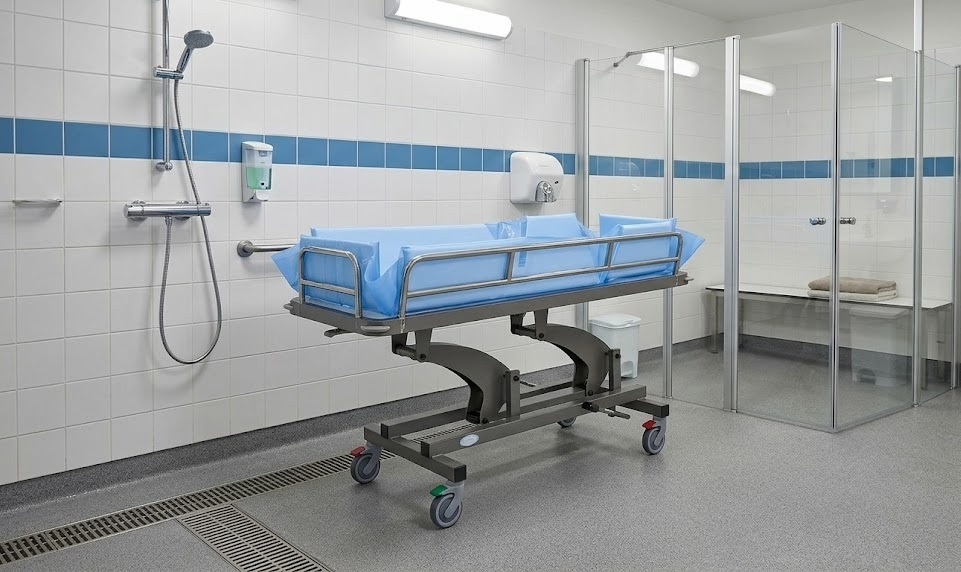
Managing hygiene protocols and hydrotherapy for bedridden patients, those with severe motor disabilities, or those undergoing prolonged hospitalization is one of the most delicate and logistically complex tasks for healthcare professionals. Choosing the right shower stretchers (also known as washboards or assisted bathing trolleys) is not just a matter of medical compliance, but also a strategic investment aimed at safeguarding the safety of the patient, optimizing the workflow of the nursing staff, and drastically reducing biomechanical stress on the spinal column of professionals. In high-volume hospitals, nursing homes, rehabilitation centers, and specialized clinics, the dignity of the patient and the efficiency of intervention depend on the stability and ergonomics of the equipment in use. This purchasing guide was created to orient you among the different structural variants, lifting architectures and load parameters available in the Holity.co.uk catalogue, guiding you towards the solution best suited to the layout of your bathroom blocks.
The height adjustment kinematics is the operational core of a shower stretcher. By determining the effort required by the operator and the smoothness of the translation movements, our catalogue offers two specific technological solutions:
They represent the cutting edge in assisted movement systems, designed to completely eliminate the manual load factor during hygiene routines.
Highly reliable mechanical systems based on closed-loop watertight hydraulic circuits, activated by physical levers.
---
The load tolerance and the width of the laying surface must be configured by analysing the anthropometric composition of the structure's users. Our technical panel allows you to isolate the models based on specific maximum load classes:
---
Continuous exposure to running water, steam flows and the biochemical action of hospital disinfectants requires rigorous metallurgical and polymeric choices:
---
Large hospitals, spinal units and intensive care units: We recommend the use of electrically adjustable shower stretchers with a load capacity of 200 kg or bariatric. Automation via a keypad eliminates downtime, minimizes staff fatigue during day and night shifts and ensures smooth movements for patients with spinal cord injuries or compromised bone stability.
Nursing homes, protected residences and geriatric centers: The ideal configuration focuses on hydraulically adjustable 180 kg or 190 kg models with removable padding. They combine extreme operational readiness with the absence of constraints related to battery charging, allowing frequent washing and rapid sanitization between each guest.
Bariatric Divisions and Obesity Centers of Excellence: It is mandatory to configure the purchase towards heavy-duty 325 kg systems. These modules have twin wheels with centralized pedal brake systems, offering absolute lateral stability even in the event of strong reflex or involuntary movements of the patient on the walking surface.
---
Raise the standards of care and asepticity of your departments, optimize housekeeping times and protect the musculoskeletal health of your nurses and OSS. In the Holity.co.uk online catalog we offer you a specialized assortment of shower stretchers and professional dishwashing trolleys, designed to guarantee multi-year durability in conditions of maximum humidity.
Use our side navigation filters to set the operating mode (electric or hydraulic) and isolate the exact load class required by your user (from 160 kg up to 325 kg). Contact our customer service today to receive detailed technical data sheets, certificates of origin of the materials and technical advice tailored to your healthcare facility.
How does the twin telescopic column architecture affect the lateral stability of 325 kg bariatric stretchers compared to single column models?
The stretchers intended for the 325 kg bariatric sector adopt a lifting structure with two synchronized parallel telescopic columns, positioned at the ends of the chassis. This configuration distributes static and dynamic loads uniformly along the longitudinal axis. Compared to standard single-column models, the double-column architecture neutralizes the bending moments and lateral torsions that are generated when a severely obese patient involuntarily shifts their center of mass towards the edges of the mattress, eliminating micro-oscillations and the risk of trolley instability.
What chemical-physical measures differentiate the removable heat-sealed PVC sheeting from the integrated padding in the prevention of cross-infection?
The removable sheeting is made of high-thickness PVC with joints made using high-frequency (HF) welding, a technique that molecularly fuses the edges, eliminating the presence of thread seams or porosity. The ability to completely remove the mattress base from the metal frame allows staff to independently sanitize both the lower part of the mattress and the internal channels of the supporting frame, areas where water and bacterial biofilms tend to accumulate in fixed-padded models and are difficult to reach with disinfectant sprays.
How does the Trendelenburg/Reverse Trendelenburg tilt kinematics work to facilitate hydraulic drainage during assisted bathing?
Professional bath trolleys integrate assisted tilt systems for the lying surface (Reverse Trendelenburg function), activated via electric controls or independent hydraulic levers. This function allows the bowl to be tilted longitudinally by a few degrees, raising the head section compared to the foot section. Under the effect of gravity, the water flows unidirectionally towards the lower drain, preventing the formation of layers of stagnant water under the patient's back and reducing post-wash drying times.
What electrical insulation and waterproofing requirements must the linear actuators of electric stretchers meet to operate safely under direct water flow?
The electric motors, control units and integrated battery packs in the 9 electrically adjustable models operate in environments with saturated humidity and direct spray (Zone 1). To ensure complete safety of the patient and operators from electric shock, the electronic components are housed in watertight enclosures that meet minimum protection levels of IPX5 or IPX6 (resistance to high-pressure water jets). The power supply is rigorously isolated at safety extra-low voltage (SELV) via 24V DC circuits.
Why are castors with centralized braking system and directional lock considered a mandatory logistical requirement for access to narrow washrooms?
Moving a fully loaded shower stretcher through corridors and bathroom modules requires pinpoint precision. The centralized braking system, operated by a single through-pedal, allows the 360° rotation and orientation of all four wheels to be simultaneously locked. The directional lock function, however, constrains the trajectory of two wheels in a straight position, temporarily transforming the trolley into a stable rail system, facilitating linear pushing along corridors by a single operator and avoiding collisions with door jambs.
How do the thickness and mix of polyurethane foam used for the perimeter cushions affect the mitigation of side impact injuries in nursing homes?
The fold-down perimeter sides and the internal profiles of the basin are lined with closed-cell polyurethane foams structured with different thicknesses. This elastomeric compound acts as a passive shock absorber: it dissipates kinetic energy resulting from ballistic movements or uncontrolled reflexes of the patient against the metal sides, minimizing the onset of bruises or skin lesions. Being a closed-cell foam, the material does not absorb moisture or body fluids through capillary action, even in the event of superficial micro-cuts, maintaining the aseptic properties of the device.
 English
  Italian
 French
 German
 Spanish