
mon-fri 9-13 / 14.30-18.30
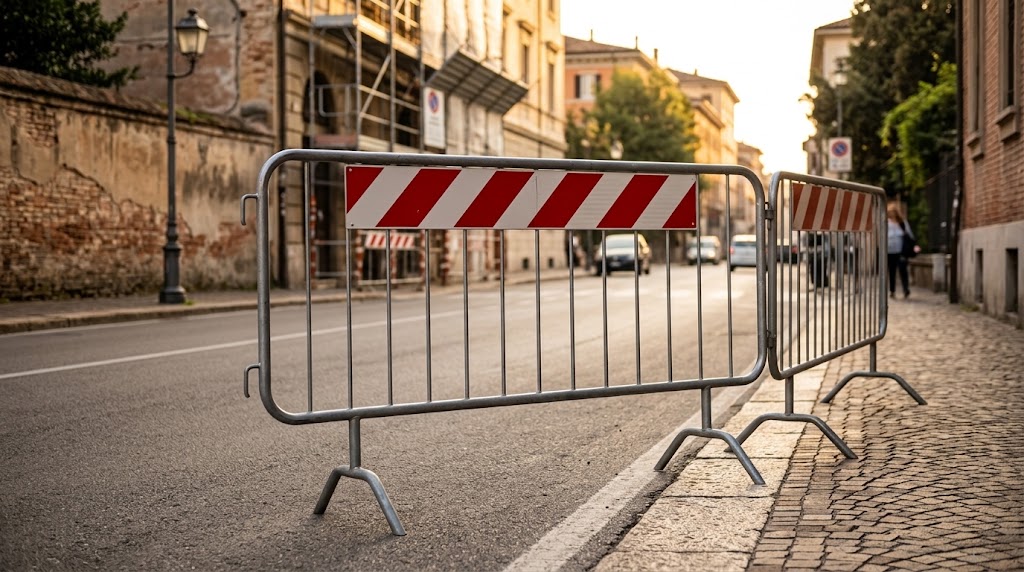
The barriers and delimitation barriers allow you to mark out an area, organize pedestrian routes, manage access or temporarily separate work areas. The Holity catalogue includes metal and plastic models, fixed or extendable barriers and versions equipped with reflective elements. The choice must consider the intended use, dimensions, weight, support system, connection between modules and any requirements applicable to the installation site.
Metal: the range includes structures in galvanized steel, iron and painted steel. Models are available for events, street furniture, temporary delimitations and construction sites. Weight, surface treatment and foot configuration vary depending on the product.
Plastic: generally offers a lower weight and can facilitate handling, transport and set-up. Holity also offers polyethylene models with hooking systems and reflective bands.
It is not correct to consider every plastic barrier as electrically insulating, UV-resistant or 100% recyclable without a specific declaration from the manufacturer. Likewise, galvanizing improves the protection of steel but does not make any structure immune to corrosion or maintenance.
The Fixed module barriers are available in different lengths and can be connected to each other when the product has hooks, staples or other compatible systems. Holity models of 120, 200 and 250 cm represent some of the configurations present in the catalogue.
The Extendable barriers instead use an accordion or pantograph structure and allow the length of the barrier to be quickly modified. They are useful for maintenance, warehouses, car parks and temporarily closed areas; some models reach around 3 metres, while other configurations are significantly longer.
The possibility of extending a barrier does not automatically determine its stability: the weight, base, wheels or feet and the methods of use envisaged by the manufacturer must be evaluated.
Some Holity barriers are equipped with white and red reflective bands or panels to increase the visibility of the barrier. This feature is particularly useful in the presence of poor lighting.
However, the simple presence of a reflective band does not automatically mean that the product is considered compliant with any road use. For construction sites and obstacles on the roadway, the characteristics, any approvals and installation methods required by applicable legislation must be verified.
For fairs, events and temporary accesses, barriers equipped with fixed or rotating feet and lateral connection systems are available. These elements allow for the creation of modular rows or delimitations by adapting the number of elements to the available space.
However, a normal barrier for events must not automatically be considered a certified barrier against crowd pressure. When the project foresees high densities or particular thrust risks, capacity and performance must be defined within the event safety plan and supported by appropriate documentation.
Presidential Decree 495/1992 regulates the barriers used to delimit road construction sites. The characteristics of the signalling depend on the location of the construction site and the configuration of the road: not any generic barrier for events or street furniture can therefore be used as a road barrier.
In the presence of pedestrian traffic, the measures necessary to protect people's path must also be evaluated. The choice of barrier must fit into the overall signalling and delimitation system planned for the construction site.
The price varies mainly according to material, length, weight, support system, presence of reflectors, extendable structure and quantity purchased. Some items are sold individually, others in multiple packs or large extension systems: it is therefore preferable to compare the complete configuration rather than using rigid price ranges.
Explore the selection of barriers and delimitation barriers on Holity and compare the models by material, size, connection system, foot configuration, presence of reflectors and extension possibility.
For construction sites, events, public bodies or supplies of multiple elements you can request a personalized quote indicating the intended use, linear meters to be delimited and quantity required.
Is a metal or plastic barrier better?
It depends on the use. Metal offers robust configurations and different surface treatments; plastic can be easier to handle. Weight, stability and environmental characteristics must be compared on the individual product.
Can the barriers be connected to each other?
Many Holity models have hooks, staples or integrated attachment systems. The connection method must be verified in the technical data sheet.
What is an extendable barrier used for?
It allows you to quickly change the length of the delimitation and reduce the space taken up when closed. It is especially useful for temporary closures and frequent movements.
Does a reflective strip automatically make the barrier approved for use on the road?
No. Use on the road requires verification of the requirements applicable to the specific barrier and the construction site signaling system.
Can an event barrier be used as a crowd barrier?
Not automatically. For situations with high crowd pressure, performance levels appropriate to the project and specifically documented are required.
How do you calculate how many barriers are needed?
Divide the length to be delimited by the usable length of each module, considering connections, necessary openings and the geometry of the route.
 English
  Italian
 French
 German
 Spanish