
mon-fri 9-13 / 14.30-18.30
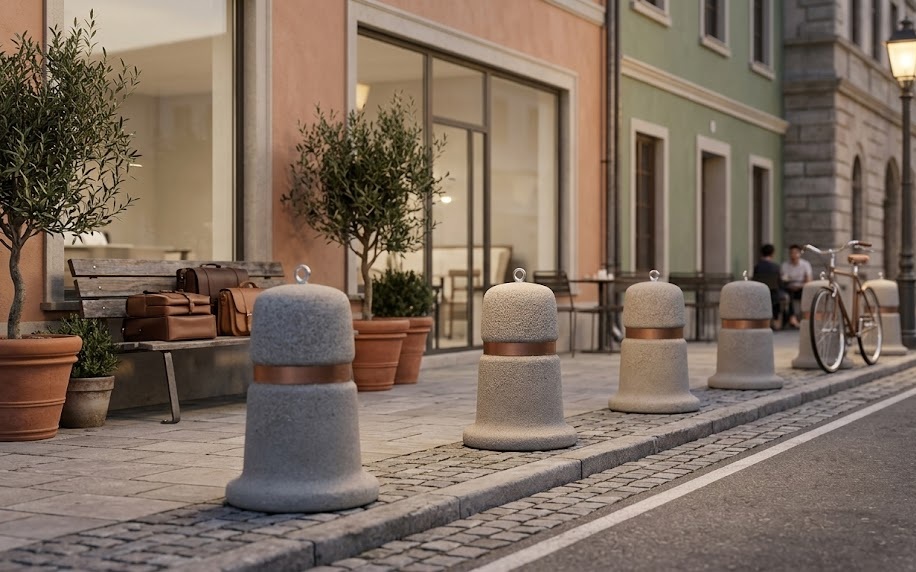
Bollards for street furniture are essential elements for delimiting pedestrian areas, protecting vehicle access points, and preventing unauthorized parking in parks, squares, cycle paths, and residential or industrial settings. Choosing the right model means balancing mechanical resistance to impact with architectural integration into the environment, identifying the ground mounting method best suited to traffic flow and temporary access needs. Whether fixed installations for pedestrian safety or removable posts to allow occasional access for emergency vehicles, the Holity.co.uk catalog offers a variety of options to configure each barrier based on materials, heights, diameters, and nighttime visibility options. This buying guide will guide you in selecting the ideal product, analyzing installation types, the presence of chain links, and current traffic regulations.
The material composition of the bollard determines the degree of protection, the visual bulk and the type of installation:
The anchoring method defines the flexibility of use of the gate over time and the mechanical resistance against collisions:
To complete the functionality of the perimeter barrier, it is necessary to evaluate the structural accessories of the cylinder:
The Holity.co.uk online catalogue allows you to profile the choice of street furniture through precise dimensional filters:
The available range guarantees maximum flexibility for every municipal or private spending plan, moving within a price range between €45.00 and €1110.00 for a single element:
Protect the pedestrian areas of your city, organize the traffic flow of your parking lots and secure the entrances to your company with the bollards for street furniture available on Holity.co.uk. Filter the products by material (steel, cast iron or concrete), select the type of fixing (grout, bolt, support or removable) and add the reflective band for maximum safety in the evening.
Request a personalized quote today: our sales team is at your complete disposal to provide you with technical data sheets with quotes, approval certificates and special offers for batch orders.
What are the operational differences between the installation by grouting and the one with a plate to be bolted to the ground?
The installation by grouting requires an excavation in the road surface of approximately 20-30 cm deep in which to drown the extension of the bollard body with concrete casting. This system guarantees maximum resistance to lateral impact stresses induced by vehicles. The fixing by bolting instead uses a flanged metal plate welded to the base of the post: the anchoring is done using expansion bolts by drilling directly into the surface pavement. It is the ideal solution for underground car parks or historic stone paving where deep excavations are not possible.
How does the extraction mechanism work in removable bollards equipped with a housing bushing?
Removable bollards are made up of two separate elements: a rigid cylindrical bushing (fixed and embedded flush with the road surface) and the actual post. By inserting the post into the bushing, an internal mechanism with a triangular key or European cylinder lock blocks the structure, preventing unauthorised lifting. When it is necessary to open the passage for emergency or service vehicles, simply turn the key to release the hook and manually remove the post, leaving the road surface completely flat and free of obstacles.
Why do the concrete bollards called "Panettoni" not require drilling or excavation for installation?
Domed concrete bollards (commonly known as "Panettoni") base their operation on mass and the force of gravity. Made of high-density vibrated concrete reinforced with synthetic fibre, they reach a weight of between 100 and 180 kg. This concentrated load makes it impossible for intruders to move them manually, acting as a self-supporting ballast that is positioned on the ground by crane on a truck without having to drill holes in the ground or spread cement binders.
In which installation contexts is the presence of a retroreflective band on the head of the bollard mandatory?
The application of a high-intensity retroreflective band is recommended and regulated by the Highway Code for all bollards placed along roadways, pavements, cycle paths or vehicle access points not equipped with dedicated continuous public lighting. The microprismatic film reflects the light from the headlights of oncoming vehicles, making the outline of the bollard visible from dozens of meters away and preventing accidental collisions or damage to tires during turning and parking maneuvers.
How do you choose between a cast iron bollard and one in AISI 316 stainless steel for a coastal town?
In seaside locations or along seafronts exposed to salt spray, the choice of material is essential to prevent corrosion. AISI 316 stainless steel contains a percentage of molybdenum that makes it resistant to paint and salt rust, guaranteeing a shiny and unaltered surface over time with zero maintenance. Traditional cast iron, on the other hand, offers a classic style ideal for ancient villages, but requires surface treatments such as cataphoresis and high-thickness epoxy painting to resist salty air without developing traces of surface oxide.
How does the price range in this category (€45.00 - €1110.00) correlate with the mass of the material, the removable mechanisms, and the anti-corrosion treatments?
The price variability depends on the quantity of raw material used, the presence of release mechanisms, and the quality of the finishes. The entry threshold (€45.00 - €120.00) includes fixed tubular posts in painted steel with a plate to be bolted. The intermediate range (€120.00 - €350.00) includes removable bollards with a stainless steel bushing and security lock, bollards cast in decorated cast iron, and self-supporting concrete blocks. Top-of-the-range prices (up to €1,110.00) are reserved for high-thickness AISI 316 stainless steel armored barriers and monolithic architectural artefacts in reconstituted stone for the redevelopment of large office centers and urban squares.
 English
  Italian
 French
 German
 Spanish