
mon-fri 9-13 / 14.30-18.30
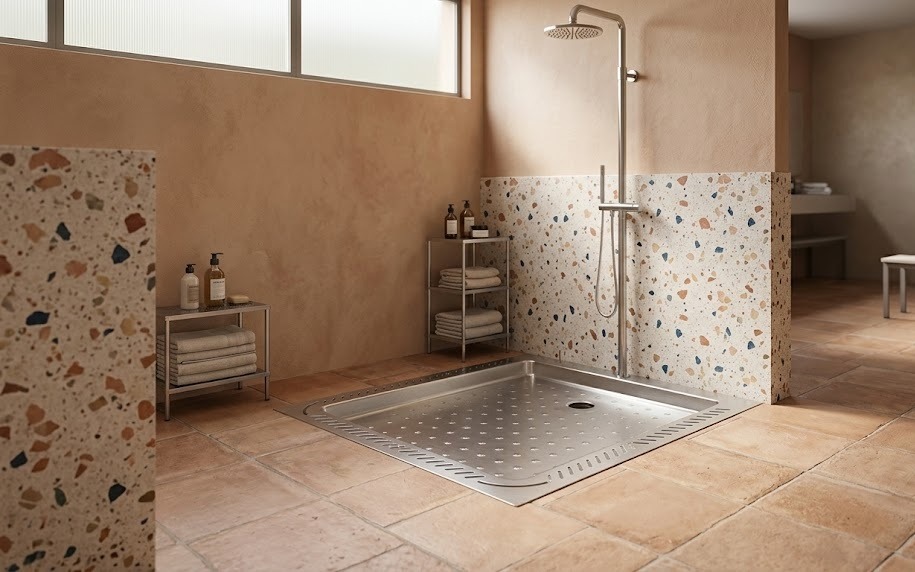
Designing public restrooms within highly frequented facilities requires the use of components capable of combining absolute structural resistance with the most stringent biosafety protocols. Choosing the right stainless steel shower trays is a crucial engineering and strategic decision to minimize extraordinary maintenance costs, combat material degradation, and optimize public hygiene. Unlike traditional ceramic or acrylic solutions, which are subject to crazing, brittle fractures, and surface porosity, stainless steel guarantees a monolithic and aseptic surface, ideal for demanding environments. Whether furnishing the restrooms of a barracks, the shower blocks of a multipurpose gym, the wards of a healthcare clinic, or the cells of a custodial institution, every geometric detail directly impacts water flow management and the containment of biological risk. This purchasing guide was created to help you orient yourself among the various models available in our online catalogue, analysing nominal thicknesses, drain hydrodynamics and system integration.
In the panorama of industrial and community sanitary ware, stainless steel shower trays differ mainly based on the geometric profile of the edge and the construction matrix of the body, determining the installation interface with the flooring.
Classic configurations featuring a raised perimeter profile designed to overlap the finished flooring of the room.
Advantages: They represent the most immediate and cost-effective purchasing solution during the construction phase. The raised perimeter edge acts as a native mechanical barrier to contain water, simplifying levelling and reducing the need for deep excavations in the underlying screed.
Disadvantages: The presence of the perimeter step constitutes a partial architectural barrier that limits independent access for users with reduced mobility.
Ideal for: Renovations of shower blocks in barracks, factory changing rooms and sports facilities where quick and economical installation is preferred.
Systems engineered to integrate at ground level with the bathroom floor, creating a continuous and uninterrupted surface.
Advantages: They offer universal and inclusive accessibility (barrier-free), facilitating the safe entry of wheelchairs and orthopedic aids. By eliminating external geometric differences in level, they allow continuous washing cycles of the floor using pressure washers, improving overall logistical cleaning.
Disadvantages: They require accurate preliminary planning of the screed dimensions and deep waterproofing of the sub-masonry.
Ideal for: Healthcare facilities, assisted living facilities for the elderly (RSA), rehabilitation centers and shower suites with a modern design and high traffic.
Special devices in high-thickness pressed steel, specifically engineered to resist forced mechanical stress and exclude grip points.
Advantages: They use steel sheets with increased thicknesses and internal geometries without removable elements. The drains are integrated directly into the casting or welded with continuous drainage with tamper-proof perforated grids, minimizing the risk of malicious obstructions and break-ins.
Disadvantages: Aesthetic footprint purely industrial and focused on passive safety, with a significant self-weight of the furniture.
Ideal for: Penitentiary institutions, detention centers, police stations and unattended public bathrooms at high risk of damage.
To configure a supply suitable for intensive and prolonged use cycles, it is essential to set up the research by analyzing precise metallurgical, dimensional and economic parameters of the frame.
The planning of the usable space inside collective shower enclosures must refer to standardized geometries to optimize the architectural layout of the rooms and the alignment with the vertical coverings. Our online catalogue adapts millimetrically to the construction site specifications, structured into three main square dimensional variants:
Resistance to elastic bending and dents induced by the user's orthostatic load depends directly on the thickness of the steel sheet. Standard contract models use thicknesses between 1.0 mm and 1.2 mm, ideal for ensuring an excellent compromise between strength and lightness. For contexts at risk of vandalism or subject to continuous heavy use (e.g. barracks, stadiums), it is essential to orient oneself towards heavy-duty structures with thicknesses from 1.5 mm to 2.0 mm, reinforced on the lower side by injections of high-density expanded polyurethane which act as both acoustic insulation and mechanical stabilizer.
The internal fluid dynamics of the bowl must guarantee the rapid flow of water towards the sewer collector to avoid unhealthy stagnation. Professional shower trays feature inclined surfaces with calibrated geometric gradients (usually between 1.5% and 2%), conveyed towards standardized drain holes. This configuration prevents the formation of stagnant water layers, drastically reducing the deposit of limescale and organic protein residues.
Direct contact between the sole of the wet foot and the metal surface requires specific solutions to prevent slipping injuries. The surfaces of our stainless steel sanitary ware adopt dedicated textures:
Flexibility in your spending plan is a crucial factor in the economic sustainability of public construction, HoReCa contract, or healthcare redevelopment projects. Our specialized selection adapts to any specification constraint, offering a flexible price range from €198.00 for standard overlay models up to €637.00** for specialized bariatric configurations featuring advanced integrated drainage systems, heavy-duty metallurgical thicknesses, and vandal-resistant structural treatments. This ensures optimal ROI based on the risk level of the installation environment.
Stainless steel shower trays and sanitary ware intended for communities and collective spaces must bear the CE marking and be provided with a declaration of performance (DoP). The reference European standard is EN 14527, which specifies the requirements for suitability for use, structural stability of the base, aptitude for emptying water and resistance to thermal and chemical shocks of detergents. From a hygienic point of view, biological compliance guarantees the absence of surface porosity, making the furniture suitable for the strict inspection controls of the local health authorities (ASL) and fully integrable into HACCP self-control plans for professional sectors.
Hospitals, nursing homes and long-term care units: We recommend installing AISI 316 stainless steel shower trays that are fully recessed and flush with the floor, measuring 90x90 cm. By eliminating the entrance height difference, they facilitate the smooth passage of wheelchairs or shower stretchers, eliminating the risk of tripping for fragile patients and reducing the strain on caregivers.
Gyms, sports centres, barracks and campsites: In these environments characterised by massive use concentrated in critical time slots, the optimal choice is overlay models (standard sizes 70x70 cm or 80x80 cm) in AISI 304 steel with a thickness of 1.2-1.5 mm, equipped with large non-slip embossed surfaces and high-flow drains to prevent flooding in the corridors.
Maximum Security Institutions and Independent Public Sanitary Facilities: It is mandatory to use welded monoblock modules with a sealed perimeter casing and completely hidden or anti-unscrewing screws. The drain grate must be integral with the body of the tray to prevent the introduction of foreign bodies or the extraction of sharp elements.
Raise the hygiene standards of your public bathrooms, reduce extraordinary maintenance costs related to breakages of traditional sanitary fixtures and adapt your facility to the most modern accessibility guidelines. In the Holity.co.uk online catalogue you will find a technical and specialized assortment of professional stainless steel shower trays, designed to guarantee many years of operational life even in the most demanding environmental conditions.
Use our side navigation filters to configure the useful dimensions in plan (**700x700 mm, 800x800 mm, 900x900 mm**) and select the most suitable price range (**€198.00 - €637.00**) for your clinical or sports layouts. Do you manage procurement for a public body via MePA, for a large construction company or do you need technical support for drafting complex tender specifications? Contact our customer service today to receive complete technical data sheets and a personalized quote tailored to your facility.
How do the acoustic coverings placed on the lower bottom of the stainless steel shower tray mitigate water impact noise?
Professional-grade stainless steel shower trays integrate special damping panels made of bituminous material or high-density, pressure-injected polyurethane foam on the underside of the body. These inserts act as a sound-absorbing barrier: they absorb the kinetic energy generated by water droplets impacting the metal sheets, reducing acoustic resonance and footfall noise inside the bathroom block, an essential protective factor for acoustic comfort in hospital dormitories and departments.
What construction provisions are necessary to connect the stainless steel shower tray to the building's equipotential earthing system?
In compliance with the directives for electrical systems in humid environments (CEI 64-8 standard), metal shower trays are classified as conductive foreign bodies. Contract structures feature a special welded steel clamp or threaded pin on the back or lower perimeter of the frame, specifically engineered for connecting the equipotential ground conductor. This feature eliminates the presence of dangerous electrical voltages due to external electrical leakage inside the shower enclosure.
What mechanical grip parameters define the DIN 51097 anti-slip classification in barefoot areas?
Anti-slip safety inside public shower trays is tested according to the DIN 51097 standard, which measures the angle of inclination of the road beyond which a barefoot operator on a wet surface begins to slip. Models featuring deep hot-stamped embossing or embossing achieve the Group B (inclination between 18° and 24°) or Group C (inclination greater than or equal to 24°) grip classes, ensuring maximum dynamic stability and preventing accidental falls by users.
How is the perimeter joint flange engineered to ensure a perfect watertight seal with the liquid waterproofing membranes on site?
Stainless steel shower trays intended for flush-fitting installation have a perimeter edge equipped with a horizontal or slightly upward-facing overlapping flange (lining edge). This metal flange acts as a structural interface for the installation of the elastic waterproof strips and the liquid cement membranes laid on the screed before tiling, preventing lateral water micro-infiltrations from penetrating the underlying slab, causing structural damage.
How does the selection of top-of-the-range configurations in the upper price range up to €637.00 maximize the amortization of the project compared to ceramic?
The adoption of a premium level stainless steel shower tray, although it requires a higher initial investment than ceramic modules, guarantees a useful life cycle of more than 25-30 years without showing signs of degradation or structural cracks. The total immunity to impact fractures (caused by the accidental fall of metal shower heads or heavy objects) eliminates the costs of extraordinary replacement and the associated biological shutdowns of sanitary facilities, also reducing average hourly sanitization times by 40% thanks to the perfectly non-porous surface.
 English
  Italian
 French
 German
 Spanish