
mon-fri 9-13 / 14.30-18.30
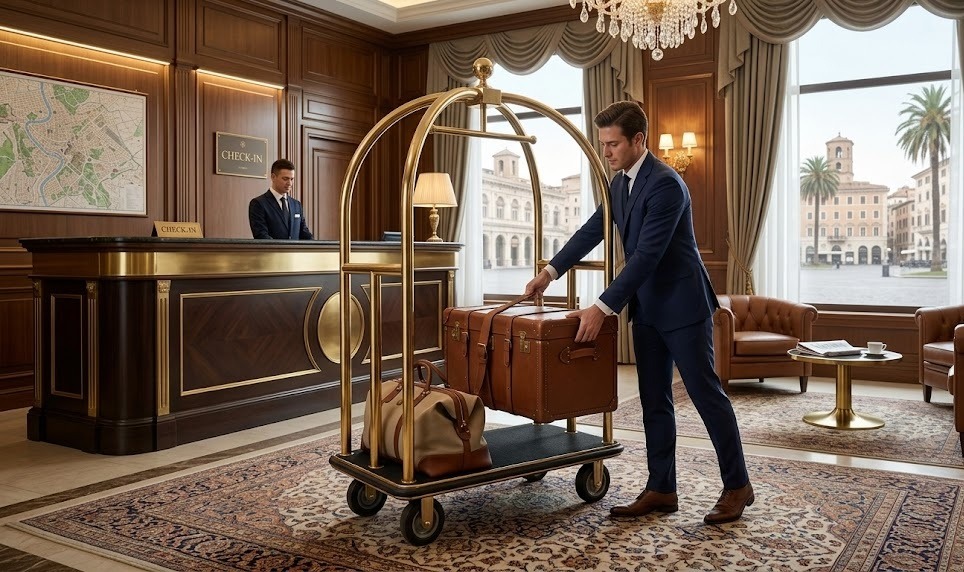
The welcome experience at a high-end hospitality facility begins the moment a guest walks through the door, and efficient handling of this first contact is the hotel's true calling card. Luggage carts are not mere transport tools, but rather functional furnishing elements that must combine refined aesthetics with superior structural strength, capable of withstanding intensive use and heavy loads. Choosing the right equipment for the HoReCa sector optimizes check-in and check-out operations, providing bellboys and concierges with an ergonomic tool that reduces physical strain and increases speed of service. Investing in superior transport systems means preventing damage to guests' luggage while simultaneously protecting the integrity of floors, walls, and elevators thanks to specific technical components. This purchasing guide will help you navigate the various models in our online catalogue to identify the ideal solution capable of raising the rating of your property.
The hotel supplies market offers various structural configurations of luggage trolleys, each engineered to meet specific space requirements, architectural style and logistics flows.
These represent the most iconic and prestigious models, characterised by imposing frames and sinuous lines that elegantly furnish the hotel lobby.
Advantages: They offer a very high level visual impact, ideal for integrating with luxury reception layouts. They have a large carpeted platform and an upper clothes rail that is very useful for carrying jackets, coats or garment bags without creasing them on the way to the rooms.
Disadvantages: They have large dimensions and curvature radii, requiring adequate maneuvering and storage space.
Ideal for: 4 and 5 star hotels, luxury resorts, boutique hotels and period contexts where image and guest experience are priorities.
Vertical and dynamic solutions, structured to favor maximum agility of movement and logistical flexibility in limited spaces.
Advantages: Extremely light, compact and manoeuvrable, two-wheeled models (often foldable) can be moved with agility in narrow corridors and stowed in just a few centimetres behind the reception desk or inside baggage storage rooms, while maintaining excellent load capacity.
Disadvantages: Lower volumetric load capacities than large horizontal platform trolleys.
Ideal for: Small hotels, boutique B&Bs, accommodation facilities in historic centres, aparthotels and contexts with severely limited storage space.
High-efficiency horizontal structures designed for mass handling and the transport of large volumes of suitcases simultaneously.
Advantages: Maximum payload and ease of loading from any angle thanks to the total absence of perimeter arch barriers. In the advanced electric or motorised versions, they completely eliminate the physical effort of porterage staff over long distances.
Disadvantages: A purely functional and industrial aesthetic, less oriented towards visual merchandising or furnishing the main hall.
Ideal for: Large airport hubs, train stations, extensive tourist villages with distributed structures and tourist bus terminals.
To configure a supply of trolleys that will last over time and protect the hotel furnishings, it is essential to carefully analyse the mechanical parameters and construction materials before purchasing.
The wheels represent the heart of the trolley and must be selected based on the nature of the floors in the facility:
The nature of the metal defines both the style and the resistance to atmospheric corrosion.Polished or satin stainless steel is the optimal choice for humid or saline environments (coastal areas) as it is structurally immune to rust.Brass is the preferred material for classic or period settings due to its warm and elegant aesthetic, although it requires regular cycles of protective polishing. An infinite number of construction variations are suitable for hotel logistics. A crucial detail is the presence of interchangeable carpet on the base platform: being the part subject to the greatest accumulation of dirt and humidity from suitcase wheels, the possibility of replacing it allows the trolley to always be kept in a decent condition over time.
When manoeuvring inside elevators or narrow passages, accidental impacts are frequent. Ensuring that the trolley is equipped with soft rubber perimeter or corner bumpers is essential to safeguard the integrity of door jambs and walls, reducing the hotel's extraordinary maintenance costs. Furthermore, for structures with ramps or surfaces that are not perfectly flat, the integration of parking brakes or centralized automatic braking systems on the rear wheels is an essential safety requirement to prevent uncontrolled movements of the fully loaded vehicle.
A common mistake to avoid when choosing is overlooking the overall geometric dimensions of the furniture in relation to the hotel's architecture. It is essential to check the height and width of the trolley to ensure that it can easily fit inside the building's standard elevator cabins, guaranteeing the smooth delivery of luggage directly to the floors.
Luxury Hotels, 5-Star Resorts and Large Hotel Chains: The choice of choice falls on platform trolleys with an arched or cage structure in polished brass or stainless steel of the highest quality, equipped with an integrated clothes rail and a base covered in carpet that matches the colours of the hall. The aesthetics must reflect the exclusivity and excellence of the hospitality brand.
Business Hotels, Medium-Sized Hotels and High-Turnover Reception Areas: We recommend the use of open platform trolleys or vertical "Birdie" style models. They focus on maximum practicality of use, offer a standard load capacity of between 150 and 250 kg and can be quickly stored inside the luggage storage rooms without taking up useful space in the reception area.
Distributed Resorts, Tourist Villages and Outdoor Structures: In these large logistics complexes it is essential to opt for reinforced luggage carts with pneumatic studded wheels (up to 400 kg load capacity), steel frames treated with epoxy powder coatings resistant to UV rays and oxidation, or electric motorized versions to cover long distances between the reception and the various accommodations.
Optimize the logistics of your check-in flows, protect the health of your staff and welcome your guests with the elegance and professionalism they deserve. On holity.co.uk we offer you a complete assortment of luggage carts for hotels, specifically designed to withstand intensive use cycles in maximum conditions of stability and silence.
Use our side navigation filters to select the most suitable structural type (arch trolleys, two-wheel models or platforms) and configure the perfect metal finishes for the style of your environments. Are you the manager of a hotel, the purchasing manager of a hospitality chain or do you need a dedicated quote for large quantities or supplies through the Public Administration portals (MePA)? Contact our customer service today to receive specialized technical advice and a personalized quote.
How does the chemical passivation process of AISI 304 stainless steel affect the structural resistance in seaside resorts exposed to salt spray?
In coastal areas, continuous exposure to chlorides present in the air triggers rapid corrosive phenomena on common metals. The AISI 304 stainless steel frames in the catalog undergo an industrial chemical passivation treatment: this process eliminates surface contaminating iron particles and accelerates the formation of a microscopic, stable and inert layer of chromium oxide. The structure thus acquires unalterable resistance to intergranular corrosion, eliminating tarnish and rust without requiring constant polishing.
How is the kinetic energy absorption of the thermoplastic elastomer (TPE) bumper profiles applied to the platform calculated?
The bumper profiles positioned along the perimeter of the structural platform are extruded from thermoplastic elastomer (TPE) or vulcanized rubber with a high resilience coefficient. When the trolley impacts against a rigid surface (such as mirrors or wooden panels in the elevator cabin), the honeycomb structure or the elastic deformation of the polymer dissipates the kinetic energy of the impact according to vectorial principles. This prevents the transmission of the impact to the metal frame and eliminates the risk of chipping or cracking the hotel's structural walls.
What physical parameters influence the choice of wheel diameter (e.g. 125 mm vs 200 mm) in relation to the sinkage coefficient on high-quality carpets?
Rolling resistance on soft, deformable surfaces, such as thick carpets (bouclé or velour), depends directly on the tyre's footprint. A wheel with a diameter increased to 200 mm distributes the weight force over a larger geometric contact arc than a 125 mm wheel, reducing localised sinkage in the textile yarn. This reduction in carpet deformation reduces frictional resistance, significantly reducing the pushing effort required of the porter.
How does the engineering of a mechanical back-pressure braking system (dead man's brake) for logistical safety on inclined planes work?
Special variants equipped with advanced active safety integrate a back-pressure braking system connected directly to the push handle. When at rest, powerful calibrated mechanical springs keep the brake shoes clamped onto the inner wheel hub, completely locking the trolley. Only when the operator applies active pressure to the handle does the kinematic mechanism overcome the spring resistance and release the brakes. If the trolley is accidentally released on an inclined ramp, the system seals instantly, stopping the vehicle's travel and avoiding accidents.
What vector and geometric balances of the base prevent asymmetrical tipping of the trolley when stacking heavy hard cases?
Static anti-tipping stability is defined by the positioning of the overall center of gravity within the support polygon delimited by the wheel axes. Horizontal platform trolleys are designed with an extremely low native structural center of gravity, thanks to the concentrated thickness of the steel base plate and the low height from the ground. Even when hard-sided luggage is stacked asymmetrically in height, the vertical projection of the combined centre of gravity remains confined within the stability axes of the castor wheels, neutralising lateral tipping moments.
 English
  Italian
 French
 German
 Spanish