
mon-fri 9-13 / 14.30-18.30
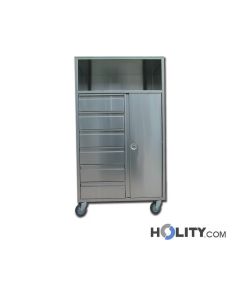
Stainless steel anesthesia trolley. Dimensions: W60 x D40 x H110 cm

Stainless steel operating room trolley with 5 drawers and one door. Dimensions: 800 x 550 x H.950 mm.

Stainless steel operating room trolley in stainless steel with drawers. Dimensions: 800 x 550 x H.950 mm.

Stainless steel operating room trolley with 4 drawers and 2 deep drawers. Dimensions: 800 x 550 x H.950 mm.
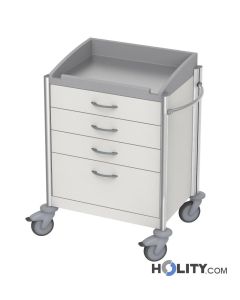
Trolley for hospital instruments and anesthesia, consisting of 4 drawers and worktop. Dimensions: 800 x 580 x H 990 mm
Operating room trolleys represent fundamental elements of the logistical and functional organization of any surgical block. These mobile devices are designed to guarantee rapid access to instruments, medications, and medical supplies necessary during surgical procedures, while maintaining the highest standards of hygiene and sterility. The choice of the appropriate trolley depends on the surgical specialty, the required equipment, and the specific operating procedures of the hospital facility. A well-organized and easily maneuverable trolley contributes significantly to operational efficiency, patient safety, and the well-being of the surgical team.
In the hospital environment, operating room trolleys are distinguished by their structural robustness, made mainly of stainless steel to ensure ease of cleaning, sterilization, and resistance to corrosion. Their configuration can vary considerably: from models dedicated exclusively to anesthesia, to multi-purpose versions equipped with multiple drawer units and large work surfaces. The morphological variety responds to the different needs of surgical équipes, allowing for the creation of specialized setups for cardiac surgery, neurosurgery, orthopedics, or other disciplines.
A well-designed operating room trolley directly influences procedural efficiency and the reduction of surgical times. The possibility of organizing instruments, sterile kits, and consumables in a logical and easily accessible way allows medical and nursing staff to focus exclusively on surgical maneuvers, reducing unnecessary movements and distractions. Trolleys with multiple drawer units and specialized compartments allow for a clear separation between different categories of supplies, facilitating the immediate retrieval of what is needed in critical situations where every second is precious. Furthermore, the mobility guaranteed by quality wheels allows the trolley to be positioned optimally relative to the surgical field, adapting to the different geometries of operating rooms.
From a hygienic-sanitary point of view, stainless steel operating room trolleys offer significant advantages in terms of preventing hospital-acquired infections. The smooth, non-porous surface facilitates post-operative decontamination through standardized cleaning and steam sterilization procedures, ensuring that no biological particles can hide in crevices. The absence of complex finishes, sharp corners, or hard-to-reach areas makes these devices compliant with international microbiological safety guidelines. The structural durability of a professional trolley ensures years of intensive use without compromising functional integrity, representing an important investment in the quality of care.
Operating room trolleys are mainly divided into three functional categories. Anesthesia trolleys are specifically configured to hold and organize anesthetic drugs, endotracheal tubes, airway monitoring devices, and anesthesia induction tools. These models generally feature a compact structure with a height varying between 110 and 95 centimeters, equipped with shallow drawers to facilitate the visualization of contents. Servant trolleys, on the other hand, are designed to accompany the surgical team during surgery, housing sterile kits, gauze, probes, and other consumable supplies. The latter are characterized by larger dimensions, with a depth between 55 and 60 centimeters, and numerous drawer units to stratify materials according to standard operating procedures.
A third category includes combined trolleys, designed for facilities with limited space, which integrate anesthetic and surgical storage functions in the same device. Specialized instrument drawer units also exist, made of AISI 304 stainless steel with a structural thickness of 20/10, representing an elegant and highly hygienic solution for organizing forceps, scissors, retractors, and other surgical tools. The choice between these types must consider not only the available space but also the prevailing surgical procedures at the facility, the mobility needs of the staff, and the sterilization protocols in use.
The selection of an operating room trolley requires a preliminary assessment of the facility’s specific operational needs. Firstly, it is essential to define which surgical specialty the trolley will support: a cardiac surgery trolley will require different configurations compared to one dedicated to orthopedics. The number and size of the drawers must be proportionate to the volume and variety of supplies routinely used. It is also necessary to consider the ergonomics of the staff, evaluating the height of the work surface and the ease of access to the various compartments during stressful surgical situations. A frequent error is underestimating the importance of depth: drawers that are too shallow make it difficult to locate materials, while excessively deep drawer units involve significant postural effort.
Another decisive factor concerns materials and finishes. AISI 304 stainless steel represents the preferable quality standard for resistance to corrosion and repeated sterilization, even if it involves a higher economic investment compared to alternatives. The overall dimensions of the trolley must be compatible with the circulation paths of the operating room: a trolley 800 millimeters wide could prove impractical in compact rooms. The quality of the wheels and locking systems is an often overlooked but crucial criterion for safety during movement near the sterile field. Finally, it is advisable to check the availability of spare parts and post-sales technical assistance, as a trolley damaged during intensive clinical use could generate significant downtime costs.
Operating room trolleys must comply with a series of regulations that guarantee safety from both a structural and microbiological point of view. In the European context, the UNI EN ISO 14971 standard establishes risk management requirements for medical devices, a principle that influences the ergonomic design and operational safety of hospital trolleys. Resistance to steam sterilization is certified following the criteria of the ISO 11135 standard, which defines the parameters of temperature, humidity, and exposure times necessary to guarantee the reduction of the microbial load. Surfaces must also meet the criteria for ease of cleaning according to guidelines established by international bodies such as the WHO and national health agencies.
At a national level, Italian hospital facilities follow the indications provided by the Ministry of Health and the Regions regarding the prevention of healthcare-associated infections (HAI). The specific choice of AISI 304 stainless steel is directly linked to the ability to withstand repeated autoclaving cycles without developing corrosion or surface degradation. Equally important is the verification of structural stability in motion, a parameter controlled through movement tests according to international standards that simulate the real stresses of clinical use. The technical documentation provided by the manufacturer must include certifications of conformity, functional test reports, and detailed instructions for periodic maintenance and post-use sterilization.
Explore all the products in the category and compare the available solutions to find the one best suited to your operational context. Each trolley has been selected based on criteria of quality, durability, and compliance with international hospital regulations.
The anesthesia trolley is dedicated exclusively to anesthetic drugs, endotracheal tubes, and airway management devices, with shallower drawers for easy visualization. The servant trolley accompanies the surgical team during the procedure, containing sterile kits, gauze, probes, and consumables, with larger drawer units and a different configuration to support operating procedures.
Yes, AISI 304 stainless steel trolleys are specifically designed to withstand repeated steam sterilization cycles in an autoclave. However, it is essential to verify that the manufacturer’s technical certification confirms compliance with the ISO 11135 standard and to follow the instructions provided for correct temperature, humidity, and exposure times.
For medium-sized operating rooms, the optimal dimensions are generally 800 x 550 millimeters for the base with a height between 95 and 110 centimeters. It is essential to check the room’s circulation paths and available spaces beforehand to avoid obstacles during critical movements around the sterile field.
Cleaning should be carried out with neutral detergents and non-abrasive sponges, followed by rinsing with distilled water to avoid streaks. After clinical use, the trolley must undergo autoclave sterilization according to specific parameters. Periodically, it is advisable to check the condition of the wheels, the locking systems, and the overall structural integrity.
Load capacity varies depending on the model and materials used, generally ranging between 150 and 200 kilograms for standard trolleys. It is important to consult the manufacturer’s technical documentation to verify the maximum supported load, especially when planning particularly heavy storage of specialized supplies.
Yes, according to international guidelines and hospital protocols, every operating room must have at least one fully stocked anesthesia trolley ready for use at all times. This represents an essential requirement for patient safety and the management of intraoperative airway emergencies.
While technically possible, using an operating room trolley for drug distribution functions is not recommended, as it involves the risk of cross-contamination and compromises the logical separation between different clinical processes. There are trolleys specifically configured for drug distribution that better comply with hospital safety protocols.
The trolley can be used immediately after the completion of the autoclave sterilization cycle, once cooling is complete. However, if it is not used within 48-72 hours, it is advisable to repeat the sterilization to ensure the maintenance of sterile conditions, in accordance with the hospital facility’s protocols.
 English
  Italian
 French
 German
 Spanish