
mon-fri 9-13 / 14.30-18.30
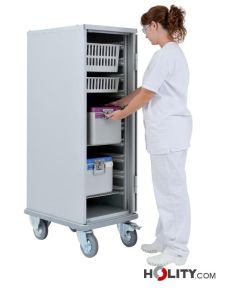
Cabinet trolley for ISO containers. Dimensions: W. 51 x D. 76.5 x h. 153.5 cm. Load capacity: 150 kg.

Cabinet trolley for ISO containers. External dimensions: W. 97.7 x D. 71 x h. 178.5 cm. Capacity: 200 kg.

Modular hospital cabinet with probe holder shelf and 6 telescopic rods. Dim.: 600x400 x h. 180 cm.
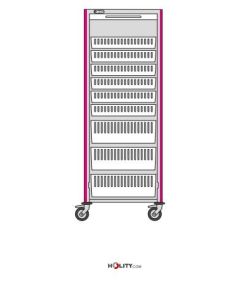
Modular hospital cabinet with code lock. Equipped with ISO trays. Dimensions: 600x400 x h. 180 cm.
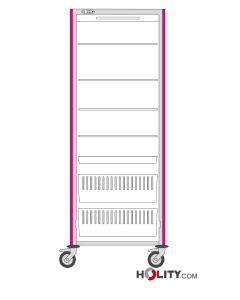
Modular hospital cabinet. Dimensions: W. 60 x D. 40 x h. 180 cm.
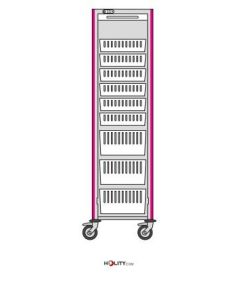
Modular hospital cabinet with code lock. Equipped with ISO trays. Dimensions: 400x600 x h. 180 cm.
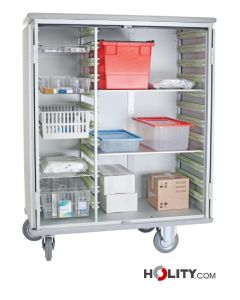
Cupboard trolley for transport and storage of consumables and medicines. Dimensions: W. 140 x D. 63 x h. 178.5 cm. Capacity: 250 kg.

Closet trolley for ISO containers. Dimensions: W. 140 x D. 71 x h. 178.5 cm. Capacity: 250 kg.
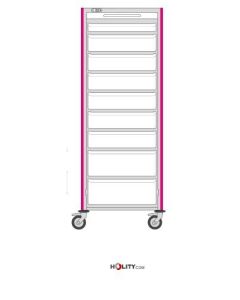
Modular hospital cabinet with code lock. With interlocking drawers. Dimensions: 600x400 x h. 180 cm

Modular 2-column storage cabinet with code lock. Single column dim.: 600x400 x h. 160 cm.
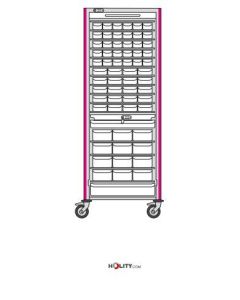
Modular medication storage cabinet. With containers and drawers. Dimensions: 600x400 x h. 180 cm.
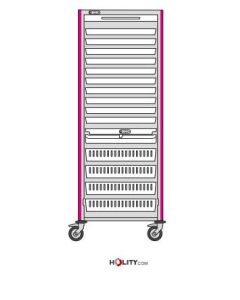
Equipped modular drug storage cabinet. Dimensions: 600x400 x h. 180 cm.
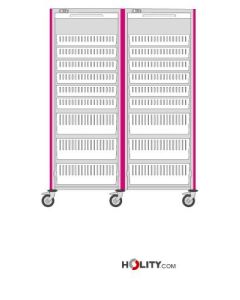
Modular double-column cupboard with code lock. With ISO containers. Single column dim.: 600 x 400 x H 180 cm.
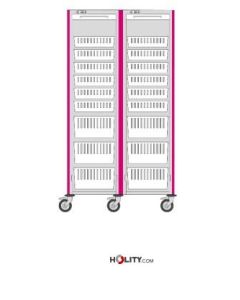
Double column storage unit with ISO containers. Code lock. Single column dim.: 400x600 x h. 180 cm
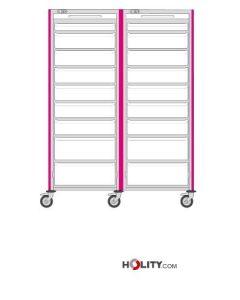
Double-column modular cabinet with code lock. With drawers. Single column dim.: 600x400 x h. 180 cm
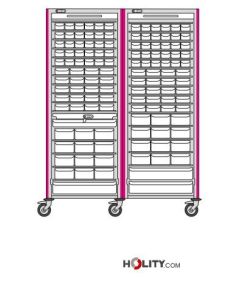
Modular double column medicine storage cabinet. With containers and drawers. Single column dim.: 600x400 x h. 180 cm.
Modular hospital cabinets represent a structured and reliable solution for the organized management of drugs, medicines, and medical materials within hospital facilities, pharmacies, and medical centers. These technical furnishings combine practical functionality with regulatory compliance with the safety and traceability requirements demanded by the medical sector. Modularity allows the available space to be adapted to the specific operational needs of each department, while ensuring controlled access, ease of cleaning, and protection from contaminants.
The modular system represents a rational investment for any hospital facility that needs to optimize storage, reduce search times for materials, and implement documentable control procedures according to current regulations. The construction versatility allows choosing between different configurations, dimensions, and accessories based on the volume of material to be contained, the physical space available, and internal operating procedures.
Modular hospital cabinets offer concrete operational benefits that directly affect department efficiency and patient safety. The internal structure organized with ISO container guides and stop systems allows medical and paramedical staff to quickly locate drugs and materials without wasting precious time during critical activities. Controlled access via code lock ensures traceability of withdrawals and prevents unauthorized access to sensitive medicines. The modular configuration also allows for progressive storage expansion, adapting to the evolution of clinical demand without the need to replace the entire system.
From the point of view of maintenance and hygiene, the materials in anodized light alloy and ABS facilitate cleaning and sanitization operations according to hospital protocols, reducing the risks of cross-contamination. The high structural capacity (up to 250 kg) allows for the concentration of a large amount of material in limited spaces, optimizing the square footage available in departments. For hospital pharmacies, pharmaceutical preparation centers, and medical warehouses, this solution represents an effective compromise between practical use, regulatory compliance, and long-term durability.
The range of modular hospital cabinets is divided into different construction configurations to adapt to specific operational needs. Trolley cabinets for ISO containers represent the ideal mobile solution for facilities that need to move medicines frequently between departments; available in three main dimensional variants (from 51 x 76.5 cm up to 140 x 71 cm), these trolleys maintain high structural capacities and integrate swivel and fixed wheels that guarantee stability during transfers. Single column cabinets (600 x 400 x 180 cm) constitute the base of the fixed range, with the possibility of customization via probe-holder shelves, ISO trays, or interlocking drawers depending on the specific use.
For larger storage needs, double-column models double the containment capacity while maintaining the same horizontal footprint, ideal for centralized pharmacies or medium-sized medical warehouses. Each configuration can be equipped with containers of different heights (from 10 to 36 ISO units), allowing for space optimization based on the usage profile. Medicine cabinets integrate further accessories such as telescopic rods for monitor probe holders, climate-controlled compartments when required, and advanced stop systems for heavy containers. The choice between models with hinged doors, sliding doors, or without doors depends on the frequency of access and the operational preferences of the department.
Selecting the correct modular cabinet requires a preliminary analysis of specific operational needs and physical space constraints. The first critical parameter is the required storage volume: it is necessary to quantify the number of ISO containers, drawers, and shelves needed during the peak of daily use, including a buffer margin for emergency situations or seasonal variations. Subsequently, the available footprint in linear meters and free height must be evaluated, considering that most models reach 180 cm and require accessibility for access. A common mistake is undersizing the initial solution: investing in a slightly larger cabinet avoids future replacement costs and ensures optimal management without operational congestion.
The need for mobility represents an important discriminant: if the department requires frequent movement between clinical areas, a trolley cabinet with wheels is mandatory; conversely, for fixed stations, a column cabinet with a code lock and specialized shelves is more efficient. Access to the type of ISO containers available and the dimensions of the medicines to be stored influence the choice of compartment height; consulting the operational staff who will use the cabinet daily is essential to avoid ergonomic or workflow problems. Finally, check if the hospital facility has specific traceability requirements or integration with IT systems: some models can be equipped with RFID readers or sensors for real-time inventory, representing a larger investment but significantly reducing administrative management costs.
Modular hospital cabinets must comply with national and international regulations governing safety, construction quality, and compatibility with the medical environment. The UNI EN 61010-1 standard defines safety requirements for medical and laboratory equipment, including support furniture; the structure must guarantee anti-gravity stability, base frame solidity, and the absence of sharp edges that could represent a hazard. Compliance with ISO 4646 containers is mandatory to ensure the interchangeability and traceability of medicines; each compartment must maintain tight dimensional tolerances to avoid unwanted shifts during movements.
The DGSA (Legislative Decree on Healthcare Waste Management) regulations also require that medicine cabinets be constructed with materials that are easily sanitizable and compatible with the disinfectants used in hospitals, excluding porosity that could constitute bacterial contamination niches. Locking systems must comply with the traceability requirements provided by local hospital procedures; numerical code or key locks represent widely consolidated solutions. Structural capacity must be certified by independent mechanical tests and declarable in a verifiable way on the product. For facilities operating in regions with more rigid regulatory standards (e.g., JCI or ISO 9001 accredited facilities), it is advisable to request explicit certificates of compliance and technical design documentation according to international standards.
Explore all the products in the category and compare available solutions to find the one best suited to your hospital, pharmaceutical, or medical research operational context.
Most single-column models measure 600 x 400 mm at the base with a height between 160 and 180 cm. Trolley cabinets range from 51 x 76.5 cm up to 140 x 71 cm. Double-column configurations double the width while maintaining the same depth. Dimensions can be customized based on specific needs.
Trolley cabinets for ISO containers reach capacities up to 250 kg, while single-column models support similar loads distributed on the shelves. Total capacity depends on the specific model and weight distribution in the containers. Always check technical specifications before installation.
Trolleys are ideal if you need to frequently move drugs between departments and feature swivel and fixed wheels. Fixed column cabinets are preferable for permanent stations that require maximum stability. Evaluate daily movement frequency and available space to decide.
Some models include ISO containers in grey ABS; others are supplied empty to allow the customer to choose containers according to their dimensional specifications. Check the product description to know if containers are included in the price.
Yes, code locks meet hospital requirements for access control and traceability. They allow recording who accesses and when, maintaining compliance with regulations on sensitive medicine management. Some models offer integration options with RFID systems for advanced tracking.
The main structure is made of anodized AlMg3 light alloy, the base frame in epoxy-polyester powder-coated steel, and the containers in grey ABS. These materials are easily sanitizable and resist common disinfectants used in hospitals.
Some advanced models can be equipped with RFID sensors, barcode readers, or automatic weighing systems that integrate with pharmaceutical management software. This option increases the initial cost but significantly reduces inventory control times and improves traceability.
Sanitization times are reduced thanks to smooth, non-porous materials; generally 15-20 minutes are enough for a thorough cleaning with standard disinfectant. The modular structure allows easy access to all internal components without the need for complete disassembly.
 English
  Italian
 French
 German
 Spanish