
mon-fri 9-13 / 14.30-18.30
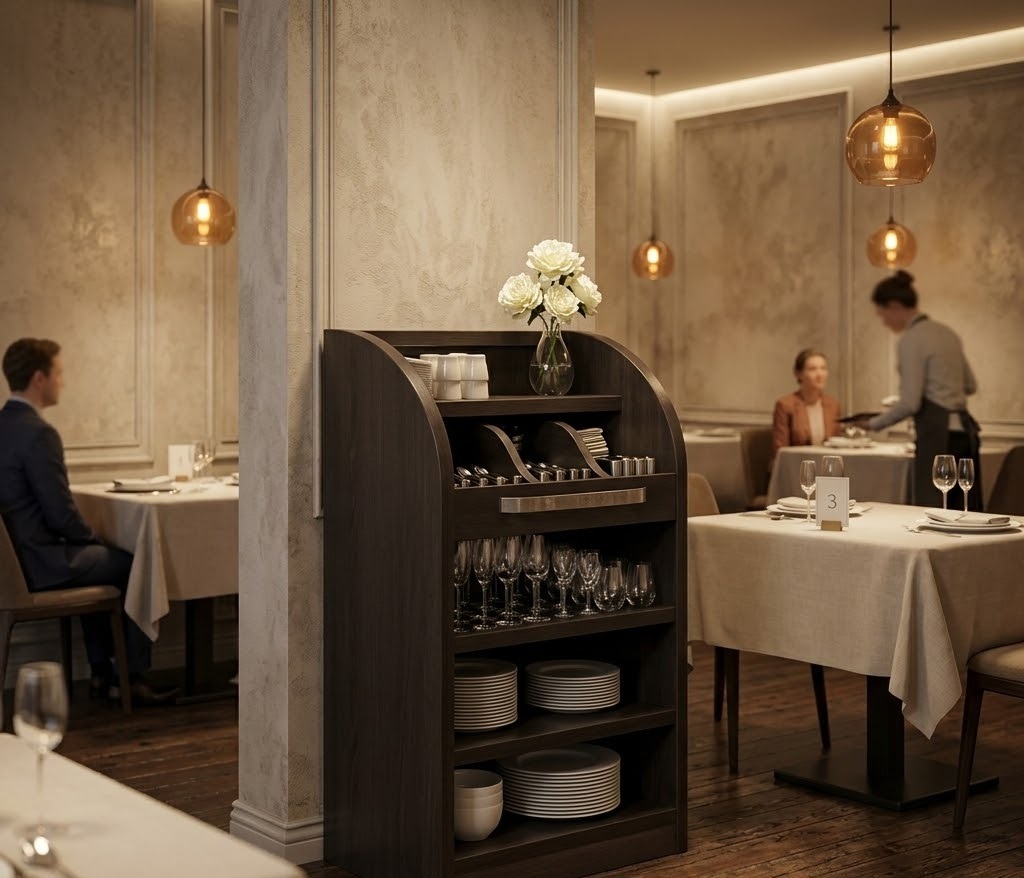
Optimizing the logistics of work flows within a restaurant dining room is one of the fundamental pillars for determining the operational success of a restaurant business and raising customer perception. Choosing dining room furniture (commonly known as service stations or gueridons) is not a mere aesthetic decision, but represents an engineering planning intervention aimed at minimizing downtime, rationalizing the storage of supplies (cutlery, linens, glassware, menus), and ensuring ergonomic postural support for waiters. Strategically positioned at key points in the dining room, these furnishing devices avoid congestion in the passageways to the kitchen, allowing staff to manage table replenishment with complete autonomy and fluidity. This purchasing guide was created to help you navigate the many configurations available in the Holity.co.uk online catalogue, analysing structural modularity, material finishes and the precise millimetric dimensional constraints required for an efficient and high-performance room layout.
In the HoReCa contract and professional hotel supply landscape, service stations are divided into macro-constructive categories developed to meet specific needs for vertical storage, mobility or floor space.
Compact configurations focused on maximum visual discretion, designed to integrate into environments where it is necessary to preserve full panoramic visibility of the room.
Advantages: They offer a footprint reduced to the bare minimum, aligning perfectly with the height of the tables or perimeter dividers. They act as rapid support hubs without weighing down the air space of the room, ensuring excellent space saving.
Disadvantages: Limited vertical load volume compared to the structured variants with a backsplash.
Ideal for: Bistros, confined service boxes, waiting rooms and restaurant corners with small floor plans.
Balanced intermediate systems that combine excellent internal volumetric capacity with a large and comfortable upper work surface.
Advantages: They represent the most versatile solution in the sector. They integrate flexible cutlery drawers and lower compartments protected by solid doors, allowing for the storage of large volumes of clean table linen and stacks of spare plates, hiding them from customer view to preserve the formal decorum of the room.
Disadvantages: They require an adequate front corridor to allow the doors to open fully without hindering the waiters.
Ideal for: Modern trattorias, high-traffic pizzerias, hotel lounges and classic restaurants with structured management by ranks.
Impressive furnishing systems that make full use of the vertical air space, configured with open upper shelves for housing accessory accessories.
Advantages: They maximize linear storage capacity per square meter of floor space. The open upper shelves are excellent for supporting ready-to-use items (bread baskets, ice buckets, oil cruets, cheese bowls), speeding up service maneuvers during peak workloads.
Disadvantages: Having a significant visual impact, they require careful perimeter positioning against the wall to avoid light barriers.
Ideal for: Large reception rooms, ballrooms, hotel breakfast rooms and restaurant contexts with very high cover turnover.
To integrate a service station that optimizes the logistics of the room and withstands intensive use cycles, it is essential to set the search filters by analyzing the millimetric and dimensional cursors provided by our technical panel.
The vertical dimension of the furniture directly influences the ergonomics of the waiter and the planning of the visual barriers of the room. Our professional assortment covers a **height in millimeters that ranges from a minimum of 815.00 mm up to a maximum of 1820.00 mm**. Choosing the low modules from 815-900 mm allows you to use the upper top as a support surface for clearing or preparing orders flush with the table; conversely, the structured variants that reach 1820.00 mm are configured as true vertical room warehouses, optimizing the solid walls of the building.
The width determines the linear positioning capacity of the cutlery drawers and the number of configurable doors. The options available on our store cover a **width in millimetres between 450.00 mm and 1459.00 mm**. The narrow 450 mm modules are configured as single-sided space-saving stations ideal as auxiliary support points for single reduced rows; the models extended up to 1459.00 mm instead represent real central consoles capable of serving macro-sectors of the room, centralising the distribution of tableware.
The depth is the most critical parameter in order not to compromise the flow of traffic and the accident prevention of personnel moving with suspended loads. Our catalog offers flexible solutions with a **depth in millimeters from a minimum of 400.00 mm up to a maximum of 1407.00 mm**. While standard measurements are around 400-500 mm to fit perfectly into wall niches without protruding into corridors, increased depths of up to 1407.00 mm identify special modules, central islands or multifunctional service counters equipped with tilting hoppers or rear compartments with double access.
The economic planning of contract furniture must combine the aesthetics of the layout with a lasting ROI. The Holity.co.uk selection guarantees access to stable and professional equipment within a **flexible price range that varies from €343.00 up to €2218.00**. This range allows you to modulate your spending, starting from basic modules in high-resistance melamine-faced chipboard, up to premium structures in painted veneered wood with stainless steel inserts, cushioned drawers and heavy-duty industrial wheels.
Since these are furniture pieces exposed to continuous mechanical scratches, food spills and daily cleaning cycles, the materials must guarantee water-repellent and non-porous surfaces. The structures use melamine-faced or veneered wood panels treated with non-toxic and moisture-resistant finishes. Our catalogue offers a complete colour palette (oak, wenge, walnut, carbon, ash) to coordinate consistently with the stylistic identity of the room: dark shades such as carbon and wenge convey luxury and modernity, while light woods such as oak and ash give brightness and visual spaciousness to the spaces.
Gourmet Restaurants, Fine Dining and Luxury Hotels: We recommend using medium or tall service units in high-quality finishes (wenge, carbon), equipped with internal drawers with cushioned drawers and lined dividers to dampen the metallic sound of cutlery. The aesthetics must be impeccable, integrating solid doors with push-pull opening systems to completely hide waste materials from guests' view.
Bistros, Pizzerias, Fast-Casual and High-Turnover Venues: The purchase choice should be oriented towards service stations mounted on multidirectional swivel wheels with a built-in total brake. The mobility allows for the table layout to be quickly reconfigured based on reservations and facilitates floor cleaning operations at the end of the shift. An integrated tilting hopper is recommended for the rapid disposal of disposable napkins or small scraps.
Reception Halls, Banqueting Rooms and Hotel Breakfast Rooms: In these contexts characterised by massive volumes of tableware required simultaneously, high vertical capacity furniture (up to 1820 mm in height) and extended width of 1459 mm, complete with an upper shelf, is essential. They allow you to keep hundreds of place settings, bread baskets and plate warmers ready, speeding up the work of area waiters.
Optimise the efficiency of your ranks, protect the integrity of your porcelain and renovate your restaurant room with the professional solutions available on Holity.co.uk. Our online store offers you a specialized and certified assortment, engineered to guarantee an operational life of more than 20 years without undergoing structural deformation under the concentrated weight of furniture loads.
Use our lateral search cursors to set the exact millimetric height, width and depth measurements suitable for the niches and corridors of your premises, and select the price range most consistent with your specification budget (**€343.00 - €2218.00**). Are you a hotel manager, a HoReCa interior designer or do you need to structure a multiple supply through the Public Administration portals (MePA)? Contact our customer service today to receive complete technical data sheets and a personalized quote tailored to your accommodation facility.
How do full-extension telescopic slide systems with hydraulic shock absorbers affect the stability of plate stacks in lower drawers?
Medium- to high-end dining room furniture uses industrial-strength telescopic slides in galvanized steel with full-extension ball bearings and hydraulic soft-close devices. This system allows the drawer to be fully extended to access the rear compartments without suffering structural flexure due to the weight of the dishes. The hydraulic shock absorber absorbs the inertial force during the closing phase, eliminating transverse impact vibrations that could cause the stacks of plates or china stored inside to break or chip.
How is the useful width of clearance (up to 1459 mm) calculated to allow the doors to be opened without obstructing the walkways of waiters?
When designing the room layout, the minimum clearance in front of the service console must include the depth of the cabinet (e.g. 480 mm), the overhang width of the door when opened at 90° (equal to half the width of the compartment, approximately 400-500 mm) and the anthropometric maneuvering space of the waiter when squatting or bent over (at least 700-800 mm). Consequently, for a 1459 mm wide cabinet, it is necessary to provide a clear front corridor of at least 160-180 cm in total to avoid bottlenecks in the service flows of adjacent tables.
What chemical-physical specifications differentiate the surface treatments of melamine-faced panels from polyurethane paints in counteracting hydrolysis from acidic liquids?
Melamine-faced wood panels are heat-sealed on the surface with phenolic resins that create a completely waterproof polymer barrier, resistant to hydrolysis and stains from acidic liquids such as wine, vinegar, fruit juices or coffee. Veneered wood structures, on the other hand, require multi-layer acrylic or polyurethane protective coating cycles that seal the wood fibres. This protective finish prevents the capillary penetration of liquids into the wood pores, avoiding localised swelling or detachment of the ABS perimeter edges during washing.
How does the diameter and tread compound of industrial wheels (up to 150-200 kg load capacity) affect rolling and the prevention of marks on resin or marble floors?
The multidirectional swivel casters integrated into the mobile units are engineered with roller bearings and treads in cast polyurethane or grey vulcanised anti-friction thermoplastic rubber, materials certified according to the REACH directive. This elastic compound with high Shore hardness prevents localised sinking and guarantees a low coefficient of dynamic friction on polished marble or industrial resin floors. The grey polymer is specifically formulated not to release migratory plasticisers or indelible dark marks on the floor even in the event of sudden rotations under loads of 200 kg.
What hygienic advantages does the internal configuration with an isolated tilting hopper bring compared to traditional open compartments according to HACCP sanitary protocols?
The stainless steel or polyethylene tilting hopper integrated into the closed units acts as a biological isolation chamber for the temporary disposal of waste or soiled linen directly in the room. Unlike open compartments, exposed to dust and public view, the passive magnetic tilting system seals the internal bag, preventing the emission of foul-smelling fumes or the dispersion of volatile contaminants into the air, fully complying with the hygienic separation requirements imposed by HACCP self-monitoring protocols for food serving areas.
 English
  Italian
 French
 German
 Spanish