
mon-fri 9-13 / 14.30-18.30

Medical trolley with lock, wheels Ø100 mm. Dimensions: 60 x 45 x H 111 cm.
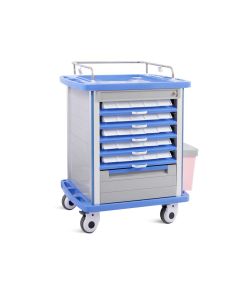
Steel medicine distribution trolley. Equipped with 10 drawers and 1 large drawer with 12 compartments.

Compact medication trolley with key lock. Dimensions: 51.5 x 53 x H 111 cm.
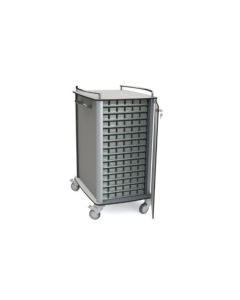
Medical trolley with lockable doors, structure on Ø100 mm wheels. Dimensions: 80.5 x 60 x H 111 cm.

Medication distribution trolley for hospital use, with steel frame, ABS work surface and technopolymer drawers. Dim.: W61 x D60 x H111 cm.
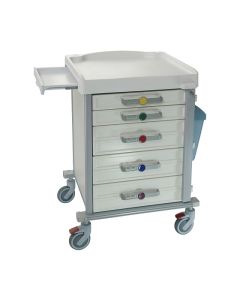
Medication transport trolley with 5 drawers. Dimensions: W. 670 x D. 600 x H. 1010 mm
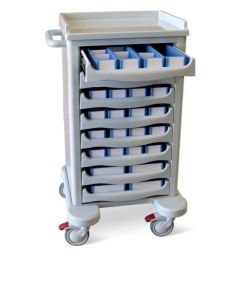
Hospital trolley for drug distribution with 8 drawers. Dimensions: 610 x 550 x 1110 h mm
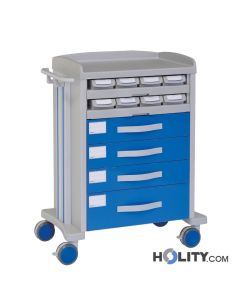
Medication and therapy trolley in aluminum complete with 4 drawers and 2 shelves with 8 compartments. Dimensions: W.78 x D. 46 x h. 97 cm. Wheels Ø 100 mm.
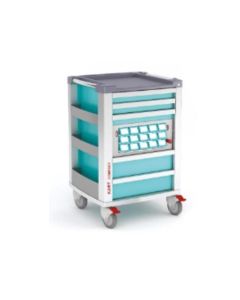
Medication distribution trolley with 15 compartments and 5 drawers.
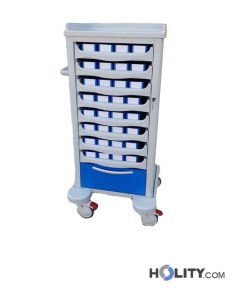
Medicine distribution trolley with 8 drawers for single-dose therapy trays and 1 standard drawer for medications. Dimensions: W61 x D60 x H130 cm.
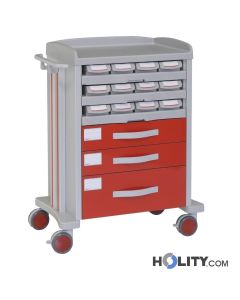
Medication distribution trolley equipped with 3 shelves with 12 compartments and 3 drawers. Dimensions: W78xD46xH97 cm.
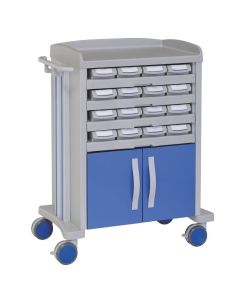
Medication distribution trolley equipped with two doors and four shelves with 16 compartments. Available in various colors and equipped with a key lock. Dimensions: W78xD46xH97 cm.
Medication distribution trolley with 21 compartments and 3 drawers. Dimensions: 655x605xh.970 mm
Medication distribution trolley with 25 compartments. Dimensions: 65.5x60.5x97 cm
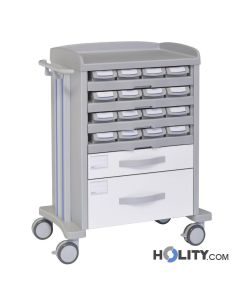
Medication distribution trolley ideal for clinics and hospital facilities. Equipped with 4 shelves and 16 compartments measuring 230x170x70 mm. and 2 drawers
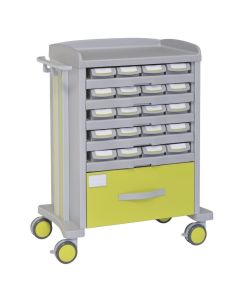
Medication distribution trolley ideal for clinics and hospitals. Consisting of 5 shelves with 20 compartments, 1 drawer. Measurements: W78xD46xH97 cm.
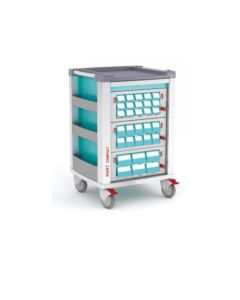
Medication distribution trolley with 3 drawers and 31 total compartments.
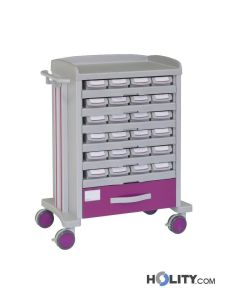
Hospital trolley for medication distribution. Equipped with 24 compartments. and 1 drawer. Dimensions: L78 x D46 x H97cm.
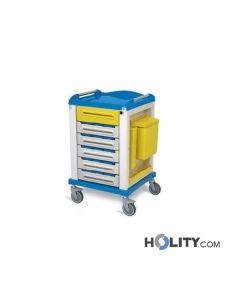
Drug distribution trolley with 15 dividers with 3 compartments, 45 total spaces. Structure in painted steel
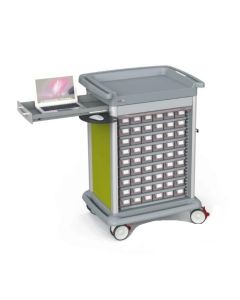
Therapy administration trolley with lateral writing desk and large plastic work surface. Twin wheels Ø 125 mm. Dimensions: 830x650xh.1100 mm.
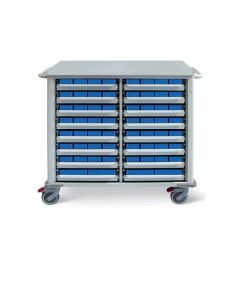
Steel medicine distribution trolley with 2 rows of 8 drawers, designed for unit dose therapies. Dimensions: W120 x D60 x H106 cm.

Hospital trolley for medication distribution equipped with drawers of different functions and sizes. Dimensions: W120 x D60 x H106 cm.
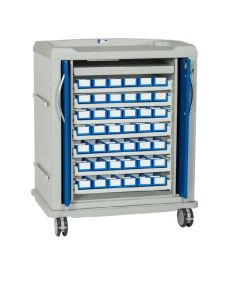
Anodized aluminum medication distribution trolley with 42 compartments. Dimensions: 880x620xh.1080 mm
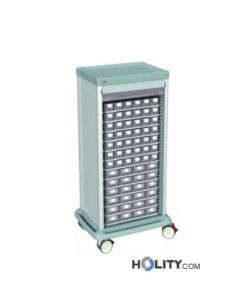
Drug distribution trolley with roller shutter closure and thermoformed plastic top. 4 twin wheels Ø125 mm. Dimensions: 830x650xh1447 cm.
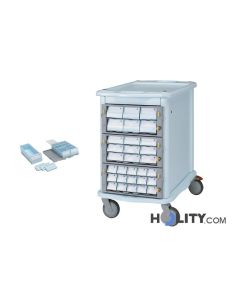
Double-faced drug distribution trolley with 3 drawers on one side and 30 single-dose drawers on the other.
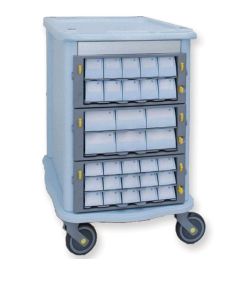
Medication transport trolley. Dimensions: W. 92 x D. 59 x h. 81 cm.
Medication distribution trolleys represent a fundamental element in hospital logistics systems and modern healthcare facilities. These tools combine organizational functionality with rigorous safety and hygiene requirements, allowing healthcare professionals to manage the administration of medicines to patients in an orderly and traceable manner. The choice of the correct model directly affects the efficiency of therapeutic pathways, the reduction of administration errors, and the overall quality of care.
A well-designed medication distribution trolley facilitates quick access to medicines, maintains the integrity of the pharmaceutical product, and allows for organized inventory management. Healthcare facilities, from small clinics to large hospital complexes, depend on this equipment to ensure continuity in the delivery of therapies and compliance with operational protocols.
Effective drug management in a hospital setting requires tools specifically designed to face the daily challenges of healthcare personnel. Medication distribution trolleys offer several operational advantages that go beyond simple transport functions. Firstly, they significantly reduce therapy preparation time, allowing nurses to quickly access necessary medicines thanks to well-structured internal organizations with drawers, compartments, and modular dividers. This efficiency translates into better management of administration times and an increase in the overall quality of patient care. Furthermore, the presence of key locking systems and locks contributes to preventing unauthorized access, a critical aspect for the control of regulated drugs and general safety.
From a clinical safety perspective, these trolleys significantly reduce the risk of pharmacological administration errors, as their internal organization promotes the correct identification of medicines and stock traceability. In complex facilities such as university hospitals or centers of excellence, the ability to quickly manage complex therapies for multiple patients represents a critical element for reducing hospital mortality and avoidable complications. Finally, the use of specifically sized and designed trolleys allows for better staff ergonomics, reducing fatigue during shifts and limiting the incidence of injuries related to manual transport.
The market for medication distribution trolleys offers very diversified solutions, each suitable for specific operational contexts. Compact trolleys with 15-30 compartments represent the ideal choice for small clinics, medical offices, and general medicine facilities where the volume of drugs to be managed is limited. These models, with dimensions generally around 50-80 centimeters in width, offer good capacity in little space and allow for easy movement even in crowded environments. Intermediate category trolleys, equipped with 40-50 compartments distributed over multiple levels, are designed for standard hospital wards, private clinics, and residential facilities for the elderly where the need for organization is greater but still manageable with ordinary staffing.
As for more structured solutions, professional trolleys with over 60 compartments, multiple drawers, and side shelves represent the benchmark for large hospitals and research centers where therapies are complex and traceability needs are maximum. These models often include integrated worktops, surfaces for unit-dose preparation, and compartmentation specifically designed for unified therapies. Another important category is represented by double-sided trolleys, with organization on two opposite sides, which allow for serving both sides of a hospital aisle simultaneously, optimizing distribution times. The choice between stainless steel, anodized aluminum, or polycarbonate structures depends on the environment of use: stainless steel prevails in environments with high cleaning frequency, aluminum in contexts where lightness is a priority, and polycarbonate in facilities requiring visibility of contents.
Selecting the trolley suitable for one’s operational reality requires a careful evaluation of multiple factors. The first critical parameter concerns the number and type of drugs managed daily: a hospital pharmacy that prepares unit doses for hundreds of patients requires a higher total capacity compared to a small specialized department. It is essential to count not only frequently used medicines but also strategic reserves of life-saving drugs and medicines for very rare use that must nonetheless be immediately available. A second essential aspect concerns the physical dimensions of the available space: a trolley unsuitable for the department’s geometry creates impediments to movement, reduces access to drugs, and compromises workflows. It is therefore necessary to precisely measure transit spaces, corridor widths, and room heights, comparing them with the external dimensions of the candidate trolley.
A common mistake consists in underestimating the specialization needs for each type of therapy. If the facility manages many unit-dose therapies, it is better to move towards trolleys with specific drawers for standardized bins rather than models with generic compartments. Similarly, if the ward treats complex oncological or cardiological pathologies, the need for organization by therapeutic plans suggests the adoption of trolleys with separate shelves and visibility from the outside. The issue of mobility is equally critical: it is preferable to choose trolleys with wheels of adequate diameter (generally 100-125 millimeters) that guarantee easy pushing and reliable braking, especially if the ward has uneven floors or level changes. Finally, it is necessary to evaluate the specific safety requirements of the institution: hospitals in areas with high patient turnover prefer multiple key locks, while facilities with stable staffing may settle for simple closures as long as they are certified.
The use of medication distribution trolleys in the healthcare sector is subject to a series of regulations that vary depending on the geographical context and the type of facility. In Italy, the main provisions derive from Legislative Decree 81/2008 (Consolidated Law on Safety at Work), which defines the ergonomic and safety requirements for trolleys used in hospitals, as well as the guidelines of the National Commission for Pharmacovigilance which establishes standards for traceability and storage of medicines. The Italian Pharmacopoeia and the UNI/EN standards relating to hospital furniture prescribe specific construction characteristics: non-porous and easily sanitizable materials, rounded edges for staff safety, and structural stability tested according to defined parameters. Many facilities also require certificates of conformity with European directives on non-invasive medical devices and certificates of environmental sustainability for the materials used.
At an operational level, healthcare facilities must comply with internal protocols for the control and maintenance of trolleys, ensuring periodic inspections of the mechanics (wheels, bearings, brakes), structural stability checks, and verification of the integrity of the locking systems. Many hospitals also implement unique trolley identification systems (RFID tags or barcodes) to track paths and ensure correct hygiene between wards. The regulation on the prevention of hospital-acquired infections requires that trolleys undergo regular cleaning and disinfection cycles, which is why the choice of materials and finishes that facilitate these processes is a priority. Finally, for facilities operating in particular fields (pediatric hospitals, immunocompromised wards), specific trolleys with additional certifications of biocompatibility and sterilizability may be necessary.
Explore all the products in the category and compare the available solutions to find the one most suitable for your operational context. Each trolley is designed to meet specific needs, from the management of ordinary therapy to the most complex applications. Contact our team to receive personalized advice on choosing the ideal model for your healthcare facility.
Compartment trolleys allow for quick visualization and direct access to medicines, ideal for unified therapies and unit doses. Drawer models offer greater storage capacity and protection from dust, preferable when sensitive or controlled drugs need to be stored. The choice depends on the therapeutic protocol and the volume of medicines managed.
Multiply the average number of patients assisted simultaneously by the average number of drugs per patient, then add a 30-40% buffer for strategic reserves and rare-use medicines. For example, a ward with 20 patients and an average of 5 drugs will need at least 130-140 equivalent compartments/drawers.
Stainless steel is denser and less porous, thus resisting intensive cleaning and disinfection cycles better. Anodized aluminum is equally hygienic if treated correctly, but less resistant to repeated abrasion. The difference is significant in wards with high sanitization frequency such as intensive care and immunocompromised units.
100 mm wheels are standard for flat and well-maintained environments. For hospitals with irregular floors or numerous level changes, it is advisable to choose 125 mm wheels which facilitate pushing and guarantee greater stability. The wheel material (rubber vs. polyurethane) affects noise level and grip.
Yes, it represents an essential physical security measure for medicines and prevention of unauthorized access. Most facilities require trolleys with brakes that can be operated with one hand and, if they may contain controlled drugs, also certified key locks. Internal regulations vary: some hospitals require permanent locking, others only during night shifts.
Recommended preventive maintenance is quarterly: inspection of wheels, bearings, brakes, and locks. Cleaning-disinfection must occur daily in standard facilities, more frequently (even 2-3 times daily) in intensive care and critical wards. Correct maintenance extends the trolley’s useful life to over 10 years.
Yes, modern professional models offer removable dividers, pull-out drawers, and height-adjustable shelves, allowing for very rapid reorganization in case of variations in therapeutic protocols or drug turnover. This flexibility is particularly appreciated in university hospitals and research centers where needs change frequently.
Trolleys with specific drawers for standardized bins (generally 230x170x70 mm) are ideal for unit doses. These models usually have 8-10 drawers arranged vertically to facilitate viewing of the days of the week and shifts. Some include side work surfaces for the actual preparation of doses.
 English
  Italian
 French
 German
 Spanish