
mon-fri 9-13 / 14.30-18.30
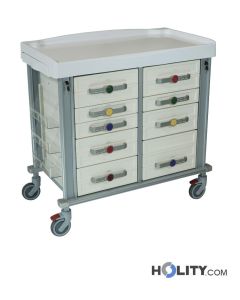
Large hospital dressing trolley in metal-aluminum with 9 drawers. Dimensions: L105 x D60 x H101 cm
Dressing trolleys represent essential solutions in healthcare environments, from medical clinics and professional practices to complex hospital facilities. These mobile furniture units are designed to organize, transport, and provide healthcare personnel with the materials needed during dressing, bandaging, and first aid procedures. Their operational efficiency directly affects the quality of service and the speed of intervention, reducing material search times and improving the ergonomics of medical work. The availability of different models allows the solution to be adapted to the specific context, both in terms of dimensions and the composition of storage elements.
A careful choice of medical trolley is not only a matter of practicality but represents an investment in the standardization of healthcare processes. Resistant materials that are easy to sanitize, modular configurations with shelves and drawers, and controlled mobility through lockable wheels: these aspects characterize professional products. Access to medical materials during procedures is a critical factor that influences the patient’s stay time and the safety of the intervention itself.
The operational advantages deriving from the use of dedicated dressing trolleys go beyond simple space organization. These furnishings allow materials to be kept close at hand, reducing the movement of healthcare personnel during critical maneuvers. In hospital settings, where reaction times and material sterility are determining factors, a well-structured trolley supports more rigorous safety protocols. Furthermore, mobility guarantees distribution flexibility: a single trolley can serve multiple stations or be dedicated to specific wards, optimizing procurement costs. The visibility of materials, favored by the arrangement on open or semi-transparent shelves, reduces retrieval errors and speeds up the execution of procedures.
Outpatient settings, where space is frequently limited, benefit significantly from the compactness of certain models: trolleys with a small footprint but sufficient capacity guarantee order without compromising circulation. In emergency room contexts or operating theaters, however, the search for robust and ergonomic models prevails, with adjustable heights and ergonomic handles that reduce operator fatigue. Resistance to washing and sanitizing cycles is a non-negotiable requirement, given that medical trolleys must undergo frequent cleaning and disinfection operations.
The range of dressing trolleys includes diversified construction solutions, each responding to specific needs. The two or three-shelf models represent the most common configuration, ideal for managing bandages, wound dressings, and first aid interventions. The shelves can be flat or shaped, designed to contain trays of specific materials and to facilitate visual access. Some trolleys integrate lower drawers, very useful for storing frequently used consumables while keeping them protected from dust, while others include additional elements such as medical waste containers or supports for bottles and disinfectant solutions. The choice of construction material varies between painted steel, stainless steel, and ABS: the first offers a good cost-resistance compromise, the second guarantees unalterability over time and ease of sanitization, and the third offers lightness combined with durability.
Stainless steel trolleys represent the top of the category, especially in facilities where cleaning cycles are intensive or where immunocompromised patients are treated. Lockable wheels, a common element in all professional models, allow the trolley to be stabilized during use, preventing unwanted movements. Dimensions vary from compact models (45-60 cm wide) to more generous versions (up to 95 cm), allowing any available space configuration to be covered. The depth, usually around 40-50 cm, is optimized so as not to cause excessive bulk in transit areas. The total height is frequently between 80 and 95 cm, a measurement consistent with the average ergonomics of medical personnel in a standing position.
Selecting the optimal medical trolley requires a preliminary assessment of spatial constraints, frequency of use, and the type of materials to be stored. A fundamental first question concerns the available space: it is preferable to measure storage areas and circulation corridors before opting for a specific model. A trolley that is too bulky, even if full of shelves, becomes counterproductive if it cannot move easily in work spaces. Subsequently, the expected load must be considered: trolleys intended to contain heavy aids or bulky equipment require more robust structures than those dedicated exclusively to light dressings. The frequency of sanitization is a decisive aspect: in wards where disinfection is daily and intensive, stainless steel models are preferable, as they better resist high-temperature washing cycles and exposure to chemical disinfectants.
A common mistake consists in underestimating the importance of material accessibility during use. Trolleys with shelves that are too high or too low compared to the average height of personnel lead to incorrect posture and fatigue: for this reason, some models offer the possibility of adjusting the height of the shelves themselves. Visibility also plays a crucial role: shelves made of transparent or semi-transparent material facilitate the rapid localization of materials without the need to open drawers or lift covers. The type of wheels deserves attention: swivel wheels provide maneuverability, while fixed wheels on at least two sides stabilize the trolley in position. A combination of both is ideal. Finally, assessing compliance with current regulations in the healthcare sector is essential: the trolley must be certified according to specific standards that guarantee structural safety and the hygiene of the materials in contact with patients and operators.
Medical furniture, including dressing trolleys, is subject to a series of international and local regulations that govern its design, manufacture, and use. The UNI EN ISO 14971 regulation governs risk management in medical devices, including considerations on the structural stability and safety of use of hospital trolleys. In Italy, Legislative Decree 46/1997 (subsequently updated by Legislative Decree 37/2021) classifies medical trolleys as Class I or II medical devices, depending on their complexity and associated risk. This classification determines the necessary certification paths and mandatory technical documentation. The CE marking is an indispensable requirement for marketing within the European Union, implying the passing of specific conformity assessments.
Fundamental regulatory aspects concern structural resistance and stability: trolleys must be tested to verify the declared load capacity, usually certified around 50-100 kg per shelf. Surfaces in direct contact with patients or medical materials must be made of biocompatible and easily sanitizable materials, such as stainless steel or certified medical-use plastics. Cleaning and disinfection are critical aspects regulated by the guidelines of the Italian National Institute of Health and by the internal procedures of each healthcare facility: for this reason, trolleys must not have sharp edges, blind corners, or cavities where the disinfectant cannot penetrate adequately. Wheels and casters must guarantee controlled movement without spilling liquids or materials during transport. Structural integrity over time is monitored through periodic checks required by regulation, with particular attention to critical areas such as joints, fixing screws, and welding points.
Explore all products in the category and compare the available solutions to find the one best suited to your operational context. From the two-shelf configuration to models with integrated drawers, each variant has been developed to solve specific needs for organizing and transporting medical materials.
The two-shelf trolley offers greater stability and accessible height for each shelf, ideal for bulky materials. The three-shelf model maximizes storage capacity in limited spaces, reducing the floor footprint. The choice depends on the amount of material to be stored and the available space in the clinic or ward.
Stainless steel resists frequent disinfection cycles, aggressive detergents, and humidity better, maintaining its properties over time. Painted steel is cheaper but requires more maintenance and can deteriorate if subjected to continuous chemical stress. For hospital facilities with high turnover, stainless steel represents the most cost-effective long-term investment.
Measure circulation spaces and corners where the trolley will need to move. Consider the available depth and the width of the corridors. Compact models (45 cm wide) fit small facilities, while 70-95 cm versions are suitable for spacious wards. Also check the height of the workstation to choose an ergonomic trolley.
Yes, periodic checks on wheels, joints, and structural stability are recommended according to current regulations. Wheels should be lubricated and verified, and casters checked for wear. Surface material must be sanitized daily. Stainless steel trolleys require less maintenance than painted models.
Stainless steel (AISI 304 or 316) is the most hygienic material, resisting aggressive detergents and sterilization cycles. ABS is also easily sanitized but less resistant over time. Avoid models with sharp edges, hidden cavities, or hard-to-clean joints that can harbor bacteria.
It depends on the intended use. Drawers protect materials from dust and maintain visual order but slow down access during urgent procedures. Open shelves allow immediate visibility and rapid retrieval. Many hybrid models combine both shelves and drawers to balance protection and accessibility.
Professional medical trolleys typically support 50-100 kg per shelf. Evaluate the total weight of the materials you use daily. Hospital facilities with heavy equipment require models certified for higher loads. Always verify the maximum load certification of the chosen product.
 English
  Italian
 French
 German
 Spanish