
mon-fri 9-13 / 14.30-18.30
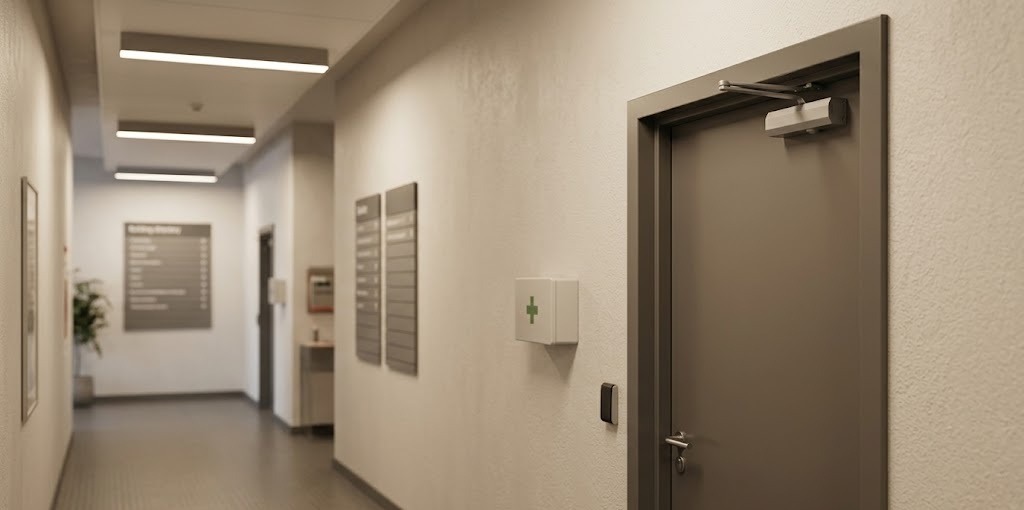
Optimal traffic flow management and access control within a public or commercial building rely on often invisible but structurally crucial hardware components. Choosing the right door closers isn't just a matter of secondary hardware; it's a logistical investment aimed at ensuring passive fire safety, optimizing thermal and acoustic insulation, and preserving the long-term structural integrity of the fixtures. Whether eliminating disturbing door slamming noises in a luxury hotel, regulating fire safety gates in a hospital, or managing monumental doors and windows with heavy pedestrian traffic, millimetric control of the door leaf is a fundamental prerequisite. This buying guide was created to guide you through the various professional models available in the Holity.co.uk catalog, analyzing closing kinematics, dimensional constraints, and mechanical force scales.
The architecture of the window frame and the positioning of the opening determine the selection of the type of machine body, developed to respond to different aesthetic needs and dynamic stresses.
This represents the most widespread and universal contract configuration, anchored directly to the top of the door or jamb.
Heavy-duty devices recessed directly into the lower concrete screed, which act as a real bearing pin for the rotation of the frame.
High-precision systems fully integrated within the thickness of the door or frame, resulting completely invisible when the opening is closed.
Models equipped with a linear slide arm reduce protruding space by sliding the pin inside a fixed guide. In double-leaf gates, the integration of GSR synchronisation systems becomes mandatory: these horizontal mechanical coordinators ensure that the two leaves always close in the correct sequence (first the passive leaf and then the active leaf), preserving the perfect hermetic fireproof seal of the frame.
---
To integrate an efficient closing device that does not offer excessive resistance during opening, it is essential to set the search parameters by analysing the dimensional dimensions provided by our technical panel.
The longitudinal development of the door closer must be compatible with the thickness of the leaf and the usable space on the upper jamb. Our range offers a millimetric breakdown of lengths to suit every installation specification:
The three-dimensional footprint of the machine body can be filtered according to precise millimetre cursors:
The flexibility of our online catalogue allows us to respond in a targeted manner both to small private maintenance interventions and to large tender specifications for industrial or commercial complexes. Our selection is structured within a flexible price range that varies from €28.00 up to €1516.00. The entrance solutions cover essential overhead door closers for lightweight internal doors, while the top-of-the-range quotes identify complex floor locking systems or remote-controlled multifunction electromagnetic coordinators for monumental REI doors.
---
The force that the hydraulic piston must exert to overcome the inertia of the door and the resistance of the seals is codified at an international level by the scale EN 1154 (forces from EN 2 to EN 6):
In public and commercial buildings, legal compliance is mandatory. Devices installed on fire and smoke doors must be CE marked, comply with the EN 1154 standard (and EN 1155 for electromagnetic holding systems) and pass fire resistance tests (such as the UNI EN 1634-1 standard for REI doors). To remove architectural barriers in hospitals or nursing homes, the maximum opening force must be limited, directing the choice towards models with high-efficiency cam technology or assisted opening systems.
---
Hospital corridors, shopping centres and public offices: In these environments characterised by intensive and continuous pedestrian traffic, it is essential to opt for overhead or floor-mounted models with durability certification (tested for over 1 million cycles) and equipped with the "backcheck" function (opening brake). This hydraulic device cushions the violent opening of the door caused by gusts of wind or forced thrusts, safeguarding the wall and the structure of the door itself.
Hotel rooms, restaurants and HoReCa spaces: The operational priority shifts to interior design and acoustic comfort. Concealed door closers or floor-standing models allow for clean, elegant architectural lines, completely eliminating annoying door slamming noise thanks to the micrometric adjustment of the deceleration valves, ensuring guests' peace and quiet in their rooms.
REI Doors and Fire Compartments: In this case, regulatory compliance takes precedence over aesthetic considerations. It is mandatory to install EN 1154 and EN 1634-1 certified overhead or slide door closers, equipped with a final closing action adjustment (click) set in the last 10-15 degrees of movement. This extra click ensures that the door overcomes the resistance of the heat-expanding gaskets and the lock latch, perfectly sealing the opening.
---
Secure the entrances to your building, improve energy efficiency by reducing heat loss in air-conditioned rooms and protect your fixtures from daily mechanical wear. In the Holity.co.uk online catalogue we offer you a complete technical assortment of professional door closers, developed to guarantee constant thermal performance in both winter frosts and high summer temperatures.
Use our lateral profiling tools to select the suitable type ( floor-standing, concealed, overhead ), refine the millimetric dimensional dimensions and set the spending budget (28.00€ - 1516.00€ ) consistent with your construction site plans. Contact our customer service today to receive complete technical data sheets, override diagrams and personalized technical advice tailored to your windows.
---
How does the thermo-constant hydraulic fluid integrated into overhead door closers prevent variations in closing speed between winter and summer?
Professional door closers use special hydraulic oils with a very high viscosity index inside the piston that remain stable over time. Common fluids tend to become thinner in the summer heat (accelerating the closing of the door) and thicken in the winter cold (slowing or blocking it). The thermo-constant mixture, however, maintains its viscous friction coefficient unchanged within a wide temperature range, ensuring that the door return time set on the valves remains constant all year round without requiring continuous manual recalibration by the maintenance technician.
What mechanical balances differentiate the operation of a rack and pinion system from cam technology in facilitating opening for vulnerable users?
The traditional rack and pinion system offers linear and constant resistance: the force required to open the door increases progressively as the door opens, requiring considerable effort in the first few degrees of movement. Cam technology (with an asymmetric egg-shaped profile) introduces a geometric reduction of force: the effort required drops sharply as soon as the door is opened by a few degrees. This kinematics drastically reduces the initial resistance to opening, ensuring an ideal fluidity of action for children, the elderly or wheelchair users in healthcare facilities.
How are the independent valves in aerial models adjusted to coordinate the closing speed and the final latch?
The door closer body houses micrometric adjustment screws that restrict the oil passages in the hydraulic circuit. The first valve governs the general closing speed of the door, covering an angular arc from 180° to approximately 15° of residual opening. The second valve exclusively controls the so-called "final blow" or closing snap, which acts in the last 15-0° before the stop. Correctly calibrating the second valve allows the door to accelerate just enough in the final section to overcome the friction of the lock and the gaskets, without causing the door to slammer violently.
What millimetric depth constraints (up to 450.00 mm) must be planned in the screed for the installation of the box of a professional floor door closer?
The installation of the 4 floor elements requires a prior analysis of the structural dimensions of the floor. The cast iron or case-hardened steel containment box must be embedded in the screed beneath the door; high-capacity models for monumental doors may require an excavation depth and geometric footprint that extends inside the slider 0.00 - 450.00 mm. It is essential that the excavation is perfectly level and hydraulically isolated to prevent rising damp or floor washing liquids from penetrating the box, triggering corrosion or seizure of the lower rotating pin.
How do the closing coordinators integrated into the GSR systems ensure the airtightness of double-leaf REI fire doors during a fire?
In double-leaf fire doors (active and passive), if the active leaf were to close before the passive leaf, the perimeter stops would overlap incorrectly, leaving the opening partially open and nullifying the smoke-proof compartmentation. The GSR synchronization system integrates a horizontal slide with an internal mechanical lock: when both leaves are open, the system holds the active leaf in a waiting position and releases the movement of the inactive leaf. Only after the inactive leaf has completed closing by activating the limit switch does the kinematic mechanism unlock the active leaf, ensuring the correct closing sequence and a heat-resistant hermetic seal.
How does the catalog's modular price range (€28.00 - €1516.00) correlate with the thickness of the metals and the classification of concealed or floor-standing types?
The variability of costs responds mathematically to the material density, the level of carpentry workmanship and the integrated system. The starting price (€28.00) maps the mechanical spare parts, single-joint arms or compact overhead door closers for residential interior doors with low EN forces. The mid-range price range covers most of the 22 standard overhead and slide elements. The top-of-the-line price (up to €1,516.00) covers industrial contract supplies for concealed systems or the four heavy-duty floor elements: devices featuring case-hardened steel alloy bodies with increased shatterproof thicknesses, dual-regulation temperature-controlled valves, and electromagnetic retaining modules that can interface with the building's fire alarm control units.
 English
  Italian
 French
 German
 Spanish