
mon-fri 9-13 / 14.30-18.30
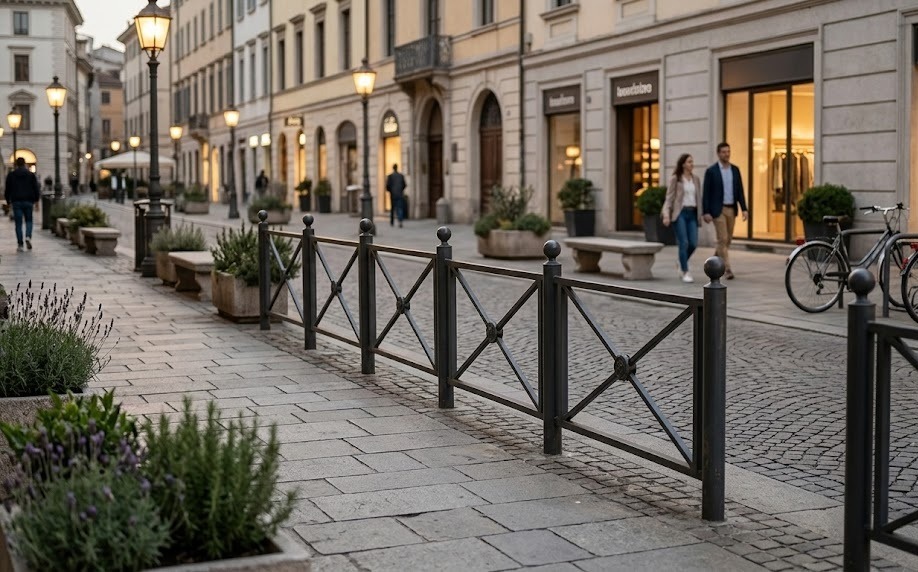
The design of contemporary public spaces requires a delicate balance between aesthetics, functionality, and, above all, safety. In this context, pedestrian barriers are a fundamental component, acting as a continuous physical and visual separation between pedestrian flows and vehicular traffic. Their function is not merely decorative, but responds to specific needs for urban traffic management, ensuring the safety of citizens and the protection of sensitive areas such as maritime or city intersections, sidewalks, schools, and protected pedestrian areas. Whether a municipal administration needs to secure a prestigious historic center or a company designing a modern commercial area, choosing the right bollard is a strategic investment. This buying guide is designed to help you navigate the various models in our catalog, analyzing materials, features, and fastening systems to optimize maintenance costs and enhance the urban fabric.
The range of pedestrian barrier solutions includes a wide variety of models that differ in design and operational flexibility, each designed to meet specific architectural and traffic needs.
This model is among the most widespread and recognisable in our cities, characterised by an internal geometric X design that combines classic aesthetics and mechanical stability.
Advantages: They offer excellent frontal and transverse visibility for both pedestrians and motorists. The iconic design integrates perfectly into the redevelopment programmes of historic centres, villages and areas adjacent to public parks.
Disadvantages: Having a more complex geometric structure, they require slightly more attention during cleaning than linear models.
Ideal for: Historic centers, monumental areas, public gardens, tree-lined avenues and urban contexts where traditional decorum is a priority.
Characterized by essential, clean and geometric lines, these pedestrian barriers focus on maximum functionality and visual minimalism.
Advantages: Extremely modern design that does not visually overload the surrounding environment. They are characterized by high structural strength and minimal maintenance thanks to the simplicity of the tubular surfaces.
Disadvantages: They offer a decidedly contemporary aesthetic impact, which could be less harmonious in historic or ancient architectural contexts.
Ideal for: Newly built areas, business districts, industrial areas, large peripheral roads and architectural contexts with an industrial or modern design.
Dynamic demarcation systems designed to alternate rigid pedestrian protection with the need for temporary vehicular access.
Advantages: Maximum logistical and operational flexibility. They allow you to establish a safe boundary during daily routines, while offering the possibility of being removed, unlocked with a key or folded to allow immediate transit if necessary.
Disadvantages: They require periodic monitoring of the unlocking mechanisms or locks to always ensure perfect efficiency.
Ideal for: Limited Traffic Zones (ZTL) with time slots, market areas, escape routes, and access points reserved exclusively for rescue, emergency or urban maintenance vehicles.
To structure a supply of public furniture capable of resisting wear and tear and atmospheric agents for decades, it is essential to carefully analyse the dimensional parameters and protective treatments of the materials.
The sizing of the barriers must be planned to guarantee total protection without turning into a visual or architectural obstacle. Our site's filter system allows for millimetric configuration:
Since these are structures intended to remain permanently exposed to atmospheric pollution, humidity and the corrosive action of de-icing salts, the nature of the material is binding:
The mechanical stability of the barrier depends directly on the installation method, which must be chosen based on the condition of the existing pavement:
Road barriers must be free of sharp edges, cutting elements or protrusions that are dangerous for pedestrians. In public areas, supplies must comply with the Highway Code and regulations on the removal of architectural barriers (Presidential Decree 503/1996 and Ministerial Decree 236/1989). The arrangement of barriers must strictly maintain the minimum distances necessary for the smooth transit of wheelchairs, strollers, and handbikes, integrating correctly with the tactile paths intended for the visually impaired. For public administration tenders, materials meet the Minimum Environmental Criteria (CAM) to ensure maximum sustainability of production processes.
School exits, hospitals, and shopping centers: In these areas with very high pedestrian traffic and the frequent presence of children, the use of St. Andrew's cross or heavy tubular pedestrian barriers, strictly buried in concrete, is recommended. It is highly recommended to integrate class 1 or 2 reflective bands to maximize night-time visibility and prevent collisions with motorists during low-light hours.
Historic centers, ancient villages and period avenues: The choice of choice falls on barriers in cast iron or galvanized steel decorated with studs and classic finishes, painted in sober shades such as anthracite gray or moss green. This configuration respects the strict aesthetic constraints of the superintendencies, while at the same time guaranteeing the required road safety standards.
Commercial transit areas, limited traffic zones and service gates: In these scenarios it is essential to adopt a combination of fixed modules alternating with removable or fold-down pedestrian barrier sections equipped with a lock. They allow the sidewalks to be protected from daily unauthorized parking, ensuring immediate and easy access for maintenance vehicles or emergency vehicles in the event of an emergency.
Protect the safety of citizens, combat illegal parking and improve the decor of your streets. On Holity.co.uk you will find a professional and certified selection of pedestrian barriers for street furniture, designed to meet any technical specification within a flexible price range from 0 to 5000 euros to adapt to both small local interventions and extensive road redevelopment plans.
Use our side navigation filters to select the design best suited to your needs (St. Andrew's cross or linear tubular models) and set the millimetric cursors to identify the exact height, length and depth for the layout of your sidewalks. Contact our customer service today to receive tailored advice.
How does the combination of hot-dip galvanizing with epoxy powder coating neutralize filiform and under-film corrosion in maritime or industrial contexts?
This "duplex" protection system combines the sacrificial action of zinc with the barrier effect of polymer paint. Total immersion in the molten zinc bath seals the steel structure both internally and externally, creating a scratch-resistant intermetallic layer. The subsequent oven-cured epoxy powder coating eliminates any surface micro-porosity. If an accidental impact or vandalism affects the external paint layer, the underlying zinc blocks oxidation by galvanic means, preventing rust from spreading in a capillary fashion under the paint layer (filiform corrosion) and preserving the structural integrity of the barrier.
What physical dynamics of kinetic absorption differentiate pedestrian barriers made of technopolymers or composite materials from traditional steel models?
Solutions made of technopolymers and advanced composite materials are engineered to exploit the principle of passive safety and programmed elastic deformation. In the event of an accidental collision with a light vehicle or a moped, the flexible barrier absorbs a significant portion of the impact's kinetic energy, flexing and subsequently returning to its original shape without breaking. This shock-absorbing behavior drastically reduces the trauma from sudden deceleration for the vehicle occupants and minimizes mechanical damage to the vehicle, unlike rigid steel or heavy cast iron which discharge the entire force of the impact onto the bodywork and foundation plinths.
How should the positioning and spacing of pedestrian barriers be calculated to ensure compliance with the removal of architectural barriers (Presidential Decree 503/1996)?
In compliance with Presidential Decree 503/1996 and Ministerial Decree 236/1989, the linear arrangement of the barriers on the pavement must strictly maintain a useful continuous transit width of no less than 150 cm to allow for the rotation, reversal and smooth crossing of two wheelchairs or pushchairs. Furthermore, if the modules are interrupted to create crossing points, the free centre distance must not constitute a danger of entrapment or a barrier for the visually impaired, integrating millimetrically with the geometry of the tactile paths installed on the road surface.
What mechanical characteristics differentiate the locking systems of removable or foldable models intended for Limited Traffic Zones (ZTL) and emergency crossing points?
The dynamic pedestrian barrier models (removable or foldable) integrate special compass hinges or ground housing cups at the base equipped with security locks with a coded cylindrical key or a standard unified triangular profile. This kinematic mechanism allows the barrier to be kept firmly locked in a vertical position during daily routines, preventing unauthorized removal. If necessary, maintenance personnel or emergency vehicle drivers (ambulances, firefighters) can unlock the mechanism in a few seconds, lowering the door to the ground or removing it from the base to completely clear the escape route.
How does the presence of underground utilities and technological networks affect the choice between direct embedding fixing and installation with a bolted base plate?
The presence of electrical lines, water pipes, or fiber optic cables positioned at a shallow depth under the pavement prohibits the execution of excavations for the foundation plinths. In these contexts, the only choice is a barrier equipped with a flanged horizontal base plate. Anchoring occurs using mechanical expansion bolts or threaded rods coupled with two-component chemical resins, which penetrate the thickness of the finished pavement by a few centimeters, ensuring excellent resistance to shear and bending moment without risking intercepting or damaging the technological systems underneath.
What optical criteria define the selection between Class 1 and Class 2 reflective strips on barriers positioned near school exits?
School exits are classified as areas with a very high risk of pedestrian accidents during low-light hours or during winter entry/exit times. The application of Class 2 (High Intensity Grade) microprismatic retroreflective films is highly recommended compared to the standard Class 1, as it offers a significantly higher light response coefficient even at critical angles of incidence. This measure ensures that car headlights illuminate the outline of the barrier from a great distance, visually alerting the driver to the presence of the protected area and of pedestrians waiting on the pavement.
 English
  Italian
 French
 German
 Spanish