The boundary bollard for urban areas is a technical solution designed for the regulation of vehicle traffic and the protection of pedestrian zones. Its massive cast iron structure makes it particularly suitable for insertion into prestigious architectural contexts, such as historic centers and monumental squares, where solidity must be combined with urban decor. The device acts as an insurmountable physical barrier to prevent illegal parking and ensure the safety of passers-by.
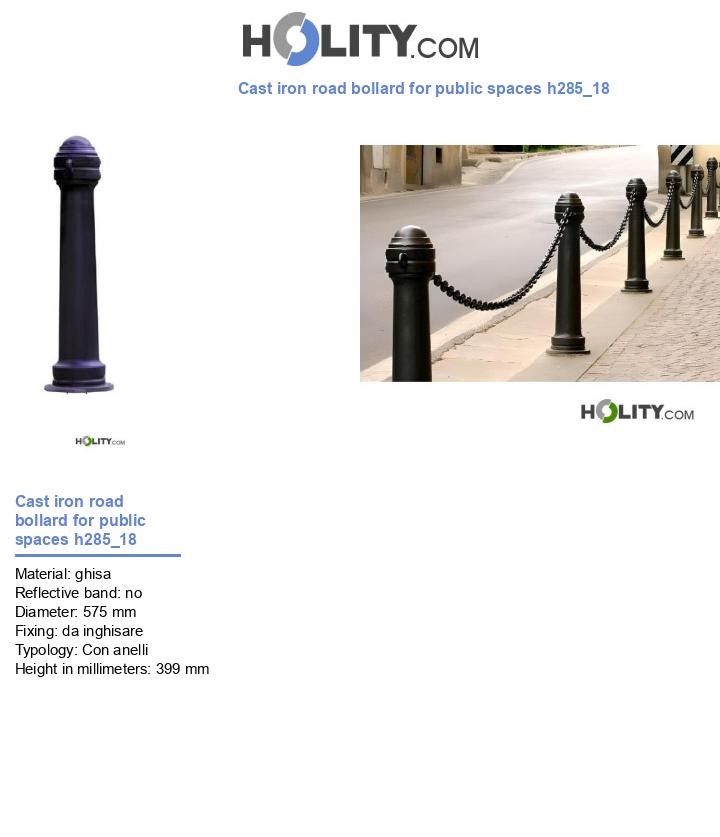
Equipped with integrated lateral rings, the bollard allows for the attachment of chains to create continuous and modular delimitation systems, adapting to the different configurations of public space.
Technical specifications
Height: 64 cm
Base diameter: 14 cm
Material: high-resistance cast iron
Fixing system: designed for direct embedding into the ground
Equipment: chain attachment rings integrated into the casting
Image for illustrative purposes only
User benefits
High mechanical resistance: cast iron ensures excellent protection against impacts and superior stability over time.
Aesthetic consistency: the classic design blends harmoniously with historic paving and traditional urban furniture.
Passive safety: the possibility of connecting chains via the rings increases the barrier’s visibility and strengthens its boundary effectiveness.
Immovability: the in-ground embedding eliminates the risk of theft or unauthorized movement of the product.
Environmental durability: the material is chosen to withstand freeze-thaw cycles and prolonged exposure to urban atmospheric agents.
Field of application
The bollard is suitable for the delimitation of pedestrian areas, the protection of places of worship and monuments, and the securing of sidewalks in high-traffic areas. It is commonly used near Limited Traffic Zone (LTZ) entrances and for the perimeter of public spaces in urban redevelopment contexts.
Why choose it
This model is the correct choice when an element of urban furniture is required that is not only functional but also contributes to the aesthetic value of the installation site. Unlike plastic or aluminum versions, cast iron offers a material presence consistent with heritage authority constraints. Installation via embedding is preferable in all scenarios where permanent safety and prevention of vandalism are essential operational requirements.
FAQ
What is the advantage of cast iron over steel in historic centers?
Cast iron offers a natural finish and a volumetric mass that matches the stone materials typical of historic centers, also ensuring greater resistance to surface corrosion without the need for frequent painting.
Does the bollard comply with current road safety regulations?
The product is designed to meet the urban delimitation needs provided by street furniture guidelines, as long as it is installed correctly according to visibility and clearance standards required by the Highway Code.
Is it possible to install the bollard on existing paving?
Yes, installation requires a hole in the laying surface to allow the embedding of the lower part of the base, thus ensuring maximum structural stability of the device.
Holity uses PayPal and credit transfer as methods of payment.
Credit Transfer
Paying by credit transfer the order will be handled only after a bank credit receiving confirmation. Payment must be made within 7 days from date of order. Go past the deadline, the order will be automatically canceled. The bank transfer purpose must necessarily bring the order number, the order date and client name. The products availability has to be judged only from the credited. The payment must 'be made payable to: ' NAMITI SRL '
PayPal
Selecting the type of PayPal payment, you will be redirected to a page on the PayPal site where in you can enter with your email address and password and make payment. Your financial data will not be shared with Holity but they will be handled directly by PayPal. In case of order cancellation or rejection by Holity, the amount will be refunded to your PayPal account and Holity will be not responsible for delays and / or damage during repayment.
Upon delivery of the goods the customer is required to inspect:
The number of packages delivered is as indicated in the transport document
The packaging is intact and not altered even in the closing strip
In case of tampering and / or breaks the customer will immediately challenge the shipment and / or delivery putting the word "SUBJECT TO INSPECTION FOR GOODS ....." (give reasons) on the delivery receipt from the courier.
The customer then must report any damage within 7 (seven) days of receipt of goods in the manner prescribed by the operator chosen for the expedition. In case the customer fails to collect within 2 (two) working days of the goods ordered and present in storage at the warehouses of courier and / or the Company due to the repeated inability to deliver to the address specified by the customer with the order, will return the goods to stores in Namiti Ltd., with charge to the account of charges for transport and storage of goods, the customer may request a new shipment of the goods, upon payment of these expenses and the new shipping cost.



 English
  Italian
 French
 German
 Spanish