
mon-fri 9-13 / 14.30-18.30
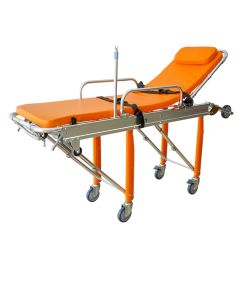
Stretcher for ambulance use. Automatic leg opening. Load capacity: 159 kg.
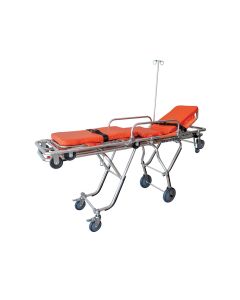
Loading stretcher for ambulance. Capacity: 159 kg. Height adjustments (4 levels).
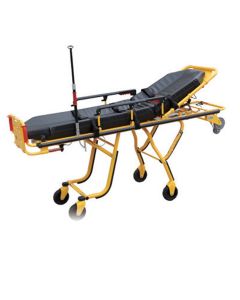
Automatic multi-position ambulance stretcher. Capacity: 159 kg. Max dimensions: L.198 x W.54 x H.93 cm.
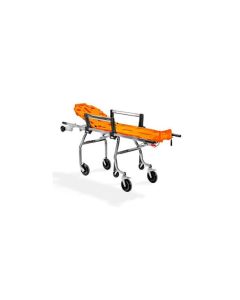
Self-loading ambulance stretcher with polyethylene platform and steel frame. Load capacity: 170 kg.
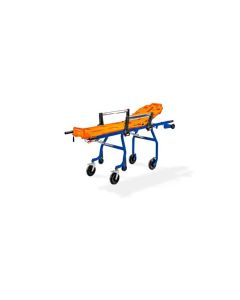
Ambulance stretcher with steel frame and Trendelenburg anti-shock position. Capacity: 170 kg. Safe bar reclining side rails.
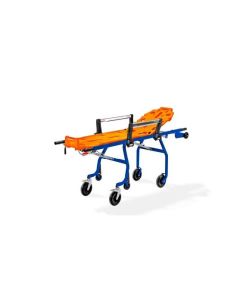
Self-loading ambulance stretcher for patient transport with steel frame. Capacity: 170 kg. Reclining side rails and Fowler position.
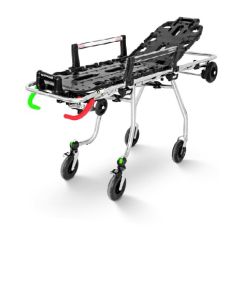
Self-loading stretcher for ambulance transport. Dimensions: L. 1980 x D. 580 x h. 600 mm.
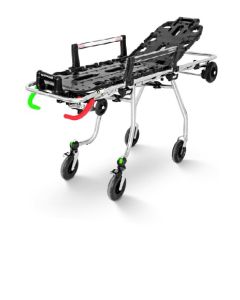
Self-loading ambulance stretcher dimensions L. 1980 x D. 585 x h. 500 mm. Materials: stainless steel and polyethylene.

Ambulance transport stretcher with yellow stainless steel frame. L. 1980 x D. 580 x h. 600 mm.
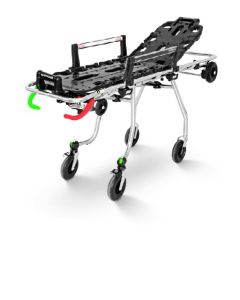
Stretcher for transporting injured people by ambulance. Self-loading. Dimensions: L. 1980 x D. 580 x h. 680 mm.
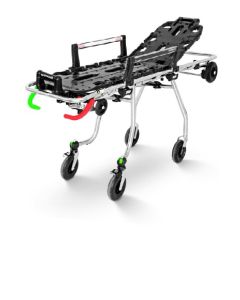
Self-loading stretcher with capacity 250 kg. L. 1980 x D. 580 x h. 680 mm.
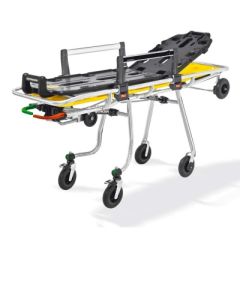
Ambulance stretcher with housing for spine board (not included). L. 1970 x D. 570 x h. 500 mm.
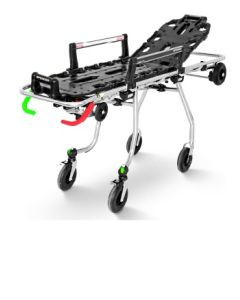
Self-loading stretcher with variable heights. Chrome-plated frame. L. 1980 x D. 585 x h. 580 mm.
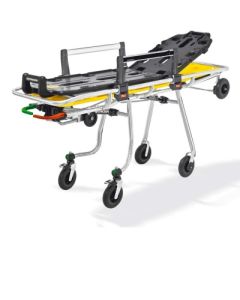
Self-loading stretcher with compartment for spine board (not included). L.1980 ± 10 m x W. 585 ± 10 x h. 600 mm.

10G certified self-loading stretcher. Shortenable frame. L. 1975 x D. 580 x h. 640 mm.
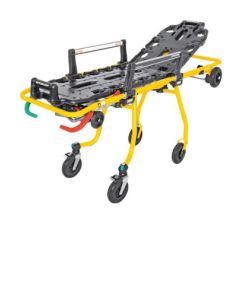
Self-loading ambulance stretcher with variable height system. Dimensions: L. 1980 x D. 585 x H. 750 mm.

Self-loading stretcher equipped with a length-adjustable frame. L. 1980 x D. 585 x h. 600 mm.

Multi-level self-loading stretcher with capacity up to 170 kg. Dimensions: L. 1980 x D. 585 x h. 680 mm.
Self-loading ambulance stretcher with polyethylene platform and color-coded controls. Dimensions: L.1980 x W.585 x H.75 cm.
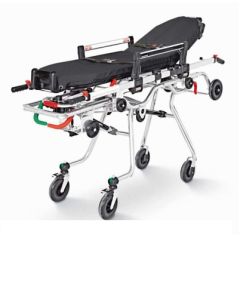
Ambulance stretcher with detachable top. L. 1975 x W. 580 x H. 650 mm.
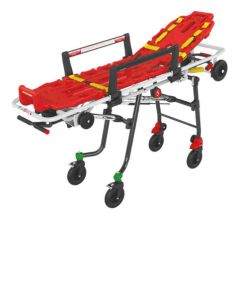
Stretcher for transporting injured people in ambulances and on the road, adjustable to 5 different heights. L. 1970 x D. 570 x H. 650 mm.
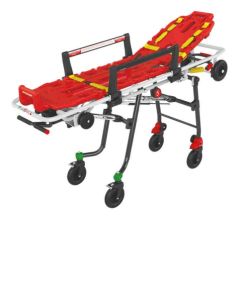
Self-loading ambulance stretcher with 5 variable heights. L. 1970 x D. 570 x h. 750 mm.
Ambulance stretchers represent a fundamental element in emergency and medical transport services, designed to ensure the safe and comfortable transfer of patients in critical conditions. These medical devices must meet specific requirements for stability, maneuverability, and ease of loading, combining robust structures with adjustment systems that adapt to different clinical situations. The choice of the correct stretcher directly affects the quality of transport and the safety of both the patient and healthcare professionals, making a careful evaluation of technical features and available certifications essential.
The ambulance stretcher plays a critical role in the patient’s journey during a medical emergency, acting as an interface between the external environment and the medical transport vehicle. An appropriate stretcher allows for minimizing loading and transport times, reducing the patient’s physiological stress and facilitating access to vital points during first aid operations. Self-loading systems represent an innovative solution that eliminates the need for manual lifting, protecting the health of operators and accelerating procedures in situations where every second is decisive. Multi-level height adjustment allows crews to work in ergonomic positions, preventing muscle and joint injuries that are a recurring problem in emergency services.
Furthermore, modern stretchers integrate features such as reclining side rails, patient containment systems, and compartments for additional equipment, transforming transport into a coordinated operation that maintains continuity of medical care. The structure must guarantee sufficient capacity to handle different types of patients, including bariatric users, without compromising maneuverability within the tight spaces typical of corridors and stairs. Selected materials—stainless steel, polyethylene, aluminum—ensure long-term durability, ease of sanitization, and resistance to corrosion, crucial factors in medical environments where hygiene is an absolute priority.
In an operational context, the stretcher also represents an investment in the healthcare service’s reputation, as modern and well-maintained equipment communicates professionalism and reliability to citizens. Public and private structures involved in out-of-hospital rescue find in the choice of stretcher an element that affects both response capacity and compliance with international quality standards. A versatile device, suitable for multiple transport configurations, reduces the need for multiple sets of equipment, optimizing purchase and fleet management costs. The availability of models with shortenable frames, compartments for spinal boards, and variable height systems allows emergency services to adapt equipment to specific territorial and demographic needs. Expert operators recognize that a robust and reliable stretcher translates into fewer accidents during transport, lower risks of medical complications, and greater efficiency in managing critical patients, factors that converge into measurable benefits for healthcare organizations.
The landscape of ambulance stretchers includes several categories built to meet variable needs according to the context of use and the type of patient. Manual stretchers represent the most essential solution, characterized by lightweight structures in steel or aluminum with manual leg opening, suitable for services with limited resources and situations where structural simplicity is a priority. Conversely, self-loading stretchers incorporate a mechanical or motorized system that allows automatic loading onto the transport vehicle without direct manual intervention, representing a significant ergonomic advancement for crews. Variants with multi-level height adjustment—commonly 4, 5, or more positions—allow operators to adapt the stretcher to their ergonomic and clinical needs, from Trendelenburg positioning for patients in shock to Fowler configuration for subjects with respiratory pathologies.
Specialized solutions include stretchers with integrated compartments for spinal boards, essential devices in trauma management when it is necessary to maintain spinal immobilization during transport. Bariatric patient stretchers feature an increased capacity—up to 250-300 kg—and reinforced structures to support higher loads without compromising stability. Some models include detachable stretchers, which facilitate patient transfer from critical environments, while other versions offer shortenable frames to improve maneuverability in tight spaces such as narrow stairs or apartments with difficult access. Bed surface materials vary between powder-coated welded iron, shockproof polyethylene, and anodized aluminum, each presenting specific advantages in terms of weight, corrosion resistance, and ease of sanitization.
The selection of the covering and safety systems constitutes a crucial differentiating aspect: reclining side rails with protection bars, multi-point restraint belts, and padded surfaces ensure that the patient remains in a safe position during routes with curves and accelerations typical of urban transport. Stretchers certified to specific standards—such as 10G certification for motor vehicles—ensure that the structure resists dynamic stresses during travel without posing additional risks. Particularly sophisticated variable height models allow continuous rather than stepped adjustments, offering a nearly infinite configuration of positions to adapt to the most complex clinical needs. The availability of different colors—yellow, chrome, or natural steel frames—in addition to aesthetic considerations, facilitates rapid identification of the stretcher in contexts with multiple devices available, an important element in chaotic emergency situations when speed is essential.
The decision regarding the appropriate stretcher requires a preliminary evaluation of the operational context where the device will be used. For territorial emergency services with a heterogeneous workload, a self-loading stretcher represents an optimal compromise between functionality and investment, reducing the physical load on operators and accelerating loading procedures in critical situations where seconds are precious. The load capacity constitutes the first selection criterion: services operating in high-density urban areas with a prevalence of elderly users may lean towards standard capacities of 159-170 kg, while structures that must face logistical challenges in rural contexts or with higher-than-average bariatric patient volumes will find greater utility in 250-300 kg solutions. The total dimensions of the stretcher—length, width, and height—must be compatible with the internal geometry of the transport vehicle, as a stretcher that does not fit easily into the loading cabin represents a recurring operational problem.
Common selection errors emerge when organizations prioritize initial cost without considering the costs of maintenance, sanitization, and operator training on poorly ergonomic devices. A stretcher with complex adjustment systems or one that is difficult to use in an emergency can become an obstacle rather than a help, generating frustration in crews. The presence of international certifications and compliance with EN 1865 standards represents a reliable indicator of construction quality and safety, even if in Italy many less certified devices have operated effectively for years. Facilities managing critical patients requiring spinal immobilization must absolutely include stretchers with spinal board compartments in their equipment, while services with limited access to technological resources will find greater practicality in simple but robust manual models.
Factors such as frequency of daily use, the type of terrain crossed (urban, mountainous, rural), the percentage of slopes and stairs in the territory, and the composition of the team in terms of the average physical strength of operators must guide the selection towards realistic and sustainable solutions over time. A technologically advanced but underutilized or poorly maintained stretcher represents a waste of resources, while a simpler device that is appropriate for the context and used correctly generates consistent operational value. Consulting technical representatives of services already equipped with particular models allows for collecting authentic feedback on reliability, maintenance, and team satisfaction—valuable information that rarely emerges from technical specifications. The evaluation of adjustable height models represents an investment in operator injury prevention, as it allows working in ergonomic positions regardless of the rescuer’s stature, an element that many structures underestimate despite the significant direct and indirect cost of musculoskeletal injuries.
Ambulance stretchers in Europe are regulated by the EN 1865 specification, which defines functional, constructional, and safety requirements for these medical devices. This regulation establishes clear parameters regarding maximum capacity, dimensions, locking systems, and ergonomic properties that the device must respect to be considered compliant with international quality standards. EN 1865 certification represents a guarantee that the product has undergone rigorous tests for structural resistance, stability during use, and patient safety, elements that cannot be compromised in a healthcare setting where malfunction could jeopardize the patient’s physical integrity. In addition, for transport vehicles where the stretcher must remain in position during vehicle movement, standards relating to resistance to dynamic stresses apply, often expressed in terms of G-forces (gravity); 10G certification for ambulances, for example, verifies that the fixing system resists accelerations and decelerations typical of urban driving without slipping or failing.
At the Italian national level, stretchers must also comply with the Ministry of Health provisions regarding the minimum equipment for ambulances, which prescribes specific characteristics regarding materials, ease of decontamination, and compatibility with vehicle fixing systems. Specific safety requirements include the absence of sharp edges or elements that could cause additional trauma to the already compromised patient, robust and reliable containment systems even in the event of sudden movement, and surfaces built with materials that allow rapid sanitization without structural degradation. Ordinary and extraordinary maintenance of stretchers falls within the organizational obligations of healthcare facilities and represents a frequently neglected aspect that can compromise regulatory compliance over time, generating operational risks and civil liability in case of an accident.
Contemporary regulatory aspects also emerge from guidelines regarding the transport of patients in special conditions: bariatric subjects, women in labor, and patients with infectious diseases require adaptations of the stretcher or its use that must reflect protocols agreed upon between the emergency service and the receiving hospital facilities. Regulatory compliance is not limited to the product itself but extends to its correct use by operators, to scheduled maintenance that ensures functional integrity over time, and to continuous training of crews on safe loading, unloading, and handling procedures. Control bodies and quality systems in healthcare facilities periodically check that equipment is maintained according to standards, verifying aspects such as the absence of corrosion, the functioning of adjustment systems, the integrity of safety belts, and the state of padded surfaces. In conclusion, choosing a stretcher compliant with current regulations represents not only a legal obligation but an investment in clinical and operational safety that positively affects the quality perceived by the patient and the reduction of risks related to medical transport.
Explore all the products in the category and compare the available solutions to find the most suitable one for your operational context, considering the specific needs of the territory, the composition of your team, and the regulatory compliance requirements applicable to your organization.
 English
  Italian
 French
 German
 Spanish