
mon-fri 9-13 / 14.30-18.30
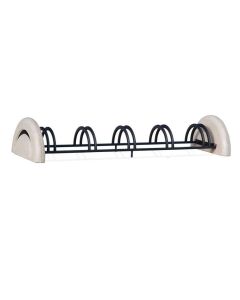
Galvanized steel bicycle rack with concrete sides. Removable 5-seater structure. Gunmetal grey. Dimensions mm 2260x780x390h. Made in Italy
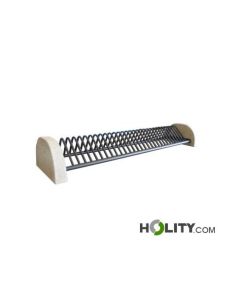
Painted galvanized steel structure with concrete sides. Available in 5, 7, and 9-seater models. Made in Italy.

Galvanized steel rack for 5 bicycles with anti-corrosion finish. Dimensions: L 226 x D 97 x H 76 cm. Weight: 162 kg.
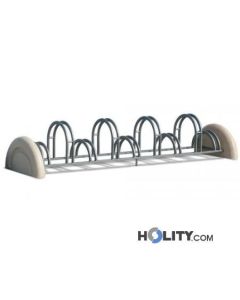
Galvanized steel bike rack with concrete supports. 9 staggered spaces. Brilliant silver finish. Dimensions mm 2810x780x550h. Made in Italy
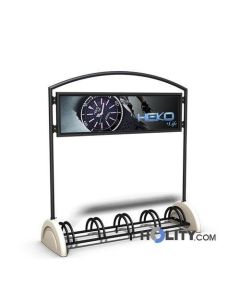
Galvanized steel bike rack with advertising panel and concrete sides. 5 spaces. Dimensions 2260x780x2305h mm. Made in Italy.
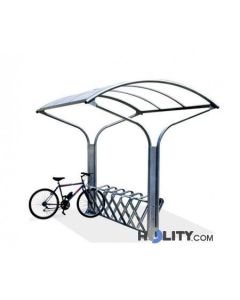
Bike carrier rack 14 places sided with rain cover and metal carbonate. Made in Italy
Bicycle racks represent an essential structural solution in public spaces, residential areas, and urban contexts where sustainable mobility is of increasing importance. These devices guarantee safe and orderly parking for bicycles, protecting vehicles from accidental damage and theft through geometries designed for correct anchoring. The choice of rack directly affects the functionality of the space, the user experience of cyclists, and the management of flows, making the correct selection a strategic element for public administrations, hospitality managers, and community leaders.
The variety of available solutions allows urban furniture to be adapted to specific needs: from bicycle capacity to the type of anchoring, from construction material to vandal resistance. Each configuration responds to logic of urban design, user comfort, and durability over time, considering factors such as exposure to atmospheric agents, ease of maintenance, and aesthetic integration with the surrounding context. Construction quality affects the costs of replacement and management of public assets, making it important to evaluate not only the initial price but the overall value of the investment.
The installation of bicycle racks in public and semi-public spaces significantly reduces the risks of theft and damage to vehicles, which positively impacts citizens’ inclination to use the bicycle as a daily means of transport. A well-designed rack facilitates quick parking, minimizes the occupation of improper spaces, and creates visual order in environments, contributing to urban decor. Railway stations, bicycle parking lots, shopping centers, schools, and public offices benefit from the availability of dedicated spaces, as the orderly management of parking also affects the prevention of conflicts with other road users and the reduction of obstacles to pedestrian passage.
From a sustainability perspective, racks encourage eco-compatible travel by representing a light and reversible infrastructure investment compared to other mobility solutions. The ease of anchoring the bicycle through dedicated geometries reduces parking times and increases the perception of safety, determining factors especially in contexts where cycling is still in the development phase. Managers of hospitality structures, parking lots, and residential communities find racks to be an economical tool to improve accessibility and service offerings, increasing the attractiveness of the structure without significant real estate investments. Routine maintenance is minimal, limited to periodic checks of integrity and cleaning interventions.
Bicycle racks differ mainly in geometric configuration, construction material, and method of anchoring to the ground. Single-sided models are designed for environments with limited space, occupying only one front surface and typically accommodating 1-3 bicycles; this solution is ideal for narrow sidewalks, transit areas, or residential buildings where space is tight. Double-sided models, on the other hand, use both sides of the structure to double the capacity for the same total footprint, making them particularly advantageous in dedicated parking lots, stations, and mobility hubs where available spaces must be maximized.
Regarding materials, hot-dip galvanized steel solutions represent the standard in the public sector for corrosion resistance and thirty-year durability even in coastal or high-humidity environments. Monoblock concrete racks, available in single-seater or two-seater versions, guarantee structural stability without the need for bolting, ideal where the ground is unstable or does not allow invasive installations. Models with a removable concrete base reduce installation costs by eliminating the need for excavation or drilling, allowing for the reconfiguration of spaces with greater flexibility. Wall-mounted versions offer a compact solution for vertically narrow spaces, suitable for transit corridors or small outdoor areas. There are also designer racks in laser-cut steel, which combine functionality with refined aesthetic characteristics, responding to urban regeneration projects or contexts where aesthetic appearance is a priority.
The choice of rack starts from a realistic estimate of the number of bicycles to be parked, a parameter that must consider peak influxes and not just the daily average: under-dimensioning generates user frustration and disorderly parking behavior, while over-dimensioning represents a waste of money and space. It is essential to evaluate the available space in terms of length, depth, and height, as well as the type of soil and accessibility for installation: rocky or cemented soils require different solutions than natural soils, and the presence of underground services (cables, pipes) requires preliminary checks. Climatic exposure represents another decision criterion: coastal or high-humidity environments require hot-dip galvanized or stainless steel, while temperate zones can tolerate painted finishes if subject to regular maintenance.
A frequent error consists in prioritizing the initial cost without considering vandal resistance and ease of maintenance, factors that significantly affect the total cost of ownership in the medium term. Racks with adjustable hooks or sophisticated anchoring systems reduce accidental damage to bicycles, improving user experience and limiting complaints. For contexts with high tourist flow or in areas at risk of vandalism, robust models in solid steel with irreversible fixings are preferable to light solutions. Compatibility with different types of bicycles (city, mountain bike, cargo bike, velocipedes) must be considered, especially in heterogeneous contexts: racks that are too narrow or not adaptable compromise usability. Finally, consulting local and regional regulations on cycle mobility avoids problems of non-compliance or subsequent costly modifications.
The design of bicycle racks must comply with the criteria contained in national cycling guidelines, in particular the “General Cycling Mobility Plan” and specific municipal regulations on the management of public space. The UNI 11157 standard defines the requirements for bicycle parking, establishing dimensional parameters for safe anchoring and the minimum space necessary for maneuvering: length between 1.8 and 2.1 meters per bicycle, space width of 0.5-0.6 meters, and a minimum height of 1.8 meters to guarantee the passage of vehicles with accessories. Structural resistance must comply with European construction standards EN 1991 and EN 15630, ensuring that the rack supports vertical and lateral loads deriving from bicycles, climatic influences, and anthropogenic actions.
For public environments, anti-theft security is required through geometries that facilitate anchoring with a U-lock, a practice recognized by urban security manuals and cycling associations. Hot-dip galvanizing certification (UNI EN ISO 1461) guarantees protection from corrosion for at least 50 years in rural environments and 20 years in urban environments, essential compliance for public assets. Metal elements must be free of sharp edges and notch points that can damage tires or cause accidental injuries, a requirement verifiable through mechanical compliance tests. Structural stability must be documented through static engineering calculations, especially for cantilever models or particular configurations. In contexts where the rack acts as an element of urban furniture, aesthetic consistency with the municipal color plan and visual integration into the landscape context may be required.
Explore all the products in the category and compare the available solutions to find the one best suited to your operational context.
The single-sided rack accommodates bicycles on only one side, occupying less frontal space and is ideal for narrow sidewalks. The double-sided rack accommodates bicycles on both sides, doubling the capacity for the same total footprint, preferable for dedicated parking lots where maximizing spaces is a priority.
Yes, hot-dip galvanized steel (UNI EN ISO 1461) guarantees protection from corrosion for at least 20 years in an urban environment and up to 50 years in a rural environment. In coastal areas with high salinity, stainless steel offers even higher performance with reduced maintenance.
Yes, models with a monoblock concrete base do not require bolting: they provide stability through their own weight (76 kg for two-seater versions) and are ideal for unstable surfaces or where invasive interventions are not permitted. However, they require verification of the load-bearing capacity of the underlying ground.
Single-seater versions accommodate 1 bicycle, 2-3 seat models are the most common in public spaces, while large double-sided racks can reach 6-8 bicycles. The choice depends on the volume of cyclists during peak times.
Models with adjustable hooks or shaped profiles reduce friction and accidental impacts during anchoring. Steel racks with smooth surfaces and rounded edges are preferable; avoid solutions with sharp sheets or sharp edges that would scratch the frames.
Yes, if made with hot-dip galvanized steel and adequate thicknesses. Laser cutting does not compromise structural strength; the refined design does not compromise on durability, making them suitable for urban regeneration contexts.
Maintenance is minimal: periodic cleaning (2-4 times a year) and visual inspection of the integrity of the galvanization. Structural interventions are rare. The cost is estimated at a few hundred euros per year, much lower than alternative parking solutions.
No, UNI 11157 recommends specific geometries that allow the passage of standard-sized U-locks (minimum section 16 mm). Check before purchasing that the diameter and spacing of the tubes allow for secure anchoring without risk of the bicycle being lifted over or torn away.
 English
  Italian
 French
 German
 Spanish