
mon-fri 9-13 / 14.30-18.30
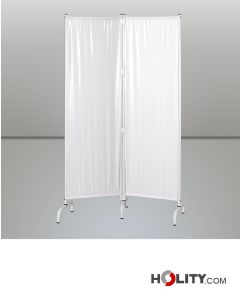
Hospital screen h654_13 with 2 panels with Ø 22 mm chromed steel structure and white fireproof PVC curtain. Dimensions W. 100 x h. 163 cm, weight 6.5 kg. Ideal for privacy and hygiene in healthcare environments.
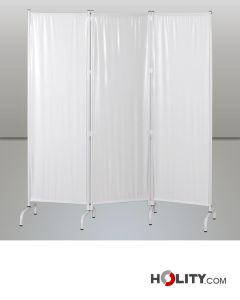
3-panel hospital screen with 22 mm chrome steel structure and fireproof PVC fabric. Dimensions 150x163 cm, weight 9.5 kg. Self-supporting and easily transportable.
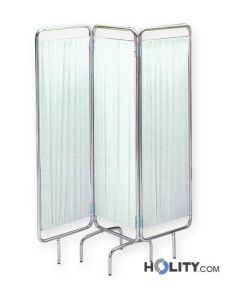
Three-panel hospital screen in tubular steel with washable white plastic curtains. Dimensions 150×170 cm. Class I, Italian production.
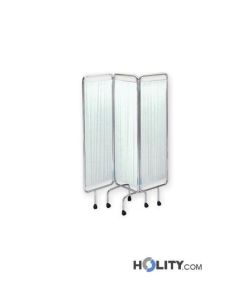
Hospital screen in aluminum with 3 folding sections, washable fireproof plastic curtains, mounted on wheels. Italian production.
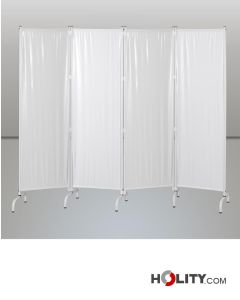
Hospital screen with 4 panels with chromed steel structure (200×163 cm) and white fireproof PVC curtain. Professional solution for privacy in healthcare environments, weight 12.5 kg.
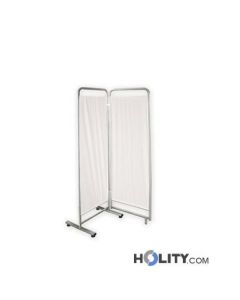
2-section screen for medical offices, washable white fabric, grey oval tube, adjustable feet, height 180 cm.
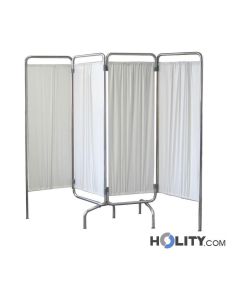
4-panel folding aluminum screen with white washable curtains. W200×H170 cm, weight 8 kg, fixed feet. Hospital room divider for surgeries and clinics.
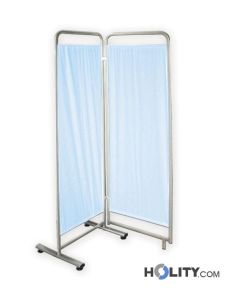
Hospital screen with 2 sections featuring an oval tube frame and light blue Trevira curtains. Adjustable feet, height 180 cm, Class I medical device.
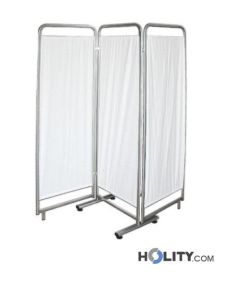
2-panel folding screen in 30x15 mm oval tube, height 180 cm, with cotton curtains and adjustable feet. Class 1 medical device for healthcare environments.
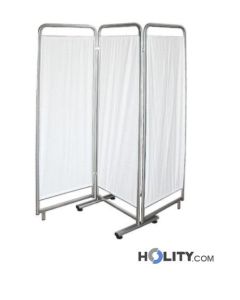
Hospital screen 3 panels, 30x15mm oval tube, epoxy grey, 180x180cm, adjustable feet.
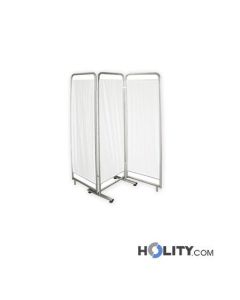
Hospital screen with 3 panels in oval tube, metallic grey epoxy structure, white washable curtains, 180x180 cm, Made in Italy.
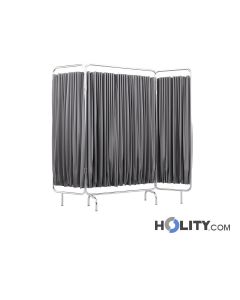
3-section hospital screen, painted steel structure, washable plastic curtains, noise-reducing feet. Dimensions W.200 x H.172 cm.
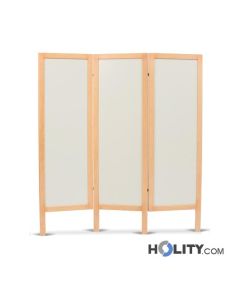
3-panel hospital screen in MDF with wooden frame, water-painted. Dimensions: 158x170 cm, 52.5x170 cm panels. Patient privacy in clinics and wards.
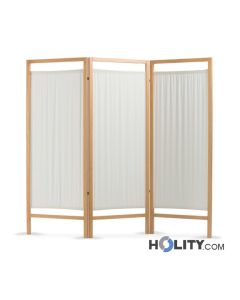
Wooden hospital screen with three fire-retardant cotton panels, water-based painting, W.193xh.170 cm. Patient privacy in medical facilities.
Hospital privacy screens represent an essential solution in healthcare environments to ensure privacy, visual isolation, and protection during medical procedures. These devices, classified as class I medical devices, are indispensable in hospitals, clinics, outpatient centers, and medical offices where temporary separations between examination and care areas are required. Their modular structure and standardized dimensions allow for flexible positioning, adapting to different layouts without requiring structural interventions. Made with biocompatible and easily sanitizable materials, hospital screens meet the safety and sanitization requirements demanded by European health regulations.
The use of hospital screens in healthcare facilities addresses multiple operational and human needs. From the perspective of patient privacy, these devices create a visually isolated space during exams, dressings, or delicate consultations, reducing anxiety and promoting a more comfortable environment. The possibility of rapid transport via swivel wheels allows for the installation of temporary separations without the need for fixed anchoring, making environments more versatile and adaptable to patient flows. On the hygienic-sanitary level, the materials used (chrome-plated steel, anodized aluminum, fire-retardant PVC, washable cotton) are specifically selected to withstand frequent cleaning and disinfection cycles, a critical element in contexts where infection control is a priority.
An additional advantage concerns management efficiency: screens allow for better use of available space, dividing large environments into dedicated zones without renovation costs. In emergency departments, first aid rooms, and hospital wards, their presence speeds up operational flows and improves the work organization of healthcare personnel. The availability of models with 1, 2, 3, or 4 folding sections offers flexibility in sizing, allowing the degree of separation to be adapted based on the space configuration and specific clinical needs. Furthermore, some models include solutions for limited visual contact between adjacent patients, while still maintaining the possibility of verbal communication for emergencies.
The catalog of hospital screens offers several construction variants, each suitable for different contexts and budgets. Chrome-plated steel screens represent the most common reference in traditional hospital environments: the ø 22-30 mm tubular frame ensures structural rigidity, while the chrome finish allows for easy cleaning and long durability. The screens, made of white or colored fire-retardant PVC, are completely removable and machine washable, a decisive factor for maintaining hygienic standards. Anodized aluminum models, although slightly more expensive, offer superior corrosion resistance and lower weight, which is advantageous when the frequency of movement is high. Screens with 100% natural cotton fabrics are intended for facilities that prefer non-synthetic materials; cotton offers a warmer appearance and is particularly appreciated in private clinics and outpatient offices where aesthetics contribute to the patient’s perceived comfort.
In terms of configuration, single-section screens (one leaf) occupy minimal space and are ideal for small outpatient rooms or for creating temporary separations in specific corners. The 2-3 section models represent the best compromise between versatility and bulk, suitable for most standard clinical contexts. 4-section screens allow for the formation of longer barriers, necessary in wards where multiple patients require visual isolation simultaneously. Almost all models are equipped with ø 50 mm swivel wheels with brakes, ensuring controlled mobility and safety during movement. Some specific models feature fixed feet instead of wheels, a choice that reduces noise and the risk of involuntary movement, preferred in contexts where absolute stability is a priority.
The selection of the most appropriate hospital screen requires a preliminary assessment of the dimensions of the available space and the environment’s configuration. A recurring error consists of not accurately measuring the desired useful height: standard screens reach 163-180 cm, a size that provides effective visual isolation without creating a sense of claustrophobia for the patient. For environments with low ceilings or to create partial separations, 165 cm models represent a good compromise. A second critical aspect concerns the frequency of movement: if the screen must be moved daily, prefer an aluminum frame (lighter) and superior quality wheels; if it remains in a fixed position for weeks, a heavier chrome-plated steel model offers optimal stability. The fabric material considerably influences management costs: fire-retardant PVC reduces washing times and dries quickly, while natural cotton requires more frequent sterilization cycles but offers superior hygienic performance in high infection risk contexts.
A further decision criterion concerns the required frequency of sanitization: in COVID or isolation wards, opt for completely removable and waterproof PVC fabrics; in low infection risk outpatient clinics, standard machine-washable natural cotton is sufficient. The available budget must consider not only the initial cost but also maintenance costs: a slightly more expensive screen built with premium materials can guarantee 5-8 years of use, while cheap models might require replacement within 2-3 years due to wheel wear or fabric deterioration. For facilities purchasing in quantity, many suppliers offer discounts on multiple orders and preventive maintenance packages. Finally, always check that the chosen model complies with UNI, EN ISO standards and is classified as a class I medical device, essential documentation for civil liability issues and healthcare accreditation.
Hospital screens, as class I medical devices, are subject to a series of European and national regulations that guarantee safety and effectiveness. The EN ISO 9001 standard governs design and production processes, ensuring quality consistency. The European Medical Device Regulation (MDR) 2017/745 requires CE marking, complete technical documentation, and production traceability. At the national level, specific legislative decrees incorporate European directives on medical devices and establish that screens with a visual separation function in the healthcare field must meet specific construction criteria. Materials in contact with the patient (fabrics, straps) must be biocompatible according to UNI EN ISO 10993, with particular attention to the absence of allergenic and toxic substances. Fire reaction is governed by EN 13823 (Euroclass), with a minimum classification requirement of B-s1, d0 for fire-retardant PVC or cotton fabrics.
From a hygienic-sanitary perspective, materials must guarantee resistance to repeated cleaning cycles with standard detergents and disinfectants commonly used in hospital facilities (alcohols, diluted chlorine, quaternary disinfectants). ISO 5833 certification attests to the microbiological resistance of surfaces after washing. Mandatory construction aspects include the absence of sharp edges (minimum rounding of 2 mm), structural stability verified according to EN 12239, and anti-pinch safety for moving parts. The wheels, when present, must be certified for specific loads (usually 10-15 kg per standard screen) and equipped with effective mechanical brakes. In the case of use in sterile or high biological risk wards, some screens are provided with terminal sterilization certification or compatibility with low-temperature autoclaves. Technical documentation (instructions for use, material safety data sheets, certificates of conformity) must accompany every supply and be kept for at least 5 years in the facility’s records, a fundamental requirement for accreditation inspections and quality audits.
Explore all the products in the category and compare the available solutions to find the one best suited to your operational context. Each model is described with complete technical specifications, dimensions, materials, and regulatory compliance, allowing you to make an informed choice based on your facility’s clinical and logistical needs.
Fire-retardant PVC fabric is waterproof, dries quickly, and better resists aggressive disinfectants, making it ideal for high infection risk environments. Washable natural cotton offers superior tactile comfort and a warmer aesthetic, preferred in private clinics, but requires more frequent sterilization cycles. Choose PVC for public hospitals and critical wards, and cotton for medical offices and private clinics.
The standard height of 170-180 cm provides complete visual isolation for a seated patient and partial isolation from a standing position. For total privacy during dressings with a supine patient, choose 180 cm models. Lower heights (160 cm) are sufficient for temporary separations in open space environments. Avoid undersized models that compromise the isolation function.
A chrome-plated steel or anodized aluminum screen, with quality fabric and regular maintenance, guarantees 5-8 years of effective use. Fabric replacement is possible and less expensive than replacing the entire unit. Wheels and brakes may require maintenance every 2-3 years. Economic models have lower durability, lasting 2-3 years before significant structural wear.
Models with ø 50 mm swivel wheels are designed for frequent mobility. The typical weight of a 3-section screen varies from 6 to 10 kg, making it transportable by one person. Mechanical brakes ensure safety during movement. Aluminum models are lighter than steel ones. For daily transport between wards, choose lightweight chrome-plated steel or anodized aluminum.
Removable PVC fabrics: wash with neutral detergent and rinse, disinfect with 0.5% chlorine or 70% alcohol, and air dry. Cotton fabrics: remove and machine wash at 60-70°C, autoclave sterilization if required. Metal structure: clean with a damp cloth moistened with a suitable disinfectant. Cleaning should occur weekly in standard wards and daily in isolation.
A 2-section screen (typical dimensions 100-150 cm wide) covers a medium linear separation, suitable for clinics with one or two stations. If you need to isolate multiple areas simultaneously, consider 3-4 section models or purchasing multiple units. Evaluate the available indoor space to ensure the open screen does not obstruct safety paths.
 English
  Italian
 French
 German
 Spanish