
mon-fri 9-13 / 14.30-18.30
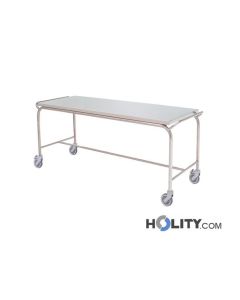
Stainless steel mortuary trolley with support bed, push handles and 4 wheels Ø125mm (2 with brake). Dimensions 202×65×80 cm, weight 35 kg.
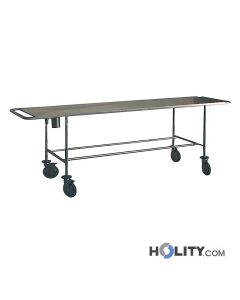
Cadaver transport stretcher in AISI 304 stainless steel with fluid drainage hole, ergonomic handles, and 4 swivel wheels (2 with brake). Load capacity 200 kg.
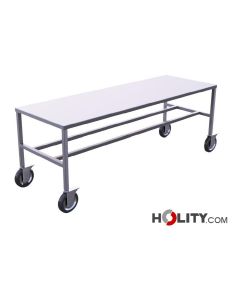
Mortuary stretcher in AISI 304 stainless steel, continuous surface, fixed height 79 cm, dimensions 207x70 cm, weight 30 kg.
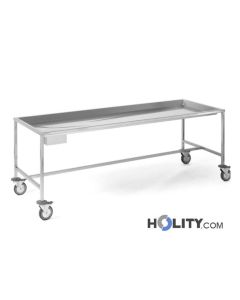
Transport stretcher for bodies in AISI 304 stainless steel, without lid, with removable collection tray and 4 wheels. Dimensions 2070x700x850 mm.
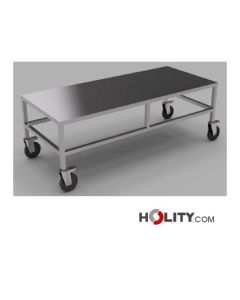
Body transport stretcher in stainless steel, continuous surface without drainage hole, fixed height. Dimensions 207x90x79 cm.
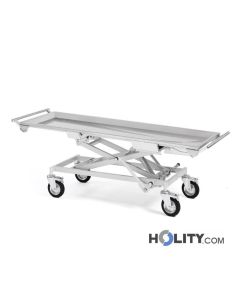
Variable height body stretcher in AISI 304 stainless steel, adjustable 635-960 mm, capacity 200 kg, 200 mm braking wheels, collapsible handles. Made in Italy.
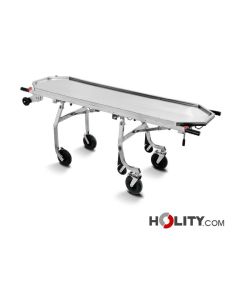
Self-loading aluminum stretcher with watertight tray for corpse transport. Load capacity 150 kg, adjustable height 50-61 cm, telescopic handles, 200 mm wheels.
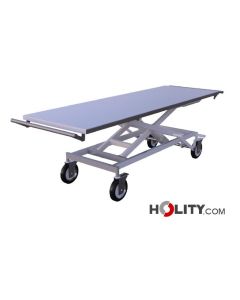
Corpse transport stretcher in AISI 304 stainless steel with continuous surface, variable height, 4 braking wheels. For the transport of the deceased in mortuary and funeral settings.
Mortuary stretchers represent a specialized category of medical equipment intended for the safe and dignified transport of the deceased within healthcare facilities, mortuaries, nursing homes, and funeral services. Mainly made of AISI 304 stainless steel, these solutions combine structural strength, ease of handling, and compliance with current health and hygiene regulations in the sector. Their design takes into account both operational practicality and respect for the deceased, ensuring suitable solutions for every context of use, from larger hospital facilities to small dedicated structures.
Cadaver transport stretchers are equipped with liquid containment systems, drainage holes, and, in many cases, lids or domes that allow for discreet transport.
Their versatility is reflected in the availability of models with fixed height, variable height via hydraulic systems, and bariatric solutions for higher load capacities. Each variant responds to specific operational needs, from internal transfer between departments to longer routes to final destination facilities.
The use of dedicated mortuary stretchers brings significant operational and organizational advantages to healthcare and funeral facilities. The stainless steel structure guarantees corrosion resistance, durability over time, and ease of sanitization, crucial factors in environments where hygiene is a priority. Unlike improvised solutions, specialized stretchers are ergonomically designed to reduce the physical effort of personnel during handling operations, while minimizing the risk of accidental damage. The presence of integrated containment systems prevents liquid spills, simplifying cleaning procedures and maintenance of work spaces.
Furthermore, the use of professional dedicated equipment communicates professionalism and respect towards families, a non-secondary aspect in the funeral sector. The availability of models with variable height allows staff to adapt working conditions to their ergonomic needs, reducing fatigue during long shifts. Facilities such as hospitals, nursing homes, and funeral homes recognize the mortuary stretcher as an indispensable tool for ensuring operational efficiency and compliance with sector standards.
The catalog of mortuary stretchers is divided into structurally different solutions, each responding to specific operational contexts and logistical constraints. Stretchers with fixed height represent the most basic and economical solution, ideal for facilities with limited space and simple movements, with height generally set around 75-80 centimeters. Variable height models, on the other hand, integrate foot-operated hydraulic systems, allowing for smooth adjustment between 35 and 87 centimeters; this versatility is particularly valuable in facilities where staff have different physical builds or when the deceased must be transferred to work surfaces of different heights.
Some models incorporate lids or domes made of stainless steel or ABS, materials that ensure discreet visual protection and vapor containment. Bariatric stretchers, with a capacity of up to 250 kilograms, represent specific solutions for cases of deceased persons with high body weight, available in both fixed and variable height versions. The presence of integrated basins, drainage holes for liquids, and drainage systems also differentiates models based on the level of sophistication required. Some specialized forklifts, equipped with a hydraulic pump, facilitate the loading and unloading of stretchers from vehicles, expanding the range of solutions for integrated transport.
The choice of a mortuary stretcher must start from the analysis of handling volumes and the average size of the facility. For small clinics or offices with a low number of cases, a fixed-height stainless steel model represents a balanced solution between functionality and cost. Large hospitals and mortuaries with intense operational flows benefit more from variable height models, which reduce staff fatigue and speed up transfer procedures. The availability of maneuvering space is a determining factor: standard stretchers have lengths ranging between 200 and 227 centimeters; if space is limited, it may be necessary to evaluate compact solutions or check the turning radius during movements.
An often underestimated aspect concerns the type of cover: stainless steel lids offer greater hygiene and durability but increase weight and maintenance complexity; fabric domes are lighter and more aesthetically elegant but require more frequent cleaning. The nominal capacity should be chosen considering the average weight of the population served; bariatric solutions, although more expensive, avoid overload situations that could compromise the lifting mechanism. Finally, evaluate whether the facility already possesses loading-unloading systems (such as mechanical elevators): in this case, solutions compatible with such systems will ensure smoother operational flows.
Mortuary stretchers must comply with a series of technical and hygienic standards defined by the European and Italian regulatory landscape. The UNI EN 1865 standard establishes safety requirements for hospital stretchers, including aspects such as stability, strength of lifting structures, and failure checks. Regarding materials, AISI 304 stainless steel is the most common reference, as it guarantees corrosion resistance in humid environments and facilitates chemical decontamination. Drainage systems and integrated basins must comply with directives on wastewater and medical waste management.
Hygiene is also regulated by guidelines on the prevention of hospital infections; consequently, all surfaces must be easily sanitizable, without hidden corners or cavities where residues can accumulate. Mortuary use stretchers, although not subject to the same standards as hospital equipment, fall into the category of medical aids and must still guarantee hygiene and structural safety. Some manufacturers include ISO 13485 certifications (related to medical devices) to attest to compliance with production processes and traceability. For facilities accredited to the national health system, the technical documentation of the product must be kept for monitoring and auditing purposes.
Explore all products in the category and compare the available solutions to find the one most suitable for your operational context, carefully evaluating dimensions, height adjustment systems, and liquid containment features most relevant to your facility.
The fixed-height stretcher remains at approximately 75-80 cm, ideal for compact spaces and limited budgets. The variable-height one uses a foot-operated hydraulic system, adjustable between 35 and 87 cm, reducing staff fatigue during transfers and allowing adaptation to different work surfaces.
Most professional stretchers are made of AISI 304 stainless steel, which guarantees corrosion resistance, ease of sanitization, and durability over time. Some covers may be in ABS to reduce weight, but the load-bearing structure always remains in stainless steel.
Standard stretchers support 135-200 kg. Bariatric solutions reach 250 kg. Choose based on the average weight of the population served; bariatric models, although more expensive, avoid overloads that could compromise lifting mechanisms.
Stainless steel lids offer superior hygiene, visual protection, and vapor containment, but add weight and maintenance complexity. Fabric domes are lighter and more elegant but require more frequent cleaning. The choice depends on the facility’s priorities.
Stainless steel allows cleaning with neutral detergents and subsequent disinfection with hypochlorite-based solutions. Drainage holes must be checked regularly. ABS surfaces should be treated with caution to avoid chemical corrosion; always consult the manufacturer’s manual.
Yes, there are specific lifting trolleys equipped with a foot-operated hydraulic pump, allowing height adjustment from 37.5 to 87 cm. They facilitate the transfer of stretchers on and off vehicles, significantly reducing physical effort for personnel.
Stretchers must comply with the UNI EN 1865 standard for structural safety and hygiene criteria. Professional manufacturers provide technical documentation and often ISO 13485 certification for traceability and quality of the device.
Standard stretchers have a length between 200 and 227 cm, width between 55 and 90 cm, and variable height from 63 to 116 cm depending on the model. Evaluate your spaces and maneuvering areas in hospital or funeral environments before choosing the model.
 English
  Italian
 French
 German
 Spanish