
mon-fri 9-13 / 14.30-18.30
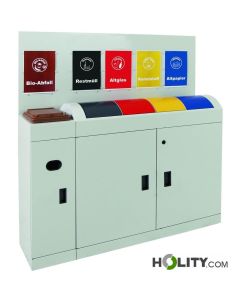
Indoor waste recycling bin with sorting of 7 types of waste. Dimensions: h 1460 x w 1365 x D 340 mm.
Indoor recycling bins represent a fundamental solution for the orderly and hygienic management of waste in enclosed environments, both commercial and public. These systems allow for the separation of recyclable materials (paper, plastic, glass, organic) according to environmental regulations, reducing ecological impact and facilitating the work of collection services. Available in various types, capacities, and materials, indoor bins must combine functionality, aesthetics, and regulatory compliance, adapting to offices, shopping centers, hospital facilities, hotels, and common areas.
The choice of specific bins for indoor recycling responds to concrete needs for order, hygiene, and environmental responsibility. A well-organized system reduces confusion, facilitates waste separation at the source, and improves recycling rates, generating benefits for both the environment and the image of the company or organization. Enclosed environments require compact, hygienic solutions that are aesthetically consistent with the context: bins with lids limit odors and cross-contamination, while noble materials like stainless steel guarantee durability and ease of cleaning. Furthermore, the use of colored bins or those equipped with pictograms facilitates the identification of the type of waste, reducing disposal errors and improving the rate of correct differentiation.
In professional and institutional contexts, recycling bins represent a visual communication tool for corporate sustainability, consolidating the commitment to responsible practices. The presence of visible and functional collection systems also contributes to the involvement of end users (employees, customers, visitors) in good environmental practices. Choosing certified bins that comply with local regulations also ensures the fulfillment of legal obligations regarding waste management.
The market offers a variety of solutions to adapt to every context and space requirement. Single bins, available in capacities from 8 to 70 liters, are suitable for small environments such as offices or hotel rooms and allow for the collection of a single waste fraction per container. Multi-compartment models (2, 3, or more sections) integrate different fractions into a single compact structure, ideal for saving space without compromising functionality: each compartment manages a waste category with dedicated lids or openings. There are also pedal bins, equipped with a foot-operated opening mechanism, which guarantee maximum hygiene in hospital environments, canteens, and professional kitchens, where manual contact with the bin must be minimized.
Construction materials vary mainly between polypropylene (lightweight, economical, colorable, but less resistant over time) and stainless steel (extremely durable, hygienic, easily sanitizable, suitable for high-traffic contexts). Some models feature bag holder rings that facilitate the insertion and changing of collection bags, while others are equipped with swing or revolving lids for more practical access. Dimensions vary considerably: compact 8-liter bins for office corners up to large 70+ liter wastebaskets for high-traffic areas. The choice of type depends on the volume of waste generated, the available space, and the fraction of waste to be collected.
Selecting the appropriate bin requires a preliminary assessment of several operational and environmental factors. First, it is essential to calculate the average volume of waste produced daily in the specific sector: a hotel room produces less waste than an open office, which in turn is less than a company canteen. An undersized bin will force frequent emptying and create disorder; an oversized one will take up space unnecessarily and could be hygienically disadvantageous. The number of compartments depends on the waste fractions that are actually intended to be collected: if local administration only requires unsorted waste and paper, a 2-section bin is sufficient; if it requires separation of paper, plastic, glass, and organic, a 4-compartment system is necessary.
The installation environment significantly influences the choice of material and shape: in dry and protected spaces (offices, receptions), colored plastic bins are acceptable, economical, and easy to clean; in damp areas, kitchens, or catering areas, stainless steel is preferable to prevent bacterial proliferation and oxidation. Physical access is an often-underestimated criterion: users must be able to open the bin without excessive effort, which is why pedal bins are ideal in contexts where hygiene is a priority. A frequent mistake is underestimating aesthetics and visual signage: a bin well-integrated into the space and equipped with clear pictograms significantly increases compliance in use. Finally, evaluating ease of maintenance and the availability of spare parts (lids, rings, bags) ensures operational continuity in the long term.
Waste management in Italy is regulated by Legislative Decree 152/2006 (Environmental Code), which establishes specific obligations for separate waste collection in confined environments. Municipal administrations issue local regulations that define the number of mandatory fractions, the allowed materials, and the collection methods; therefore, there is no single national standard, but each territory has variations. However, the general trend includes at least four fractions: paper and cardboard, plastics and metals, glass, and organic waste. The containers used must be suitable for contact with waste without releasing harmful substances, in compliance with food safety regulations (if used in catering contexts) and general hygiene.
For public, commercial, and hospital environments, additional safety standards apply: containers must be built with materials that do not facilitate microbial proliferation, must have corners and edges that facilitate cleaning and disinfection, and in some cases (hospitals, laboratories) must comply with specific directives on biohazard disposal. Signage is mandatory: each compartment must clearly and legibly show the type of waste to be disposed of, through labels, pictograms, or coded colors. These pictograms must respond to recognizable standards (normally ISO 7001 or equivalent). The entities responsible for maintenance must guarantee regular cleaning, absence of debris on the outside, and bags that are not torn.
Explore all products in the category and compare the available solutions to find the one best suited to your operational context.
An indoor container is designed for enclosed environments such as offices, hotels, and canteens, with compact dimensions and easily cleanable materials. Unlike heavy metal outdoor bins, these systems prioritize compactness, aesthetics, and hygiene, often with airtight lids to limit odors. They are built of polypropylene or stainless steel to facilitate frequent sanitization.
An office of 20 people generates an average of 15-25 kg of waste per week. A 2-3 compartment system with a total of 30-50 liters is generally adequate, with emptying twice a week. If the office produces a lot of paper, prefer a dedicated fraction with a larger capacity. Request a preliminary assessment from the local waste manager to optimize sizing.
Plastic (polypropylene) is sufficient in dry, ventilated offices with adequate management hygiene. Stainless steel becomes a priority in kitchens, canteens, hospitals, and wet areas, where hygiene and sanitization are critical. Steel is also more durable over time, despite the higher initial cost.
Install clear and legible pictograms on each compartment, train staff with short informative sessions, and periodically remind them of the correct methods. Bins with compartments easily distinguishable by color (yellow for paper, blue for plastic, etc.) reduce disposal errors by 30-40%.
Plastic bins should be cleaned weekly with a neutral detergent; stainless steel ones with specific non-abrasive products to avoid scratches. Regularly check lids, hinges, and bag holder rings, replacing worn parts. Emptying according to local frequency (generally 1-2 times a week).
It is not mandatory to use multiple containers: local regulations require the separation of fractions, not the method. Single bins take up more space but allow flexibility in arrangement and management. Choose based on available space and the operational practicalities of your facility.
Technically yes, but it is not recommended: it compromises differentiation, generates confusion, and undermines correct waste separation. Keep dedicated bins for unsorted waste separate from those for recycling, even if temporarily, to comply with regulatory obligations and good environmental practices.
 English
  Italian
 French
 German
 Spanish