
mon-fri 9-13 / 14.30-18.30
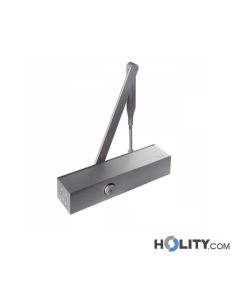
Designed based on experience gained during decades, the DORMA TS 83 meets the highest demands thanks to the many features and ease of adjustment.
Door closers represent a fundamental component in the professional hardware sector, ensuring the controlled and safe closing of doors in commercial, industrial, and public environments. These mechanical or automated devices fulfill critical functions: they control closing speed, prevent sudden slamming, maintain compliance with fire safety regulations, and improve the energy efficiency of buildings. The choice of the right door closer depends on multiple variables, including door weight, leaf width, usage conditions, and specific industry regulatory requirements. In the context of HoReCa, hospital facilities, public offices, and commercial premises, the door closer is not simply an accessory but a safety and accessibility element that directly affects the user experience and compliance with international standards such as EN 1154.
A correctly installed door closer offers concrete operational advantages that influence the daily management of spaces. Controlled closing prevents structural damage caused by slamming, extending the service life of doors and reducing extraordinary maintenance costs. In critical environments such as hospital corridors, inpatient facilities, and public areas, the control of closing speed ensures accessibility for people with reduced mobility, respecting inclusion directives. In premises subject to fire safety regulations, the door closer keeps fire and smoke doors in the closed position, an essential element for the continuity of passive protection against the spread of fire.
From a technical-economic point of view, the door closer automates a function that would otherwise require manual intervention or constant correction, improving energy efficiency in air-conditioned buildings by reducing uncontrolled heat exchange. In high-traffic public environments—such as shopping centers, healthcare facilities, and offices—the use of a correctly sized door closer minimizes annoying noise and creates a more comfortable environmental experience. Furthermore, the installation of models compliant with current standards represents added value for building certification and for the operator's civil liability, reducing potential safety-related disputes.
The market offers several door closer solutions, each optimized for specific application contexts. Overhead door closers with arms—also called "overhead"—represent the most common type in public and commercial buildings, thanks to limited aesthetic visibility and ease of maintenance. These models use an internal hydraulic system that slows down closing via cams or rack-and-pinion mechanisms, offering granular speed adjustments in different angular sectors. Floor springs, known as "floor closers," are the ideal solution for heavy and wide doors, particularly frequent in hotels, hospitals, and public places where dynamic loads require superior closing force. Concealed door closers—or "concealed closers"—integrate the mechanism inside the door frame, offering a clean aesthetic and a minimalist profile, although they require a more complex installation phase during carpentry construction.
Alongside these main categories, slide rail door closers are used, characterized by an extensible arm that allows greater flexibility in adjustment and in applications on fire doors. GSR systems for double doors represent a specialized solution that synchronizes the closing of both leaves, essential in openings of significant width or in contexts where orderly and coordinated closing is required. Each type has advantages and limitations: overhead models offer simplicity of installation but require free space above the door; floor closers guarantee performance on heavy doors but occupy floor space; concealed closers ensure superior aesthetics but involve higher implementation costs and less accessibility for future maintenance.
Selecting the correct door closer requires a systematic analysis of fundamental technical parameters. The first aspect concerns the weight of the door, measured in kilograms: this data directly determines the necessary closing force, expressed on the EN scale (from EN 2 to EN 6, where EN 2 is the minimum force and EN 6 the maximum). A 50 kg door requires an EN 2-3 force, while 100-120 kg doors need EN 4-5 or higher; undersizing this parameter results in insufficient closing with subsequent safety issues, while oversizing increases costs and creates opening difficulties for fragile people. The leaf width is the second critical factor: most standard door closers cover doors up to 1100 mm, but specific models support widths up to 1250-1400 mm with performance increases. The required type of mounting must also be verified: some doors may not allow overhead installation due to structural constraints, making a floor or concealed model mandatory.
Another decisive aspect concerns the installation environment: external doors, fire doors, doors subject to weathering or humid environments (such as professional kitchens or changing rooms) require corrosion-resistant materials and specific treatments. Local and international regulations also influence the choice: fire-certified buildings must use door closers compliant with EN 1154 with CE marking, a non-negotiable aspect for legal liability. Common mistakes include choosing a generic model without checking the door load, ignoring the depth available for installation (some overhead models require space above the door), and failing to consider the expected number of opening-closing cycles: in very high-traffic environments (shopping centers, hospitals), it is advisable to choose models with extended durability certification and available technical assistance services.
Regulatory compliance is a non-derogable element in the selection and installation of door closers. The European standard EN 1154 defines the functional and safety requirements for door closers used on doors of public and residential buildings: it prescribes durability tests (minimum 1 million cycles), regulations on closing force, speed control, and hold-open devices. In addition to EN 1154, there is EN 1155 which regulates closing control systems on swing doors with electrical hold-open devices, applicable in specific contexts such as public swimming pools or sports facilities. For fire and smoke doors, local standards (in Italy UNI EN 1634-1 for REI doors) require the exclusive use of certified door closers tested in test chambers, with documentation available on-site during testing. Occupational safety directives (Directive 2006/42/EC, Machinery Directive) also require that the door closer does not generate dangerous situations, particularly regarding crushing or blocking risks.
From a construction standpoint, door closers must guarantee a closing speed that is not excessive to avoid slamming that could cause damage or injury: this is generally set between 15-30 seconds for the last meter of closing. For applications in public buildings subject to accessibility regulations (such as hospitals, public offices, facilities for the disabled), the maximum opening force is often limited to 150 N (EN 12125 standard), making it necessary to use door closers with reduced force or integrated with assisted opening systems. Periodic maintenance is an implicit requirement: door closers must be inspected at least once a year to check for hydraulic fluid leaks, component wear, and consistency of adjustments. Technical documentation, including the declaration of conformity and the installation manual, must be kept by the building manager for the entire life of the system.
Explore all the products in the category and compare the available solutions to find the one most suitable for your operational context. From entry-level compact door closers to complex systems for heavy and fire-rated doors, our range covers every professional application with CE marking and EN 1154 certifications.
A door closer is a mechanical device that controls the closing speed of a door through an internal hydraulic system. It uses cams or rack-and-pinion gears to slow down movement, preventing sudden closing and ensuring correct positioning. The force is adjustable and complies with EN 1154 standards.
The overhead door closer is mounted above the door with a visible extensible arm; ideal for standard doors up to 1100 mm. The floor model is installed in the base and suitable for heavy doors and widths exceeding 1100 mm. The choice depends on the door weight and available space.
The EN force depends on the weight of the door measured in kg. Doors up to 60 kg require EN 2-3; from 60 to 100 kg EN 3-4; over 100 kg EN 5-6. Undersizing the force causes insufficient closing; oversizing makes opening difficult. Always consult the manufacturer's technical specifications.
Yes. In public buildings and for fire doors, compliance with the EN 1154 standard with CE marking is mandatory. For hospital and healthcare facilities, EN 12125 accessibility requirements may apply. Compliance documentation must be kept for the entire service life of the system.
Yes, but with specific precautions. For external doors, corrosion-resistant materials (stainless steel) are required. For fire doors, the door closer must be tested and certified according to EN 1634-1 to maintain the REI function. Always verify certification before purchase.
Routine maintenance is minimal: visual inspection at least once a year to check for fluid leaks and wear. Costs range from 50 to 150 euros per year for technical checks. In high-traffic environments, a review might be necessary every 6 months. Extraordinary maintenance (replacing internal components) costs 200-400 euros.
Yes. In these contexts, it is advisable to choose models with extended durability certification (over 1 million cycles) and CE marking compliant with EN 1154. Dormakaba TS professional series and GU OTS systems are designed for intense traffic with guaranteed technical assistance and available spare parts.
 English
  Italian
 French
 German
 Spanish