mon-fri 9-13 / 14.30-18.30
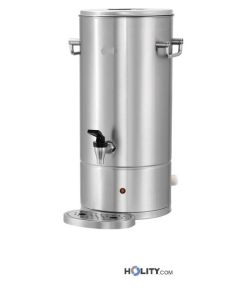
Stainless steel hot water dispenser with automatic filling. Equipped with a hose connected directly to the water source.
The hot beverage dispensers constitute the operational core of every breakfast room, break area, or catering service aiming for excellent quality standards. These are not simple containers, but technological tools designed to solve the complex challenge of constant thermal maintenance of liquids such as drip coffee, milk, tea, and herbal infusions. In high-traffic contexts, the ability to dispense beverages at a controlled temperature is not just a matter of comfort for the guest, but a fundamental requirement for food safety and service efficiency.
The integration of these systems allows for the decongestion of floor staff work, delegating to the end user the possibility of serving themselves in total autonomy through drip-proof taps and intuitive interfaces. The choice of a professional distributor directly reflects on the perception of the structure’s professionalism: a liquid served lukewarm or a difficult dispensing can compromise the entire customer experience, which is why mechanical and thermal reliability must be the first selection criterion for every HoReCa professional.
The adoption of professional distributors for hot liquids responds primarily to a logic of time and resource optimization. In a modern buffet, dispensing speed is crucial to avoid crowds and ensure a constant flow of users. Using high-performance thermoses with taps ensures that the infusion or coffee maintains its aromatic notes intact for hours, avoiding the oxidation process or the “burnt” aftertaste typical of direct, unregulated heating systems.
In addition to the quality of the product served, these devices offer an advantage in terms of hygiene and cleanliness of common areas. Dispensing systems with pressure or lever taps are designed to minimize accidental spills, keeping the support surface dry and tidy. This drastically reduces cleaning interventions during peak hours and prevents potential accidents related to slippery floors or wet surfaces. Investing in a hot beverage distributor therefore means improving internal logistics, while ensuring safe dispensing that meets the expectations of an increasingly demanding and attentive clientele regarding the technical details of the service.
Another fundamental aspect concerns application versatility. From the meeting rooms of large companies, where prolonged autonomy is needed for quick coffee breaks, to outdoor catering banquets where external temperatures could quickly cool the liquids, the thermal dispenser acts as a protective barrier. The double-wall structure, often in high-quality stainless steel, ensures insulation that not only protects the internal heat but also keeps the external surface cool to the touch, preventing accidental burns for less experienced users or children present in hotel breakfast rooms.
The range of available solutions is mainly divided based on the power mode and water load management. Dispensers with a connection to the electrical grid are the most common in stable buffets; they use internal heating elements to maintain the liquid at the desired temperature, simply requiring proximity to a power outlet. These models often integrate large internal tanks that are filled manually by staff, offering great flexibility in positioning within the room.
For professional kitchens or high-rotation bars, hot water thermoses with water mains connection represent the choice of excellence. These systems eliminate the need to monitor the tank level, as filling occurs automatically. This configuration is perfect for the continuous preparation of tea, infusions, and drip coffee, ensuring an uninterrupted flow of hot water without waiting times for heating new loads. There are also purely thermal versions (non-electric), which rely exclusively on the quality of the insulation to maintain the heat of already hot beverages, ideal for mobile catering situations where a constant power source is not available.
Variants also differ in dispensing mechanics. Models equipped with a professional tap are designed to withstand thousands of opening and closing cycles, with food-grade silicone gaskets that prevent post-dispensing dripping. Volumetric capacity is another diversification parameter: starting from small 4-liter containers for boutique contexts or private offices, up to reaching impressive 25-liter distributors intended for large conference centers or company canteens, where the volume of water required in a single time frame is massive.
Choosing the correct dispenser must be based on a realistic estimate of the frequency of use and the type of user. If the service is self-service, it is essential to opt for a model with an easy-dispense tap, which is understandable even to a foreign or distracted guest. A common mistake is to purchase a dispenser that is too large for a low number of covers: an excessive volume of water that stays too long in the tank tends to lose freshness and organoleptic quality. Conversely, a tank that is too small will force the staff into frequent and annoying refills during service.
It is also vital to evaluate the construction material: AISI 304 stainless steel is the standard of excellence, as it does not alter flavors and resists lime deposits typical of hot water. Attention must also be paid to the ease of descaling. In areas with very hard water, dispensers with contact heating elements tend to accumulate scale quickly; in these cases, models with shielded heating elements or systems prepared for connection to softening filters (for water mains versions) represent a smarter investment that extends the life of the machine and ensures a always pure flavor of the beverages.
A final criterion concerns stability and the footprint on the support base. A full dispenser can weigh over 30 kg; ensuring the chosen model has a non-slip base and a low center of gravity is essential for guest safety. The presence of external level indicators, usually in glass or graduated transparent plastic, is a technical detail often underestimated but vital for allowing staff to monitor the tank status at a glance, intervening only when strictly necessary without having to open the lid and dissipate precious heat.
Hot beverage distributors fall under the category of FCMs (Food Contact Materials) and must therefore be certified according to Regulation (EC) No. 1935/2004. This regulation ensures that the metals, plastics, and gaskets used do not release chemicals or heavy metals into the beverages, even after hours of exposure to temperatures close to boiling. For managers, having certified products is the only way to pass health inspections successfully and guarantee the health of customers, avoiding heavy penalties and reputational risks.
From an electrical point of view, dispensers must comply with low voltage and electromagnetic compatibility directives, mandatorily bearing the CE mark. Thermal safety is another regulatory pillar: devices must include protection systems against dry running (which would turn off the heating element in the absence of water) to prevent fires or permanent damage.
Finally, in the HACCP context, the maintenance and sanitization of water circuits and taps must be documented. Professional dispensers are designed to facilitate these operations, with manually removable taps and round-bottomed tanks that prevent the stagnation of bacterial biofilms or lime deposits, critical factors for maintaining the hygiene standards required for serving food and beverages in public places.
Explore all the products in the category and compare available solutions to find the one best suited to your operational context.
To preserve the aroma without burning the coffee, the temperature should range between 80°C and 85°C. A professional dispenser with an adjustable thermostat allows this range to be kept constant, preventing the beverage from becoming too bitter due to excessive heat or unpleasant because it is too cold.
No, water, tea, and coffee dispensers are not suitable for thick hot chocolate. The density of the product would quickly clog the tap and the internal heating elements could burn the mixture on the bottom. For chocolate, specific chocolate makers equipped with a continuous stirrer and bain-marie heating are required.
In a professional vacuum-insulated double-walled thermos, water maintains a temperature suitable for service (above 70°C) for approximately 4-6 hours, depending on the external temperature and the residual volume. The fuller it is initially, the better the thermal conservation over time due to less dispersion.
It is recommended to use specific descaling solutions for coffee machines or diluted citric acid, avoiding aggressive products like bleach. You need to fill the tank, let the solution act, dispense some through the tap to clean the ducts, and rinse thoroughly with potable water.
Yes, for outdoor use, non-electric thermal dispensers or models with reinforced insulation are preferable. If using electric models, it is essential that they are placed in areas protected from moisture and that the electrical connection is certified for outdoor use to ensure operator safety.
The main advantage is the total automation of the service: the tank never remains empty, eliminating the downtime needed for manual refilling and subsequent heating. It is the ideal solution for bars and canteens where the demand for hot water for tea and herbal infusions is constant and massive.
Dripping is often caused by small limescale deposits or tea residues that prevent the gasket from closing perfectly. It is often sufficient to dismantle the front part of the tap and rinse it under running water. If the gasket is worn, it must be replaced with an original food-specific spare part.
 English
  Italian
 French
 German
 Spanish